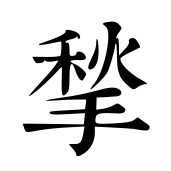
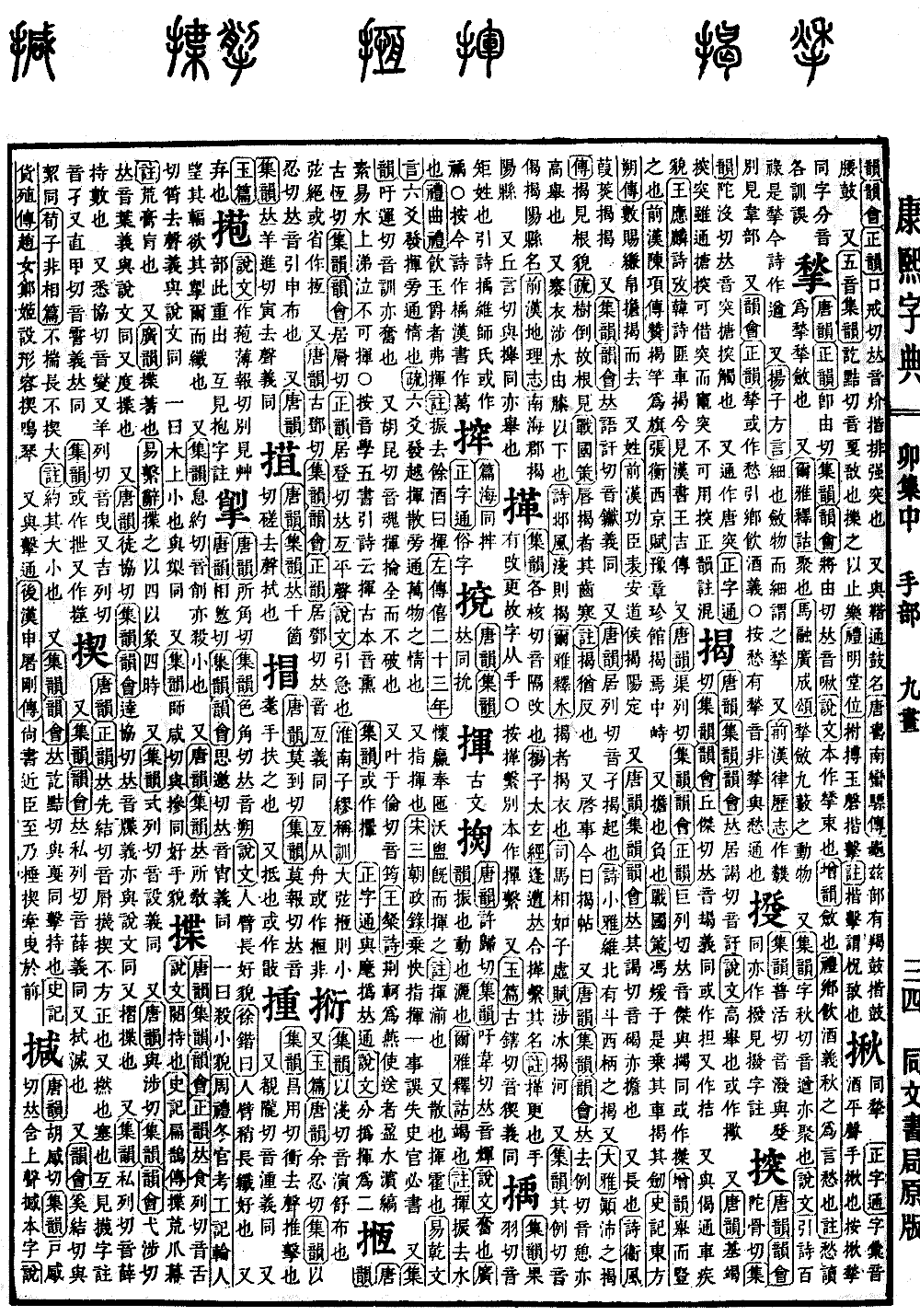
Mao Collection, Middle Volume
Radical: Hand (shǒu)
Kangxi strokes: 13
Page 444, Entry 02
Pronounced jiu.
According to the Explaining Graphs and Analyzing Characters (Shuowen Jiezi), it was originally written as a variant form. It means to bind. According to the Augmented Rhymes (Zengyun), it means to gather. In the Book of Rites (Liji), in the chapter on the meaning of drinking at local wine ceremonies, the commentary states that the autumn season is associated with sorrow; the term sorrow is read as jiu, which means to gather. Furthermore, according to the Erya (Erya), it means to assemble. In the Broad Success Odes (Guangcheng Song) by Ma Rong, it describes gathering the creatures of the nine marshes.
Also, according to the Collected Rhymes (Jiyun), pronounced qiu. It also means to assemble. The Explaining Graphs and Analyzing Characters cites the Book of Odes (Shijing) stating that all blessings are gathered; modern editions of the Book of Odes use a variant form instead.
According to the Dialects (Fangyan) by Yang Xiong, it means fine or minute. To gather items into a small or fine state is called jiu.
Also, in the Treatise on Harmonics and Calendars (Lüli Zhi) from the History of the Former Han (Qianhanshu), it is written as a variant form. It is separately listed under the Radical: Leather (wéi).
Additionally, the Rhyme Collection (Yunhui) and the Correct Rhymes (Zhengyun) note that this character is sometimes written as the character for sorrow. This cites the commentary on the local wine ceremony. However, it should be noted that while the character for sorrow has a pronunciation of jiu, this does not imply that the two characters are interchangeable in meaning.