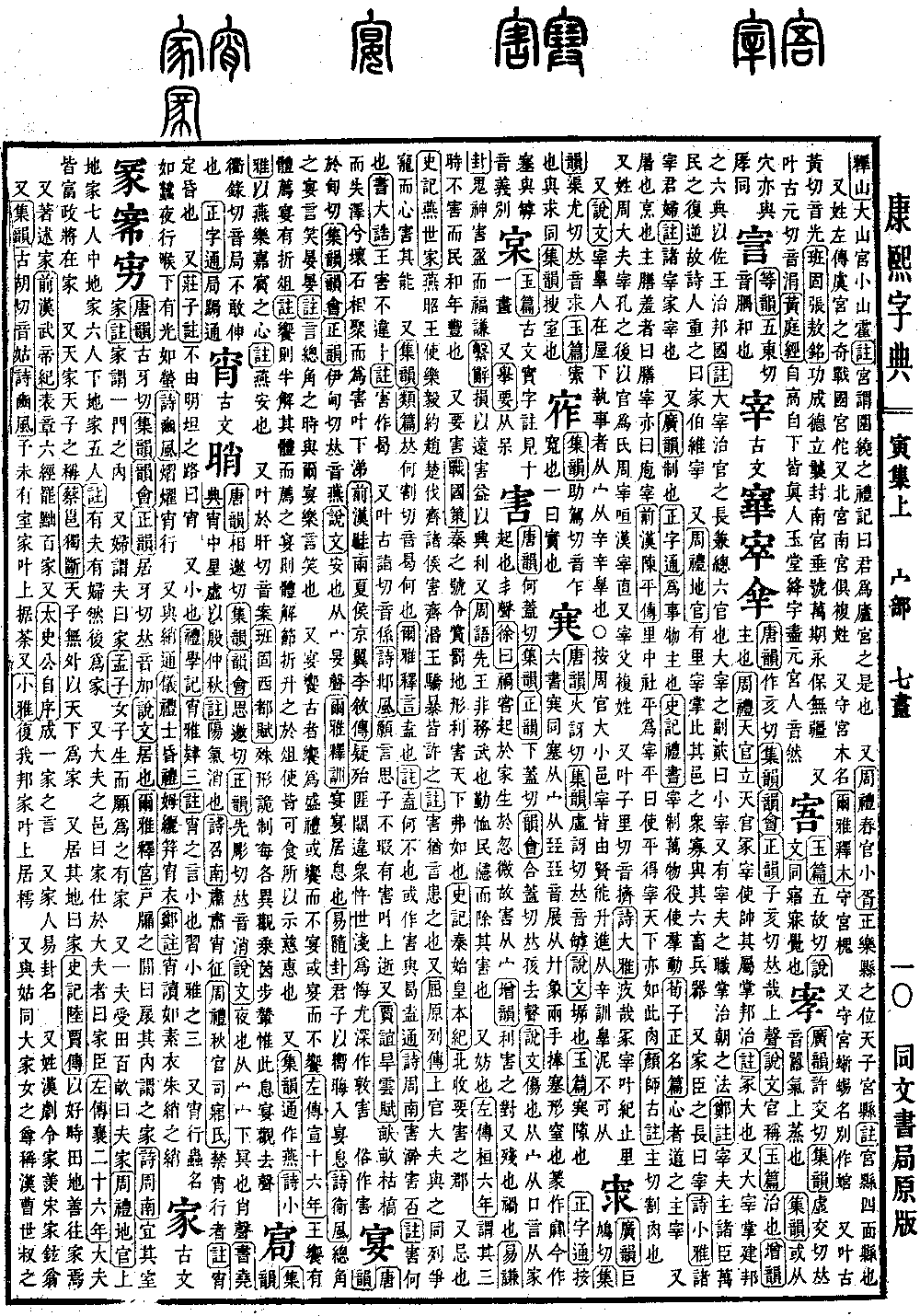
Yin Collection, Upper Volume
Radical: Roof (mián)
Page 286, Entry 17
Pronounced jia.
According to the Explaining Graphs and Analyzing Characters (Shuowen Jiezi), a home is a dwelling. According to the Erya, the space between the door and window is called the screen (yi), and the interior of that is called a home (jia). According to the Book of Odes (Shijing), in the chapter Zhou Nan, it states that he is suitable for his household and home. The commentary notes that home refers to the space within one doorway.
Also, women refer to their husbands as home. According to the Mencius, when a girl is born, she hopes to have a husband's home.
Also, a man who receives one hundred mu of land is called a household (fu jia). According to the Rites of Zhou (Zhouli), under the Earth Official, a household of seven people resides on superior land, six on middle land, and five on lower land. The commentary notes that there must be a husband and a wife to constitute a household.
Also, the fief of a senior official is called a home, and those serving under an official are called household ministers (jia chen). According to the Zuo Commentary (Zuozhuan), in the twenty-ninth year of Duke Xiang, the senior officials were all wealthy, and political power would fall into their hands.
Also, Heaven's Home is a term for the Emperor. According to the Du Duan by Cai Yong, the Emperor does not distinguish between inner and outer, treating the whole world as his own home.
Also, residing in a certain place is called home. According to the Records of the Grand Historian (Shiji), in the biography of Lu Jia, because the land in Haochi was fertile, he went there to establish a home.
Also, referring to authors or schools of thought. According to the History of the Former Han (Qianhan Shu), the Emperor Wu honored the Six Classics and dismissed the Hundred Schools of Thought.
Also, according to the Preface of the Grand Historian, to become a unique school of thought.
Also, Family Members (Jiaren) is the name of a hexagram in the Book of Changes (Yijing).
Also, a surname. Ju county magistrate Jia Xian of the Han dynasty, Jia Xuanweng of the Song dynasty.
Also, pronounced gu. According to the Book of Odes (Shijing), in the section Bin Feng, it states I do not yet have a home, rhyming with the preceding word according to the tea plant (tu).
Also, in the Minor Odes (Xiao Ya), it states to restore my state and home, rhyming with the preceding word according to the ailanthus (chu).
Also, identical to the word for paternal aunt (gu). Dagu (Great Aunt) is an honorific for women. Ban Zhao, the wife of Cao Shishu of the Han dynasty, was called Dagu; she was the younger sister of Ban Chao.
Also, rhyming with the sound ge. In the Ancient Pheasant Morning Flight Tune (Gu zhi chao fei cao), it states what kind of fate is mine that I do not yet have a home, the sky is turning late, what can be done.
Also, in the Liao Fu by Kong Zang, it states if it is not virtue and righteousness, do not treat it as a destination. To be at ease without ambition is no different from the beasts.
Also, rhyming with the sound gu. According to the Yilin by Jiao, a three-legged solitary bird uses intelligence as its carriage. It governs faults and punishes evils, harming its own home.
According to the Explaining Graphs and Analyzing Characters (Shuowen Jiezi), the character is composed of the roof radical (mian), with the sound of the character for boar (jia) in an abbreviated form. Zhou Bowen stated that a pen where pigs live is called a home, therefore it uses the roof radical and the pig radical (shi). Later generations borrowed it to use for the home of a family. According to the Six Scripts Origins (Liushu Gu), it is written as a compound meaning where people gather. It uses the roof radical and three people gathered beneath, meaning gathering. The character for crowd (ju) is the ancient form of the character for clan (zu); the crowd character was incorrectly written as the pig character. The claim in the Explaining Graphs and Analyzing Characters (Shuowen Jiezi) regarding the boar character is unreasonable. The character should use the roof radical and the crowd character, or the roof radical and the crowd character variant. The crowd character is composed of the person radical and multiple person characters, similar in shape.
Textual Corrections:
According to the Explaining Graphs and Analyzing Characters (Shuowen Jiezi), it is a dwelling. According to the Erya, Explanation of Palaces, the space between the door and window is called the screen (yi), and the interior of that is called a home (jia). The original text has been corrected to say it is a dwelling. In the Erya, the space between the door and window is called the screen (yi).
According to the Zuo Commentary (Zuozhuan), in the twenty-sixth year of Duke Xiang, the senior officials were all wealthy, and political power would fall into their hands. The original text has been corrected from the twenty-sixth year to the twenty-ninth year.