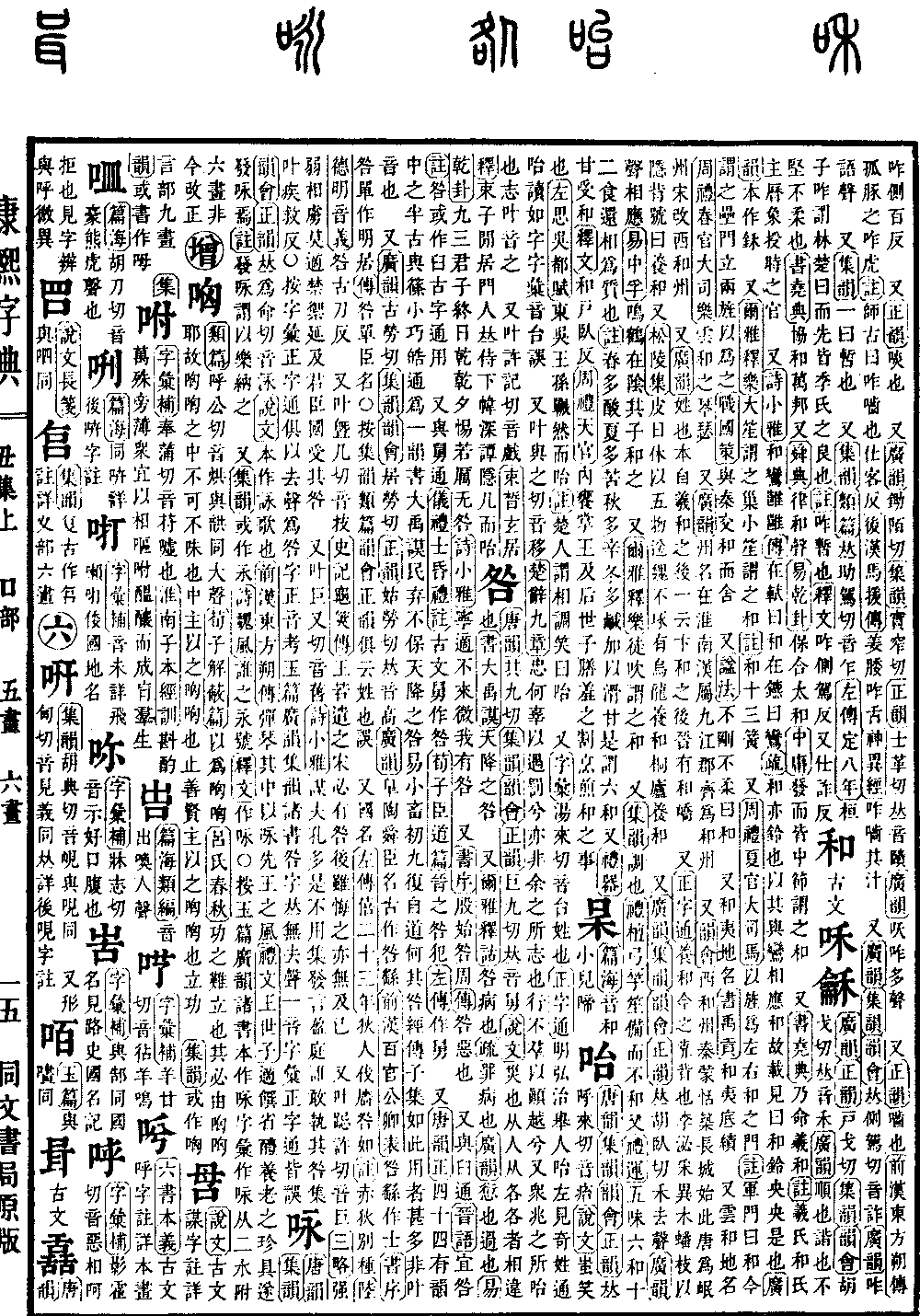
Chou Collection, Upper Volume
Radical: Mouth (kǒu)
Kangxi Strokes: 8
Page 185, Entry 06
Pronounced jiu.
Shuowen Jiezi (Explaining Simple and Compounding Characters): Disaster. Composed of the character for person and the character for each. The character for each implies things going against one another.
Book of Documents (Shangshu): Heaven sends down these disasters.
Erya (Approaching Elegance), Interpretation of Ancient Words: Jiu means illness.
Commentary: Crime or illness.
Guangyun (Broad Rhymes): Transgression, fault.
Book of Changes (Yijing), Qian hexagram: Nine in the third position: The superior person is active all day long; at evening, he is still cautious as if in danger; there will be no blame.
Book of Odes (Shijing): Rather than not coming, it is not because I am at fault.
Book of Documents (Shangshu), Preface: The Shang dynasty first acted against the Zhou.
Commentary: Jiu means evil.
Also interchangeable with the character jiu (mortar).
Discourses of the States (Guoyu): Yi Jiu.
Note: Jiu. Sometimes written as the mortar character; the two were used interchangeably in ancient times.
Also interchangeable with the character jiu (maternal uncle).
Book of Etiquette and Ceremonial (Yili), Commentary on Marriage Rites for Gentlemen: In ancient texts, the character for uncle was written as jiu.
Xunzi, Chapter on the Way of the Subject: Jin's Jiu Fan.
Zuo Zhuan (Commentary of Zuo) writes it as the uncle character.
Tangyun Zheng (Corrected Tang Rhymes): Among the sounds in the group of forty-four, the you rhyme and the xiao, xiao, qiao, and hao rhymes were anciently grouped together. In the Book of Documents, the Book of Odes, and the Book of Changes, there are many examples of this usage; it is not merely a rhyming phonetic adaptation.
Pronounced gao.
Guangyun: Gao Yao, the name of a minister to the legendary Emperor Shun. In ancient times, it was written as Jiu Yao.
History of the Former Han (Hanshu), Table of Officials: Jiu Yao served as minister of justice.
Book of Documents (Shangshu), Preface: Jiu Dan created the Ming Ju.
Commentary: Jiu Dan, the name of a minister.
Note: The Jiyun (Collected Rhymes), Leipian (Classified Chapters), Yunhui (Collection of Rhymes), and Zhengyun (Correct Rhymes) all incorrectly state this is a surname.
Name of a state.
Zuo Zhuan (Commentary of Zuo), 23rd Year of Duke Xi: The Di people attacked Qiangjiuru.
Note: A distinct branch of the Red Di.
Lu Deming, Sound and Meaning: Jiu, pronounced gu.
Also rhymes as ji.
Records of the Grand Historian (Shiji), Treatise on Tortoise Divination: If the king sends him, Song will surely have cause for regret. Even if one repents later, it will be too late.
Also rhymes as ju.
Three Strategies (Sanlüe): When the strong and weak capture one another, and there is no one suitable to prohibit or restrain them, the disaster extends to the ruler and ministers, and the state suffers its blame.
Also rhymes as jiu.
Book of Odes (Shijing), Lesser Odes: The advisors are numerous, but their advice is not gathered. Words fill the court; who dares to take responsibility for the blame.
Note: The dictionaries Zihui (Collection of Characters) and Zhengzitong (Proper Character Guide) both consider the falling tone to be the correct pronunciation for the character jiu. However, investigating works such as Yupian (Jade Chapter), Guangyun, and Jiyun, the character jiu does not have a falling tone pronunciation. The Zihui and Zhengzitong are both mistaken.