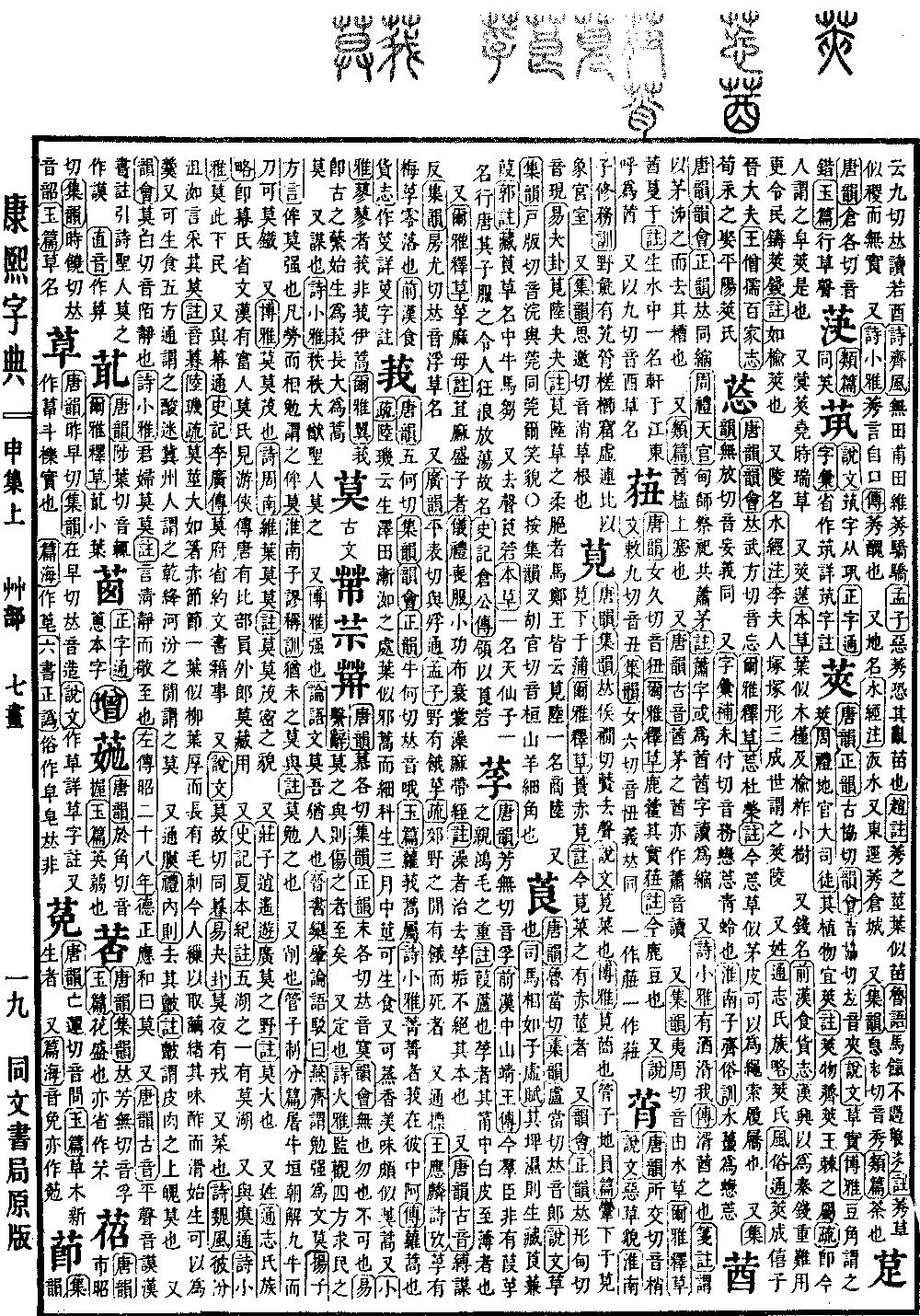
Shen Collection, Upper Volume
Radical: Grass (cǎo)
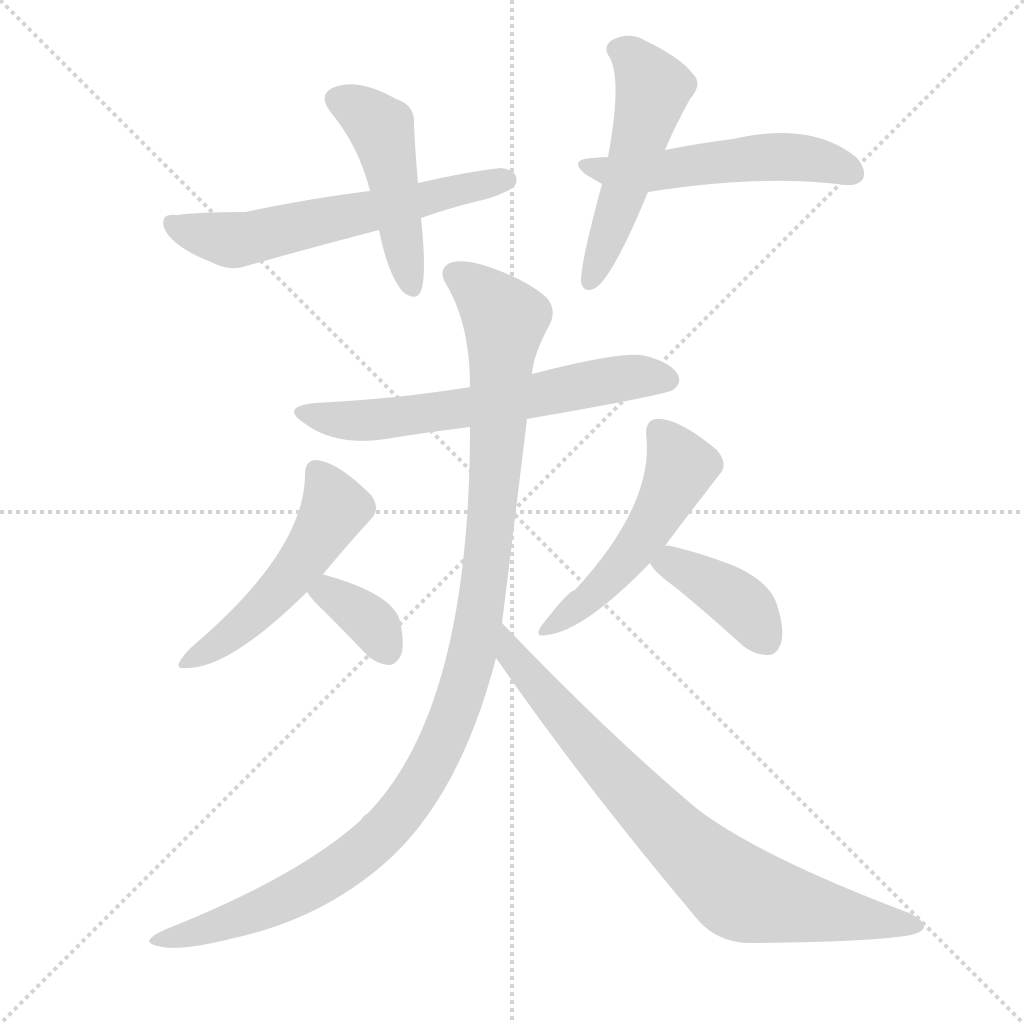
Jia
Kangxi dictionary strokes: 13
Page 1035, Entry 04
Pronounced jia
Shuowen Jiezi (Explaining Single-component Characters and Analyzing Compound Characters): The fruit of a plant.
Guangya (Expanded Elegance): The pod of a bean is called a jia.
Rites of Zhou (Zhouli), Earth Offices, Grand Master of the Masses: Plants suitable for this include jia varieties.
Commentary: Jia varieties refer to plants such as the shepherd's purse pod or royal jujube.
Sub-commentary: This refers to what people today call the honey locust (zaojia).
Also, Mingjia, an auspicious plant from the era of Emperor Yao.
Also, jiami.
Compendium of Materia Medica (Bencao): The leaves resemble those of the rose of Sharon, the elm, or the oak, and the plant is a small tree.
Also, a type of currency.
Book of Han (Hanshu), Treatise on Food and Money: When the Han dynasty began, it was considered that the coins of the Qin dynasty were too heavy and difficult to use, so the people were ordered to cast jia coins.
Commentary: Shaped like the winged seed of an elm tree.
Also, the name of a tomb.
Commentary on the Classic of Waterways (Shuijingzhu): Lady Li's tomb, which is shaped in three tiers; the world calls it Jia Tomb.
Also, a surname.
Comprehensive Records (Tongzhi), Treatise on Clans and Lineages: The Jia clan.
Customs and Traditions (Fengsutong): Jia Cheng, an official of the Jin state.
Wang Sengru, Records of the Hundred Families: Xun Yongzhi married a woman of the Jia clan of Pingyang.
Textual Research:
In the Rites of Zhou, Earth Offices, Grand Master of the Masses: The text states "plants suitable for this include jia." Following the original text, the word "variety" has been added after the word "jia."