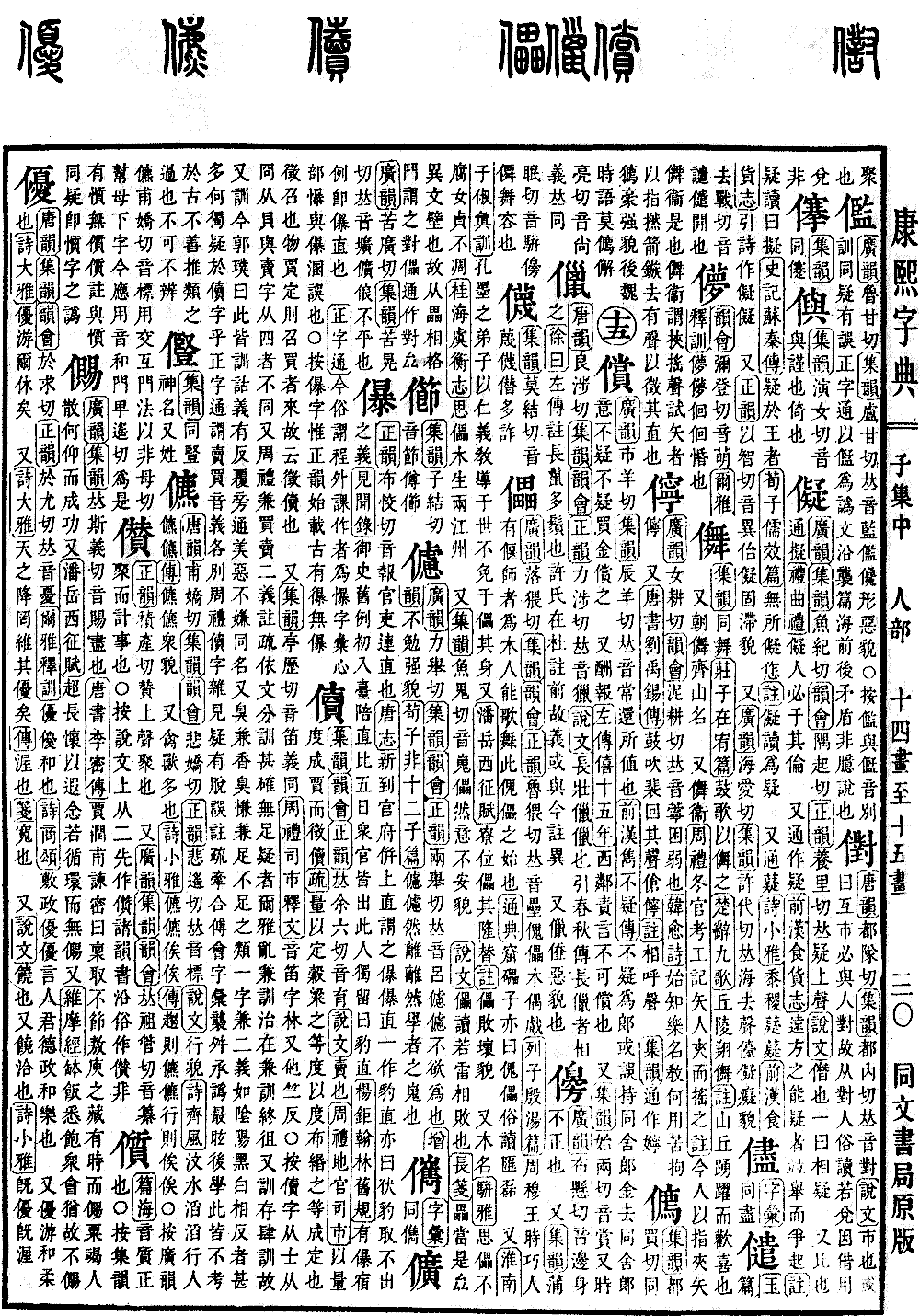
Yin Collection, Upper Volume
Radical: Corpse (shī)
Kangxi Strokes: 14
Page 120, Entry 01
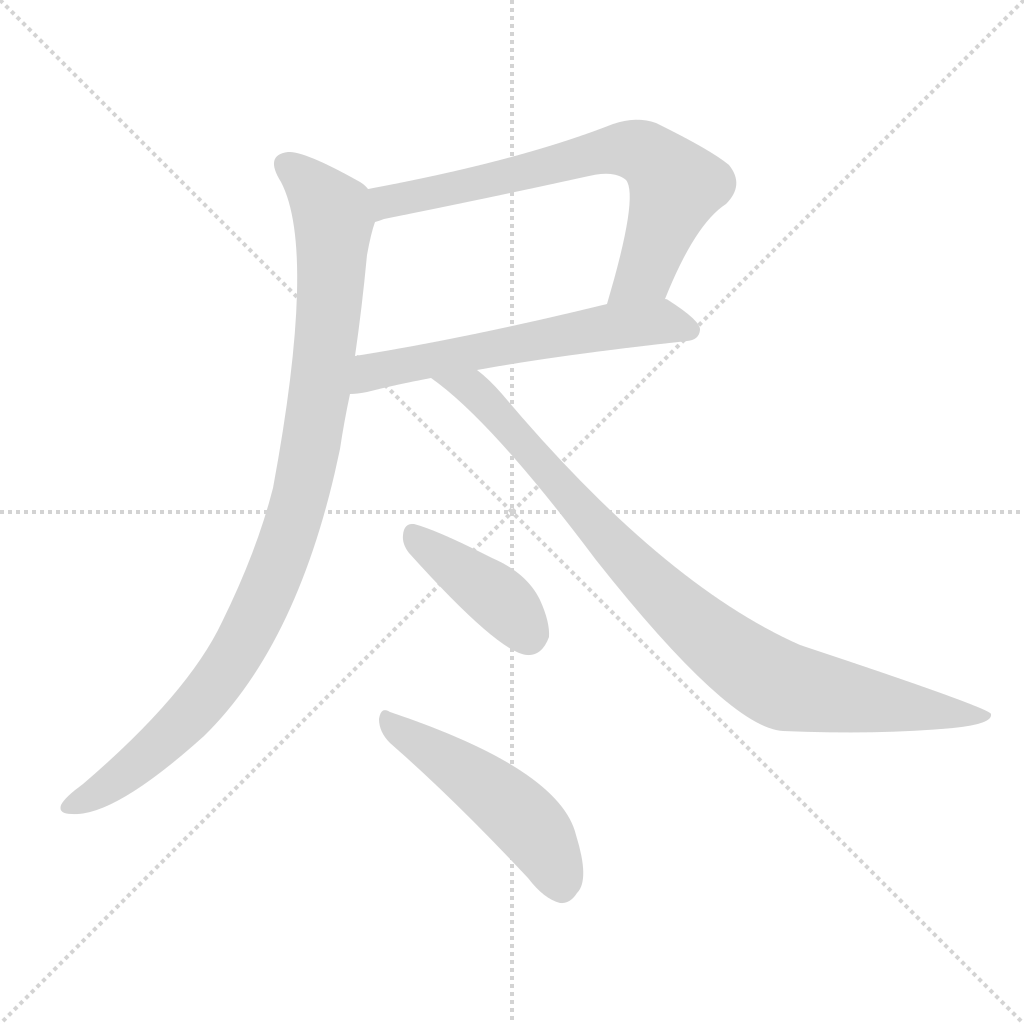
Correct Writing Guide (Zhengzitong): This is the vulgar form of the character for finished or exhausted. For a detailed explanation, see the entry for that character under the Vessel (mǐn) radical.
Pronounced jin (rising tone). According to the Tang Rhyme (Tangyun) and Correct Rhymes (Zhengyun), it is pronounced like the rising tone of qin.
Explanations:
Shuowen Jiezi: The state of a vessel being empty.
Xiao Erya: To cease or stop.
Yupian: To conclude or finish.
Guangyun: To exhaust or deplete.
Jiyun: All or entire.
Citations:
Book of Changes (Yijing), Xici: Writing cannot fully express speech, and speech cannot fully express thoughts.
Zuo Zhuan, Year 1 of Duke Ai: There is nothing better for removing evil than total thoroughness.
Guliang Zhuan, Year 10 of Duke Ding: Confucius ascended the steps one by one, yet he did not reach the highest level.
Book of Rites (Liji), Quli: A gentleman does not demand that others be entirely fond of him.
Doctrine of the Mean (Zhongyong): The way of heaven and earth can be summarized entirely in a single phrase.
Records of the Grand Historian (Shiji), Treatise on Rites: Brilliance is the complete manifestation of ritual.
Xunzi, Zhengming: Although desires can never be completely satisfied, one can approach satisfaction. Commentary: This means to stop when appropriate.
Han E, Suihua Jili: There are major and minor months. Commentary: A month of thirty days is a major month; twenty-nine days is a minor month. Also a surname. Found in Wanxing Tongpu.
Pronounced jin (rising tone). According to the Tang Rhyme (Tangyun) and Correct Rhymes (Zhengyun), it is pronounced like the rising tone of jin.
Explanations:
Leipian: A limit or extremity.
Zhengyun: To cause something to reach its limit.
Citations:
Book of Documents (Shangshu), Kang Gao: Exert your full heart and strength.
Book of Odes (Shijing), Xiaoya: Highly benevolent and highly timely, for he is able to exhaust the duties of his office.
Zuo Zhuan, Year 2 of Duke Min: The Duke of Jin sent his heir, Shen Sheng, to attack the Gaoluo clan of the East Mountain, saying: Exterminate the enemy completely before returning.
Book of Rites (Liji), Yueji: The rituals of the Yin and Zhou dynasties were complete to the highest degree.
Yunhui: All or entirely.
Zuo Zhuan, Year 2 of Duke Zhao: Han Xuanzi said: The Zhou rituals are all preserved in the state of Lu.
Leipian: To let be or to allow.
Zengyun: Even if or granted that.
Zuo Zhuan, Year 14 of Duke Wen: Gongzi Shangren contributed all his family wealth as a loan to the ducal house.
Book of Rites (Liji), Quli: When sitting idly, keep as far back as possible; when eating, sit as far forward as possible.
The vulgar form is written as the character for allow/exhaust. Also, the reduplicated form describes the appearance of peering intensely and exhausting the observation of an object.
Xunzi, Feishierzi: Those degenerate scholars have the appearance of peering and staring intensely.
Pronounced jin (departing tone). Also means to exhaust.
Citations:
Guoyu, Zhouyu: The words of the Minister of Qi were very direct and thorough. Commentary: This means he fully expressed his sentiments, with no taboo regarding praise or blame.
A New Account of Tales of the World (Shishuo Xinyu): It can cause all things that weary the heart to be eliminated. Commentary: This means empty.