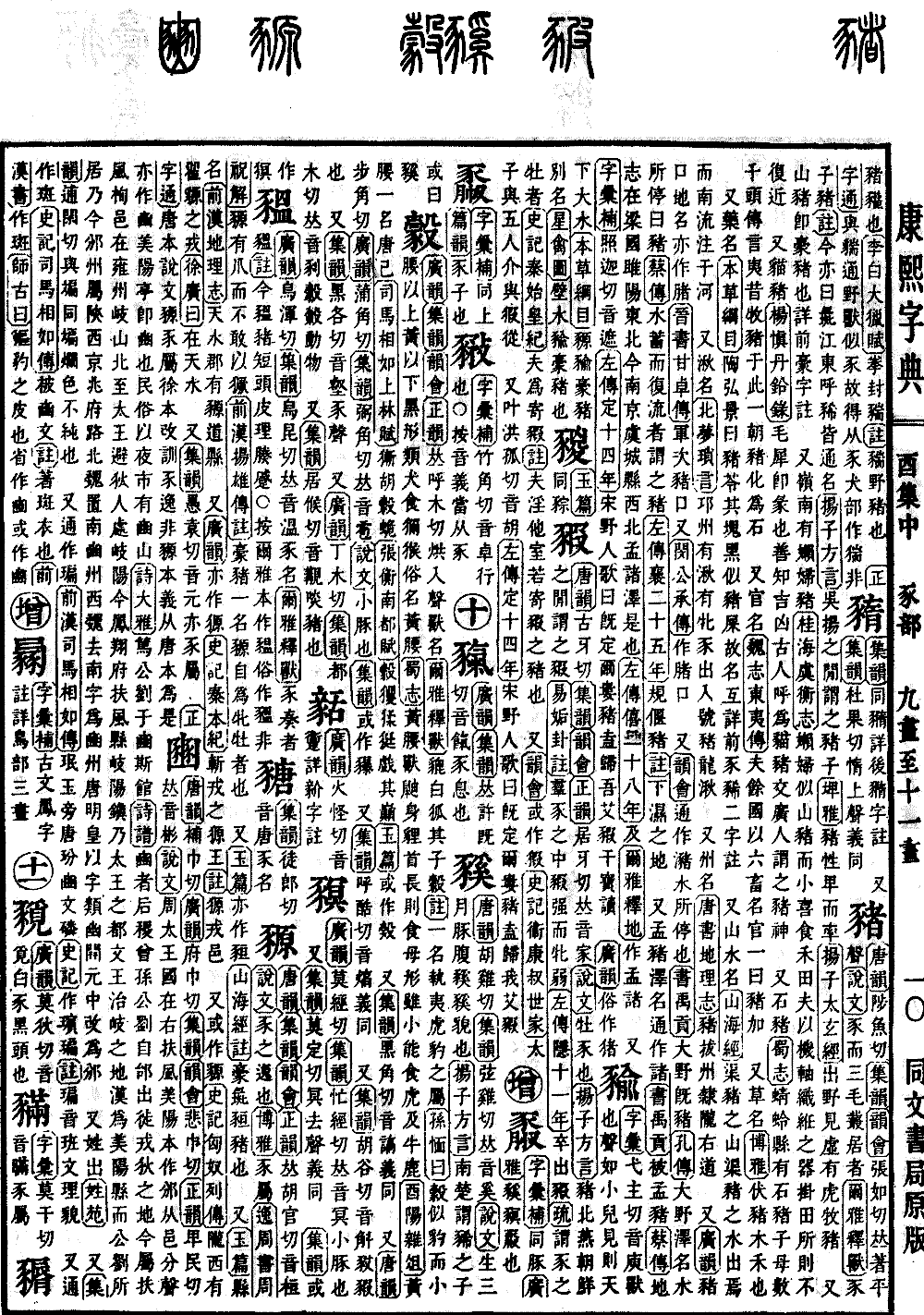
You Collection, Lower Volume
Radical: Pig (shǐ)
Kangxi Strokes: 16
Page 1198, Entry 05
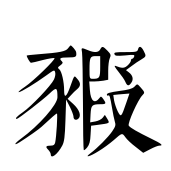
Pronounced jia
Shuowen Jiezi (Shuowen): Refers to a boar.
Yangzi's Dialect (Fangyan): Pigs are referred to as jia in the regions of Northern Yan and Korea.
I Ching (Yijing), Commentary on the Gou Hexagram: Among a group of pigs, the boar is strong while the sow is thin and weak.
Zuo Tradition (Zuozhuan), 11th Year of Duke Yin: Suddenly a boar rushed out.
Commentary (Shu): Refers to a boar.
Records of the Grand Historian (Shiji), Annals of Qin Shi Huang: A man is like a boar kept at someone else's house.
Commentary (Zhu): A man who has an illicit affair with another woman is like a boar kept elsewhere.
Also in Rhyme Collection (Yunhui): Sometimes written as a variant form (jia).
Records of the Grand Historian (Shiji), Genealogy of Wei Kangshu: The crown prince, along with five men in armor, followed him in a carriage drawn by a boar.
Also pronounced hu.
Zuo Tradition (Zuozhuan), 14th Year of Duke Ding: A rustic from the State of Song sang: Since you have already settled your sow, why not return my boar.
Textual Research: In the Records of the Grand Historian (Shiji), Genealogy of Wei Kangshu, the original text reads with a boar. It is noted that this should be corrected to a carriage drawn by a boar, and the character zhi should be added after the word follow. In the Zuo Tradition (Zuozhuan), 14th Year of Duke Ding, the original text reads return my. It is noted that this should be corrected to return my.