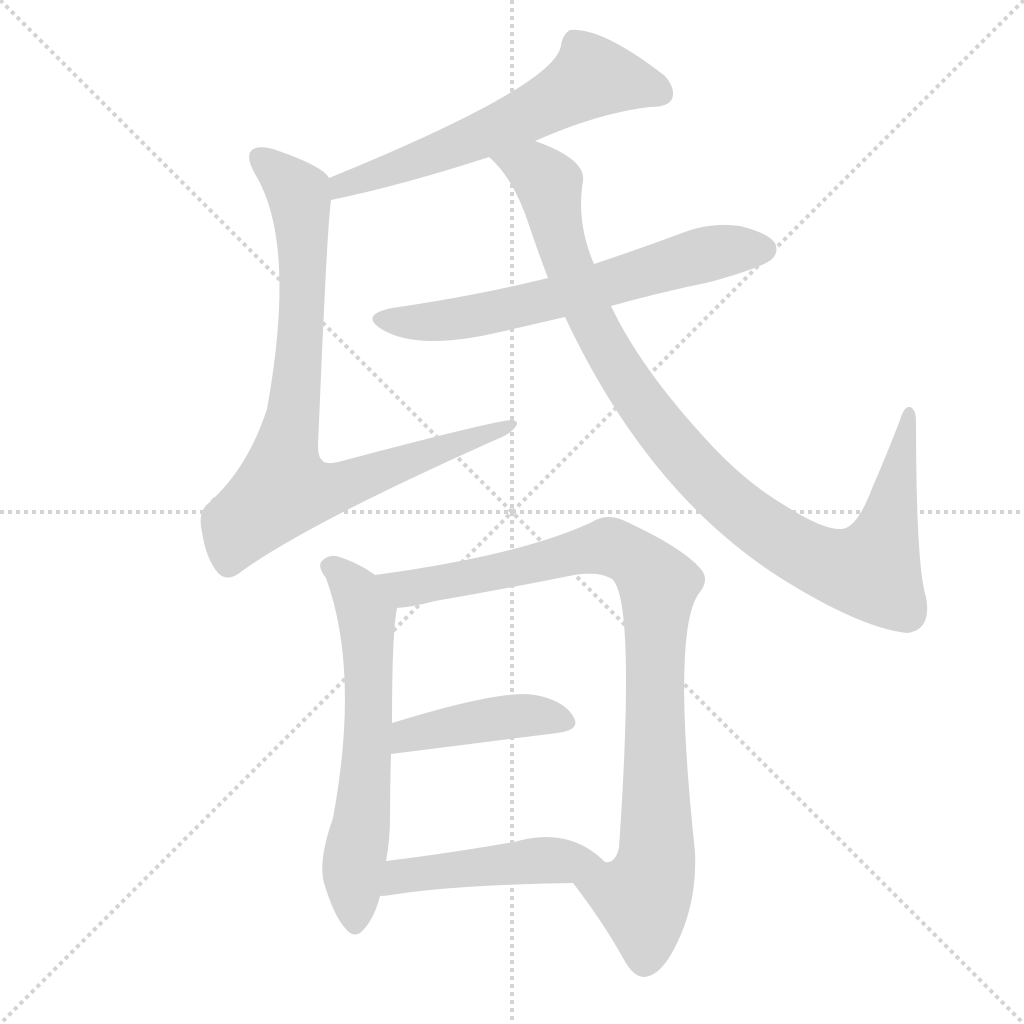
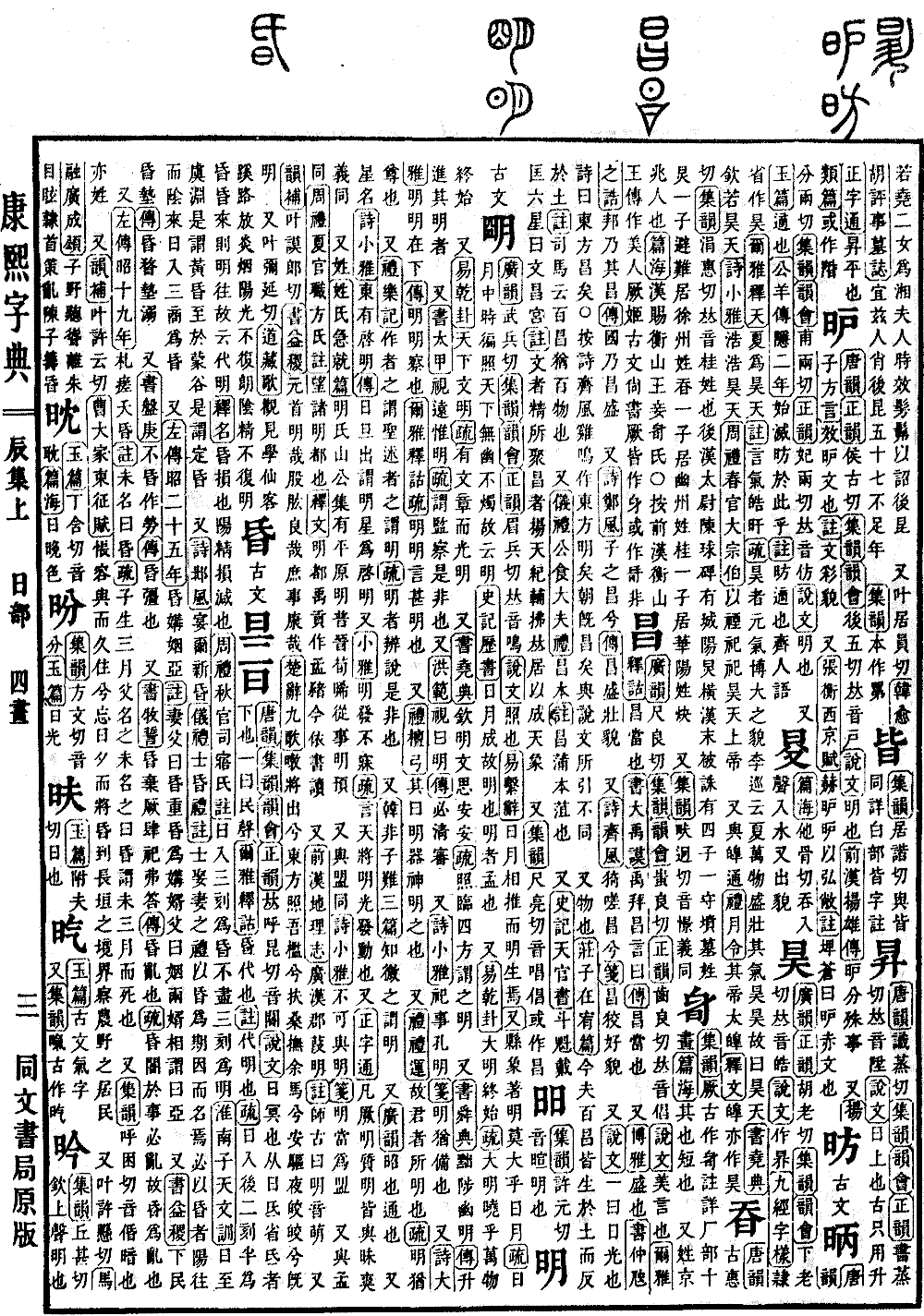
Chen Collection, Upper Volume
Radical: Sun (rì)
Kangxi Strokes: 8
Page 491, Entry 14
Pronounced hun. Homophonous with hun.
Exegesis from Explaining Graphs and Analyzing Characters (Shuowen Jiezi): The sun descends, and the sky becomes dark. The character is composed of sun and the abbreviated form of di, which denotes lowness. Another explanation suggests that the character uses min as a phonetic component.
Erya, Interpretation of Names (Erya, Shizheng) states: Hun signifies replacement. Note: Replacement refers to the alternation of brightness. Commentary: Two and a half units of time after sunset are called hun. Night arrives as the day departs, hence it is said to replace the light.
Interpretation of Names (Shiming) explains: Hun signifies diminution, referring to the reduction of the sun’s essence.
Record of Rituals of Zhou, Autumn Officials, Master of Awakenings (Zhouli, Qiuguan, Siwushi) commentary: Three units of time after sunset is called hun; less than three units is called bright.
Huainanzi, Treatise on Astronomy (Huainanzi, Tianwenxun) states: When the sun reaches the Abyss of Yu, it is called dusk. When it reaches the Valley of Meng, it is called nightfall.
Also, in the Book of Odes (Shijing), Beifeng section: Enjoying your new marriage.
Ceremonial and Ritual (Yili), Commentary on Scholar’s Marriage Rites: The rites for a scholar taking a wife use dusk as the hour for receiving the bride, which is why it is so named. It must be at dusk because this is when the yang energy departs and the yin energy arrives; three units of time after sunset is called hun.
Also, in Zuo Tradition (Zuozhuan), Year 25 of Duke Zhao: Marriage alliances. Note: A wife's father is called hun; double marriage alliances are called gou; a son-in-law's father is called yin; two sons-in-law referring to each other are called ya.
Also, in the Book of Documents (Shangshu), Yiji section: The common people are darkened and submerged. Commentary: Darkened and sunken in misery.
Also, in the Book of Documents (Shangshu), Pan Geng section: Do not confuse hard work. Commentary: Hun means to strive.
Also, in the Book of Documents (Shangshu), Mushi section: Confusedly abandon their ancestral sacrifices without responding. Commentary: Hun means confusion. Commentary: To be ignorant and confused regarding affairs inevitably leads to chaos; therefore, hun means chaos.
Also, in Zuo Tradition (Zuozhuan), Year 19 of Duke Zhao: Premature infant deaths. Note: A child who dies before three months is called hun. Commentary: A father names his child three months after birth. To die before naming is called hun, referring to an infant who dies before three months.
Also, from the Collection of Rhymes (Jiyun), pronounced hun. The meaning is dark. It also serves as a surname.
Also, in the Rhyme Supplement (Yunbu), rhymed with xun.
Ban Zhao’s Rhapsody on the Eastern Journey (Dongzheng Fu): My heart is melancholy, lingering for a long time, forgetting the time as dusk approaches. Arriving at the borders of Changyuan, I observe the residents of the fields.
Also rhymed with xuan.
Ma Rong’s Rhapsody on Guangcheng (Guangcheng Song): Ziye has keen hearing, and Lizhu has exceptional vision. Lishou’s calculations are chaotic, and Chenzi’s planning is confused.