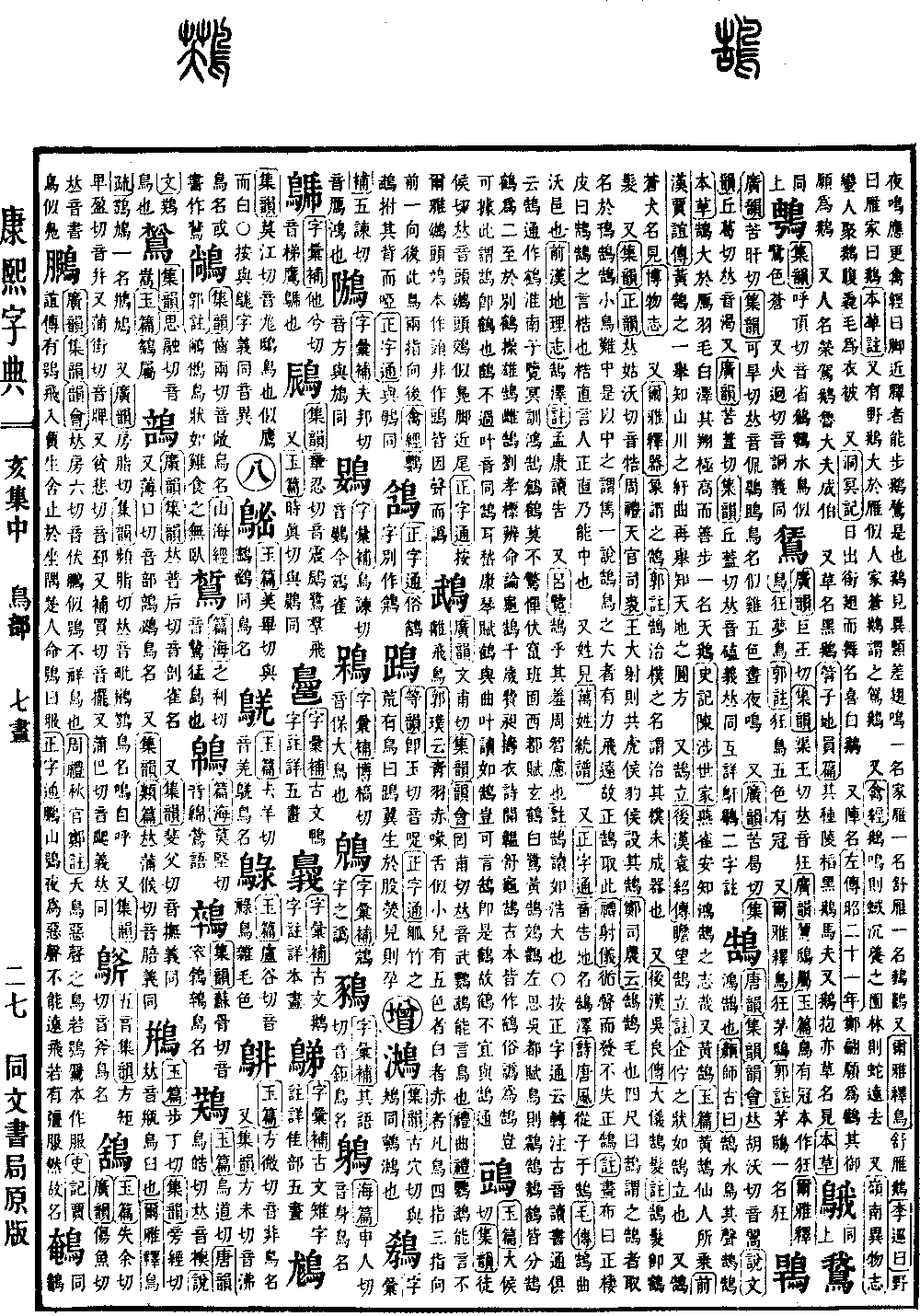
Hai Collection, Lower Volume
Radical: Bird (niǎo)
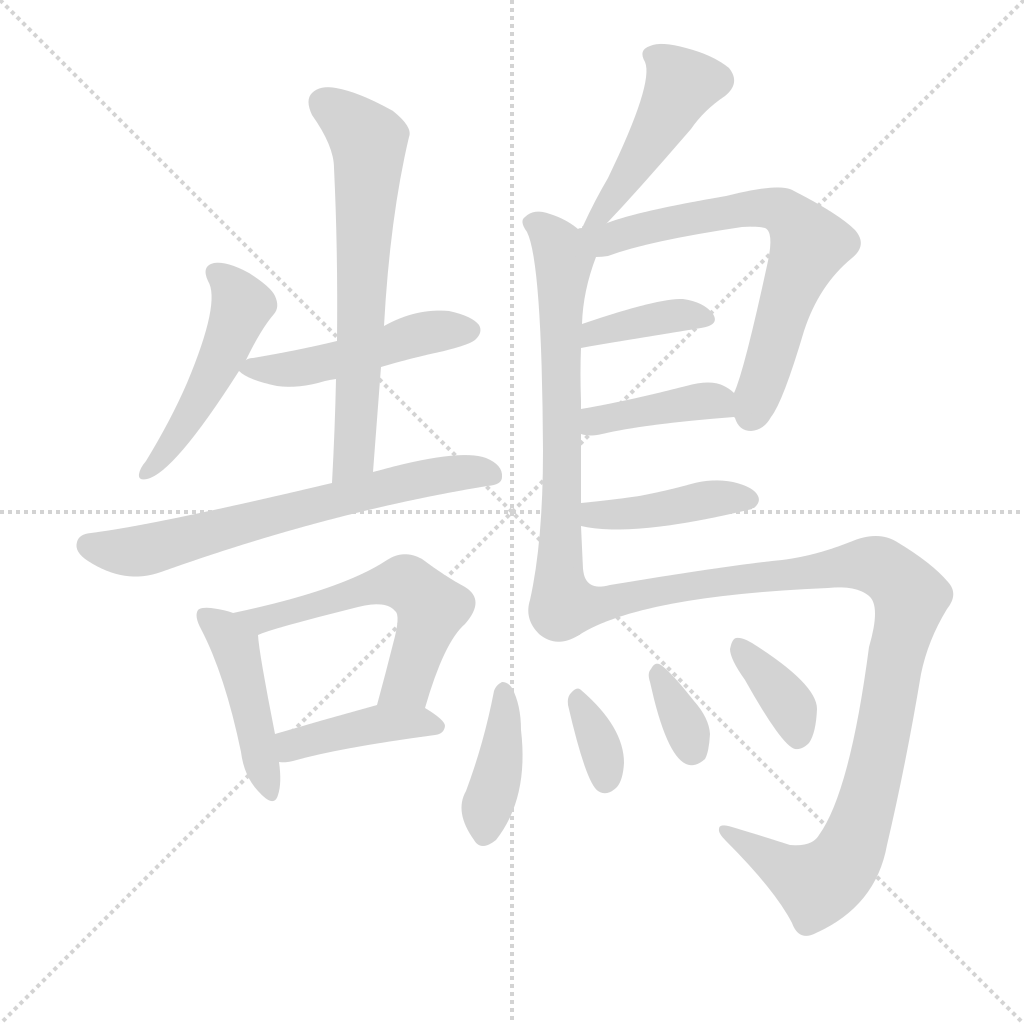
鵠
Kangxi Stroke Count: 18
Page 1491, Entry 06
Pronounced huò.
Shuowen Jiezi (Explanation of Graphs and Analysis of Characters): A wild swan.
Yan Shigu stated: The huò is a water bird; its cry sounds like huò huò.
Compendium of Materia Medica (Bencao): The huò is larger than a wild goose, has white, lustrous feathers, flies extremely high, and walks well. It is also known as a swan.
Records of the Grand Historian (Shiji), Biography of Chen She: How could the swallow or sparrow know the ambitions of the swan?
Also, the yellow swan.
Yupian (Jade Chapters): The yellow swan is what immortals ride.
Book of Han (Hanshu), Biography of Jia Yi: With one flight, the yellow swan understands the twists and turns of mountains and rivers; with a second flight, it understands the roundness and squareness of heaven and earth.
Also, standing like a swan.
Book of the Later Han (Houhanshu), Biography of Yuan Shao: Gazing and standing like a swan.
Commentary: This refers to the state of standing on tiptoe, like a swan standing.
Also, Huocang, the name of a dog. Seen in Treatise on Things and Objects (Bowuzhi).
Also, Erya, Explanation of Implements: Ivory is called a target.
Guo Commentary: Target is the name for processed raw material, meaning the processing of raw material before it is fashioned into an object.
Also, Book of the Later Han (Houhanshu), Biography of Wu Liang: Grand appearance with white hair.
Commentary: White hair here means crane-like white hair.
Also, pronounced gù.
Rites of Zhou (Zhouli), Offices of Heaven, Overseer of Furs: When the King performs the great archery ritual, he provides tiger and leopard target skins and sets up the target.
Zheng Sinong said: The target is [made of] swan down. Four feet in size is called a target. It is called a target because it takes its name from the target bird. The target bird is a small bird and difficult to hit; therefore, hitting it is called an achievement. Another theory states that the target is a large bird with the strength to fly far, and thus the center of a target is named after it.
Book of Rites (Liji), Ritual of Archery: Follow the sound and release the arrow, without missing the center of the target.
Commentary: The cloth is called the center, and the leather base is called the target. The word target implies confinement; it means a person must be upright in character to be able to hit the mark.
Also, a surname. Seen in Comprehensive Genealogy of Ten Thousand Surnames (Wanxing Tongpu).
Also, Zhengzitong (Correction of Character Meanings): Pronounced gào. A place name. Huoze.
Book of Odes (Shijing), Odes of Tang: Following you to Huoze.
Mao Commentary: Huoze is a city in Quwo.
Book of Han (Hanshu), Treatise on Geography: Huoze.
Commentary: Meng Kang reads this as gào.
Also, Master Lu’s Spring and Autumn Annals (Lüshi Chunqiu): Grand is his shame regarding worldly wisdom.
Commentary: Pronounced like hào, meaning grand.
Note: The Zhengzitong states that Zhuanzhu Guyin and Dushutong both claim that huò is interchangeable with hè (crane). Huainanzi (Lǎn míng xùn): Wild swans and cranes, none do not tremble in fear and slink away. Ban Gu’s Rhapsody on the Western Capital: Cranes and white egrets, yellow swans and crested ducks. Zuo Si’s Rhapsody on the Capital of Wu: As for birds, there are cranes and swans. All these texts distinguish between the huò and the hè as two separate entities. As for the piece titled Parting Crane Tune, the male swan and female swan, Liu Xiaobiao’s Treatise on Fate mentions the tortoise and swan living for a thousand years, and Fei Chang’s poem on beating clothes mentions unfolding the swan down, all original texts use the character for crane, which has been corrupted by common error into the character for swan. How could one use this as evidence that the swan is the same as the crane? The character for crane merely shares the same phonetic rhyming group as swan. In Xi Kang’s Rhapsody on the Zither, the word for crane is rhymed with the word for song, and read like the word for swan; how could one say that the swan is therefore a crane? Thus, the crane should not be considered interchangeable with the swan.