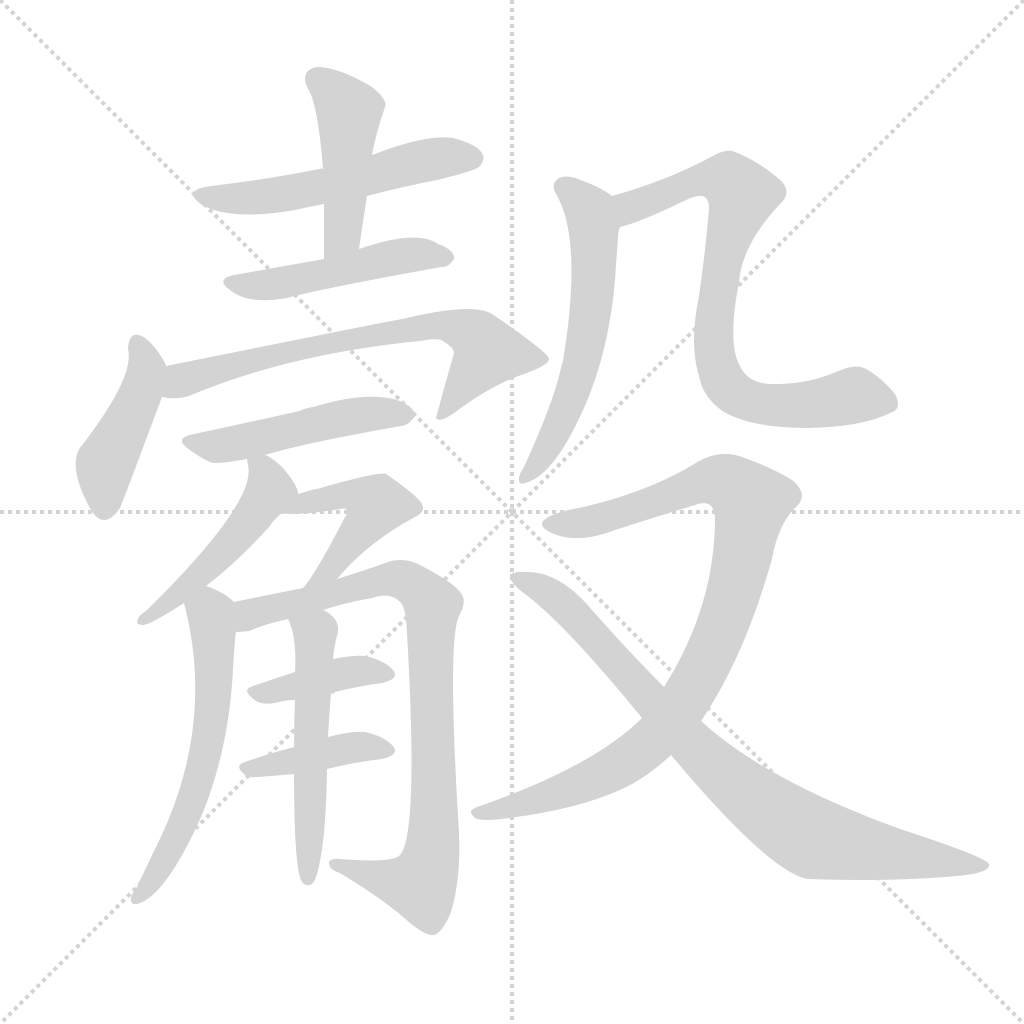
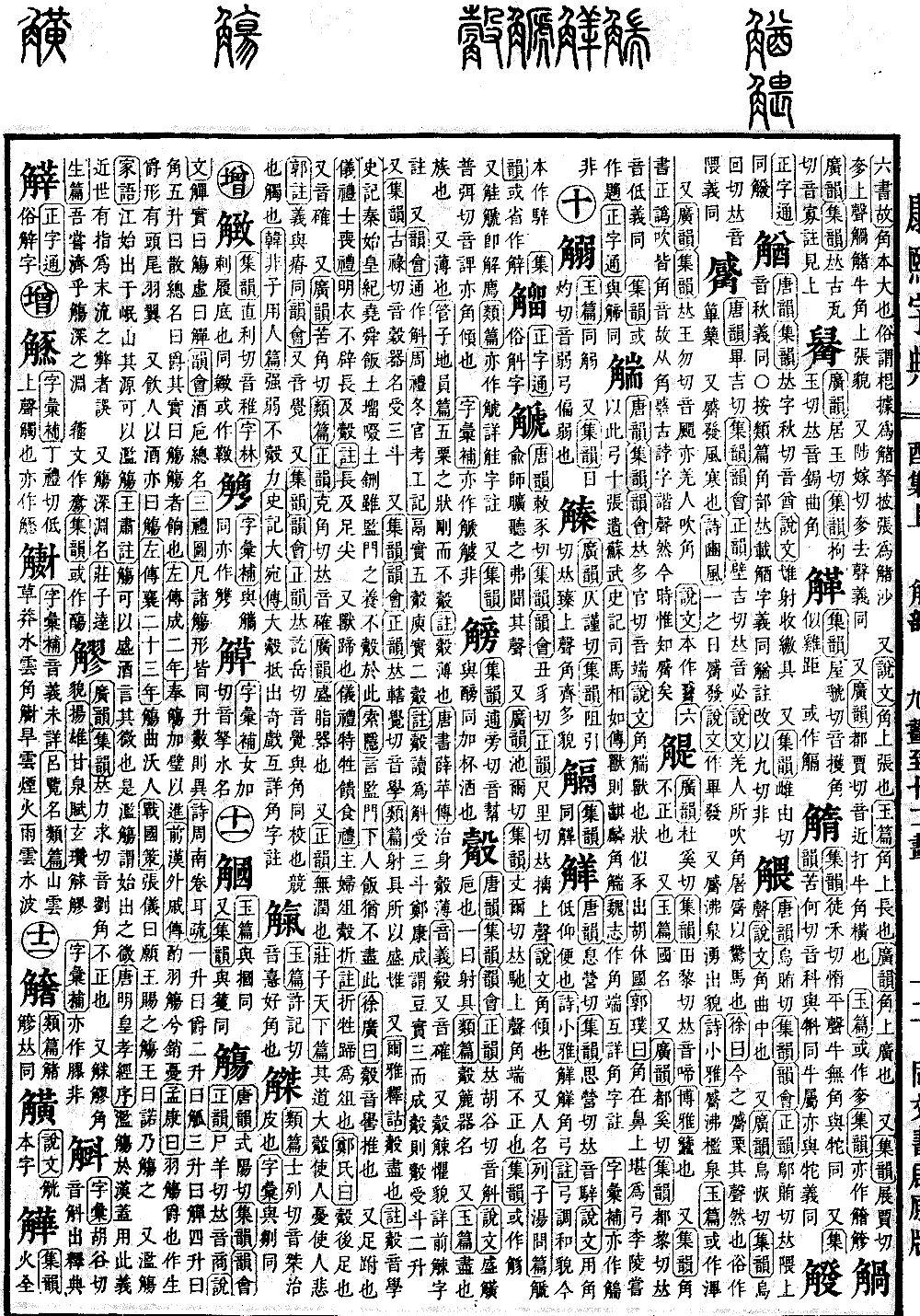
You Collection, Upper Volume
Radical: Horn (jiǎo)
Kangxi Strokes: 17
Page 1144, Entry 18
Tang Dynasty Rhymes (Tangyun), Collected Rhymes (Jiyun), Rhyme Compendium (Yunhui), and Correct Rhymes (Zhengyun) state it is pronounced hu, tone: rising. According to the Explaining Graphs and Analyzing Characters (Shuowen), it is a cup for holding wine. Another definition states it is archery equipment. The Compiled Chapters (Leipian) states it is the name of a container. Furthermore, the Jade Compendium (Yupian) states it means to exhaust or to be in a group. It also means thin or sparse. In the Book of Master Guan (Guanzi), section on Earth Resources (Diyuan Pian), it says the condition of five-grain soil is firm and not thin. The commentary notes that it means thin. In the History of Tang (Tangshu), biography of Xue Ping, it says to govern oneself with simplicity and frugality. The Pronunciation and Meaning notes that it is also pronounced que. It also refers to the appearance of fear, specifically the term husu. See the previous entry for the character su for details.
Additionally, the Rhyme Compendium (Yunhui) notes it is interchangeable with the character hu (a unit of dry measure). In the Rites of Zhou (Zhouli), section on Winter Offices: Artisans' Record (Kaogongji), it mentions a container holding five hu, and a granary holding two hu. The commentary states that the character is read as hu, a measure of three dou. Zheng Kangcheng claims that three dou make a hu, meaning a hu holds one dou and two sheng.
Furthermore, the Collected Rhymes (Jiyun) states it is pronounced gu, tone: level. It is the name of a vessel holding three dou.
The Collected Rhymes (Jiyun), Rhyme Compendium (Yunhui), and Correct Rhymes (Zhengyun) state it is pronounced xue, tone: entering. The Compiled Chapters (Leipian) states it is archery equipment, specifically used to hold arrows.
Additionally, the Literary Expositor (Erya), section on Explaining Ancient Words (Shigu), defines it as to exhaust. The commentary notes it is pronounced xue. In the Records of the Grand Historian (Shiji), Annals of the First Emperor of Qin, it states that when Yao and Shun ate from earthenware bowls, even a prison guard's fare would not be less than this. The commentary explains that even a guard's meal would not be finished to this extent. Xu Guang states it is pronounced ku, meaning to push.
It also refers to the instep of the foot. In the Book of Etiquette and Ceremonial (Yili), section on Rites for the Burial of a Scholar (Shisangli), it mentions that the burial garment should not be tucked and should reach the instep. The commentary states it reaches the tips of the feet. It also refers to the hooves of an animal. In the Book of Etiquette and Ceremonial (Yili), section on Rites for Special Animal Offerings (Tesheng Kuishi Li), it mentions the hostess presenting a tray of animal feet. The commentary states it means breaking the animal's hooves for the serving tray. Zheng Xuan states it refers to the hind feet. It is also pronounced que.
Furthermore, the Extensive Rhymes (Guangyun) states it is pronounced que, tone: entering. The Compiled Chapters (Leipian) and Correct Rhymes (Zhengyun) state it is pronounced que, tone: entering. The Extensive Rhymes (Guangyun) defines it as a vessel for holding grease. The Correct Rhymes (Zhengyun) states it means lacking moisture. In the Book of Master Zhuang (Zhuangzi), section on All Under Heaven (Tianxia Pian), it says the path is very barren, causing people sorrow and grief. Guo’s commentary notes the meaning is the same as emaciated. The Rhyme Compendium (Yunhui) also notes it is pronounced jue.
The Collected Rhymes (Jiyun), Rhyme Compendium (Yunhui), and Correct Rhymes (Zhengyun) state it is pronounced jue, tone: entering. It is identical to the character for horn. It means to compare, to compete, or to touch. In the Book of Master Han Fei (Hanfeizi), section on Using Men (Yongren Pian), it says strength and weakness should not be pitted against each other. In the Records of the Grand Historian (Shiji), section on the Account of Dayuan, it mentions great spectacles and peculiar performances. See the entry for the character for horn for further details.