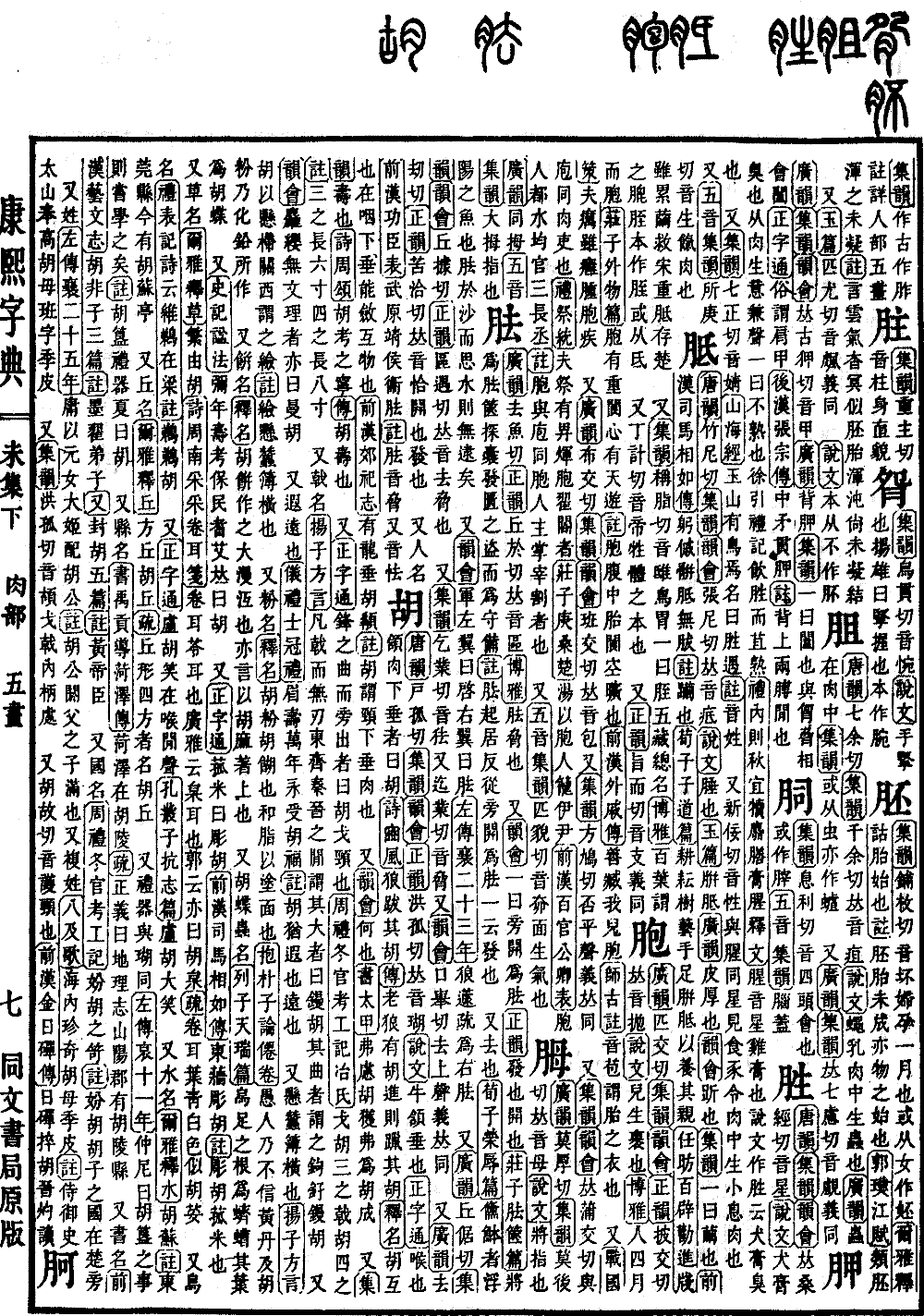
Wei Collection, Lower Volume
Radical: Meat (ròu)
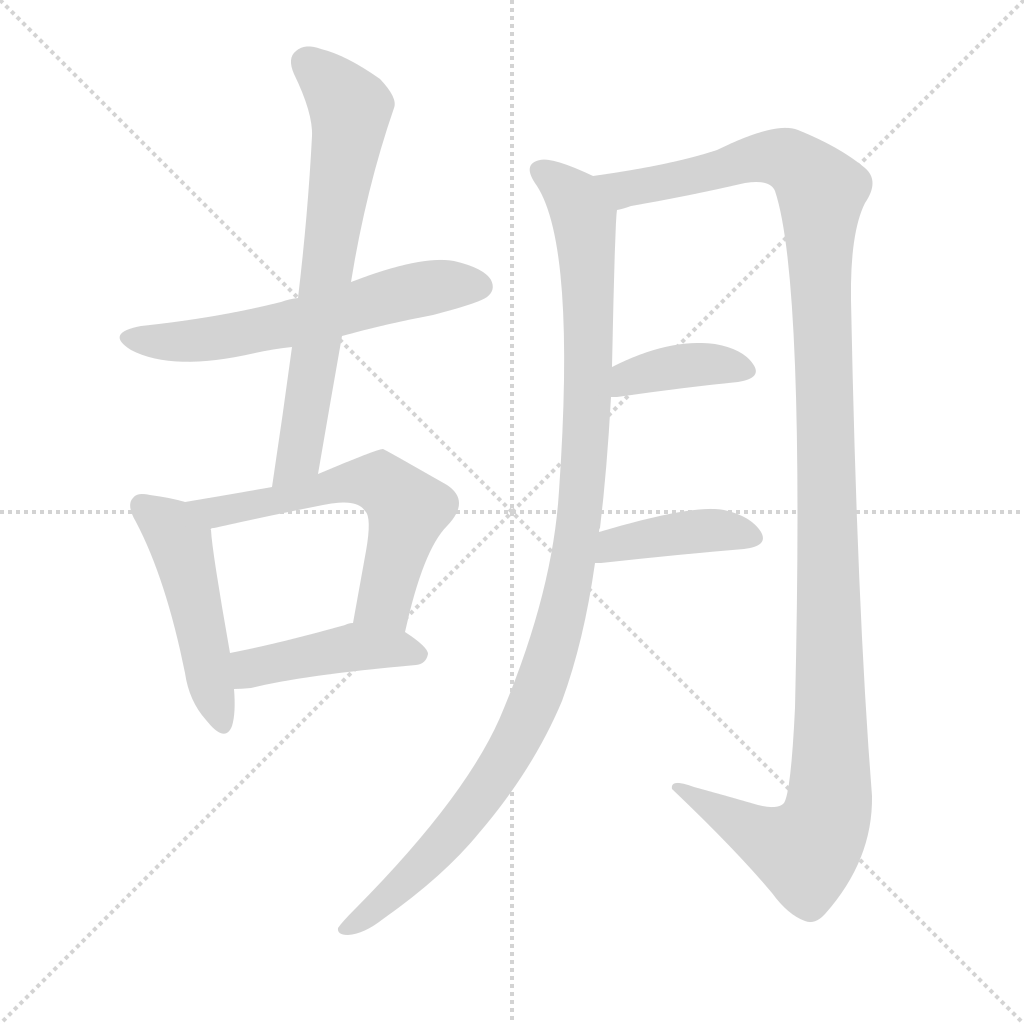
Hu
Kangxi Strokes: 11
Page 979, Entry 12
Tang Yun (Tángyùn): Pronounced hu. Jiyun (Jíyùn), Yunhui (Yùnhuì), and Zhengyun (Zhèngyùn): Pronounced hu.
Shuowen Jiezi (Shuōwén Jiězì): The hanging flesh under the chin of an ox.
Zhengzitong (Zhèngzìtōng): Refers to the throat. The hanging part of the flesh under the chin is called hu.
Book of Odes (Shijing): A wolf stepping on its own hu.
Commentary: Old wolves have a hu; when moving forward, they step on their own hu.
Shiming (Shímíng): Hu means mutual. It hangs below the throat and can gather or contain things.
Book of Han (Qián Hànshū): A dragon hanging down its whiskers.
Commentary: Hu refers to the hanging flesh under the neck.
Yunhui: Indicates the word he, meaning how or why.
Book of Documents (Shūjīng): If one does not think, how can one have a harvest? If one does not act, how can one succeed?
Jiyun: Indicates longevity.
Book of Odes (Shijing): The peace of those with longevity.
Commentary: Hu means longevity.
Zhengzitong: The part of a weapon's blade that is curved and protrudes to the side is called hu. It refers to the neck of a ge (dagger-axe).
Rites of Zhou (Zhōulǐ): The length of the hu on a ge is three times the length of the blade, and the length of the hu on a ji (halberd) is four times the length of the blade.
Commentary: Three times means six inches long; four times means eight inches long.
Also a name for a type of halberd.
Yangzi Fangyan (Yángzǐ Fāngyán): For any halberd without a blade, in the eastern states of Qi, Qin, and Jin, the large ones are called manhu, and the curved ones are called gouyi manhu.
Yunhui: Coarse, unpatterned hat tassels. Also called manhu.
Indicates distance.
Book of Etiquette and Ceremonial (Yílǐ): Longevity for ten thousand years, forever enjoying distant blessings.
Commentary: Hu is like the word xia, referring to distance.
Refers to the horizontal bar for hanging silkworm mats.
Yangzi Fangyan: Things used for hanging are called [yú] in the regions west of the pass.
Commentary: [Yú] is the horizontal bar for hanging silkworm mats.
A type of powder.
Shiming: Hu powder; hu means paste, mixed with oil and used to smear on the face.
Baopuzi (Bàopǔzǐ): Foolish people actually do not believe that yellow lead and hu powder are made from transformed lead.
A type of cake.
Shiming: Hu cake; when making it, the dough is spread very thin; it is also said that sesame seeds are placed on top.
Butterfly, a type of insect.
Liezi (Lièzǐ): The root of the crow-foot plant turns into a grub, and its leaves turn into a butterfly.
Records of the Grand Historian (Shǐjì): Longevity and old age, protecting the people so they may live long, is called hu.
Zhengzitong: Man chao (wild rice) is called diaohu.
Book of Han (Qián Hànshū): The diaohu on the eastern wall.
Commentary: Diaohu is wild rice.
A type of grass.
Erya (Ěryǎ): Fanyouhu.
Book of Odes (Shijing): Juan'er is ling'er. Guangya (Guǎngyǎ) says: it is shi'er. Guo Pu says: it is also called hushi.
Sub-commentary: The leaves of juan'er are greenish-white, like coriander.
A type of bird.
Book of Rites (Lǐjì): The pelican on the dam.
Commentary: The pelican is the tihun.
Zhengzitong: Luhu, refers to the sound of laughter in the throat.
Kongcongzi (Kǒngcóngzǐ): Luhu, a loud laugh.
A river.
Erya: Husu.
Commentary: There is a Husu Pavilion in Dongguan County today.
A mound.
Erya: Square mound, huchiu.
Sub-commentary: A mound that is square in shape is called a huchiu.
Refers to a ritual vessel. Same as hu (the vessel name).
Zuo Tradition (Zuǒzhuàn): Confucius said: Regarding the hu-gui vessels, I have studied them.
Commentary: Hu-gui are ritual vessels. In the Xia Dynasty, they were called hu.
A county.
Book of Documents (Shūjīng): Heze is in Huling.
Sub-commentary: The Justice commentary says: The Geography Records state that Shanyang Commandery has a Huling County.
A book.
Book of Han (Qián Hànshū): Hufeizi, in three chapters.
Commentary: A disciple of Mozi.
Also: Fenhu, in five chapters.
Commentary: A minister of the Yellow Emperor.
A state.
Rites of Zhou (Zhōulǐ): The arrow shafts of Fenhu.
Commentary: Fenhu is the State of Hu, located next to the State of Chu.
A surname.
Zuo Tradition (Zuǒzhuàn): At that time, the eldest daughter Daji was betrothed to Duke Hu.
Commentary: Duke Hu was the son of Efu, and his name was Man.
A compound surname.
Bajie Ge (Bājíe Gē): The rare figures of the world, Humuji Pi.
Commentary: The attendant censor of Taishan Fenggao, Humu Ban, styled Jipi.
Jiyun: Pronounced hu. Refers to the hole in a weapon like a ge or ji where the handle is inserted.
Also pronounced hu. Refers to the neck.
Book of Han (Qián Hànshū): Jin Ridi grabbed the neck. Jin Zhuo reads it this way.