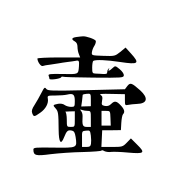
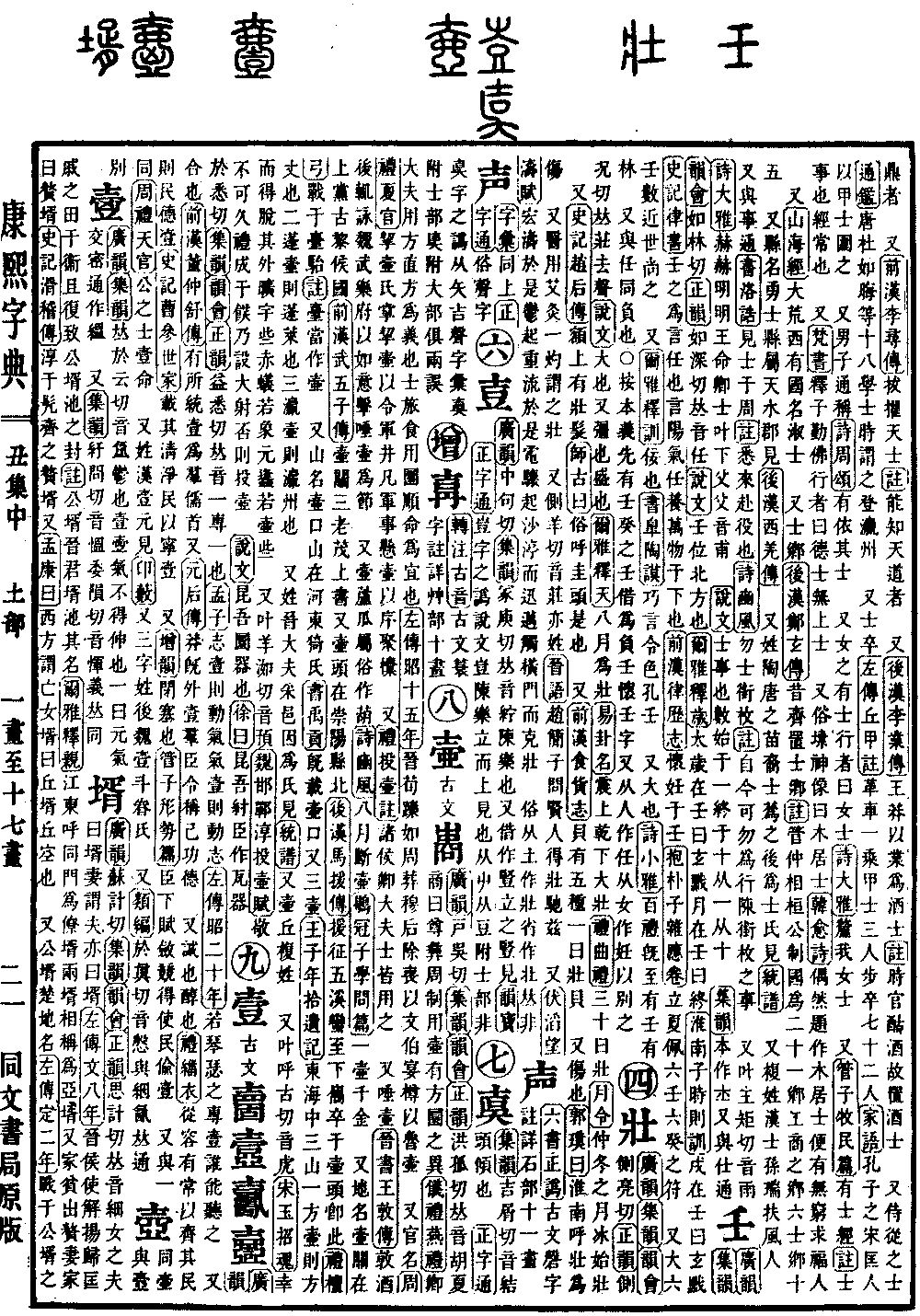
Chou Collection, Middle Volume. Radical: Scholar (shì). Kangxi Strokes: 11. Page 243, Entry 08.
Ancient script. According to the Broad Rhymes (Guangyun), pronounced hu. According to the Collected Rhymes (Jiyun), the Rhyme Assembly (Yunhui), and the Correct Rhymes (Zhengyun), pronounced hu. During the Xia and Shang dynasties, they were called zun yi (ritual bronze vessels). In the Zhou dynasty system, the term hu was used, with distinctions made between square and round forms. Book of Etiquette and Ceremonial (Yili), in the chapter on Banquet Rites, notes that ministers and grand masters used square hu to symbolize integrity and uprightness. Officials eating while traveling used round hu, indicating that compliance with commands is appropriate. Zuo Tradition (Zuo Zhuan), in the fifteenth year of Duke Zhao, records that Xun Yue of the Jin state went to the Zhou court to bury the queen and, after removing his mourning clothes, feasted with Wen Bo, using a hu from the Lu state as a wine vessel.
Also refers to an official title. Rites of Zhou (Zhou Li), in the Summer Official section, mentions the Master of the Hu who was responsible for carrying the hu to command the army to draw water; for all military operations, they would hang the hu to gather the troops in sequence.
Also, refer to the commentary on the Rites of Pitch-Pot (Touhu), where it is noted that feudal lords, ministers, grand masters, and scholars all used it.
Also refers to a spittoon. Book of Jin (Jin Shu), in the biography of Wang Dun, states that after drinking, Wang Dun would always recite the Music Bureau poems of Emperor Wu of Wei and use a ruyi (curved decorative object) to beat time against his spittoon.
Also refers to the bottle gourd, a type of melon, commonly written as hu. Book of Odes (Shijing), in the chapter on the Customs of Bin, states: In the eighth month, the bottle gourds are harvested. Pheasant Cap Master (Heguanzi), in the chapter on Learning, states: One bottle gourd is worth a thousand pieces of gold.
Also refers to a place name. Huguan, located in Shangdang, was the ancient state of Li. History of the Former Han (Qianhan Shu), in the biography of the Five Sons of Emperor Wu, mentions the elder Mao of Huguan submitting a petition.
Also refers to Hutou, located north of Chongyang County. Book of the Later Han (Houhan Shu), in the biography of Ma Yuan, records that Ma Yuan campaigned against the Five Streams barbarians, reached Xiaxi, and died at Hutou; this is that place. Book of Rites (Liji), in the chapter on Tan Gong, mentions the battle at Taitai; the commentary notes that tai should be written as hu.
Also refers to a mountain name. Hukou Mountain, located in Yishi in Hedong. Book of Documents (Shu Jing), in the Tribute of Yu, mentions having recorded Hukou.
Also refers to the Three Hus. Records of Observations of Anomalies (Shiyi Ji) by Wang Zinian mentions the three mountains in the East Sea: the first is Fanghu, which is Fangzhang; the second is Penghu, which is Penglai; the third is Yinghu, which is Yingzhou.
Also refers to a surname. Named after the fief of a grand master of the Jin state, it became a surname as seen in the Comprehensive Genealogies (Tongpu).
Also refers to Huqiu, a double-surname.
Also read as hu. Song Yu, Summoning of the Soul (Zhao Hun), writes: Fortunate to escape, the space outside is vast; red ants are like elephants, black bees are like hu.
Also read as yu. Han Dan Chun of the Wei state, Rhapsody on Pitch-Pot (Touhu Fu), writes: Respect cannot be maintained for long, the rites are completed, then the grand archery is set, otherwise the pitch-pot is used. According to the Analytical Dictionary of Characters (Shuowen), it is a round vessel of Kunwu. Xu says: Kunwu was a minister to Zhou who made pottery vessels.