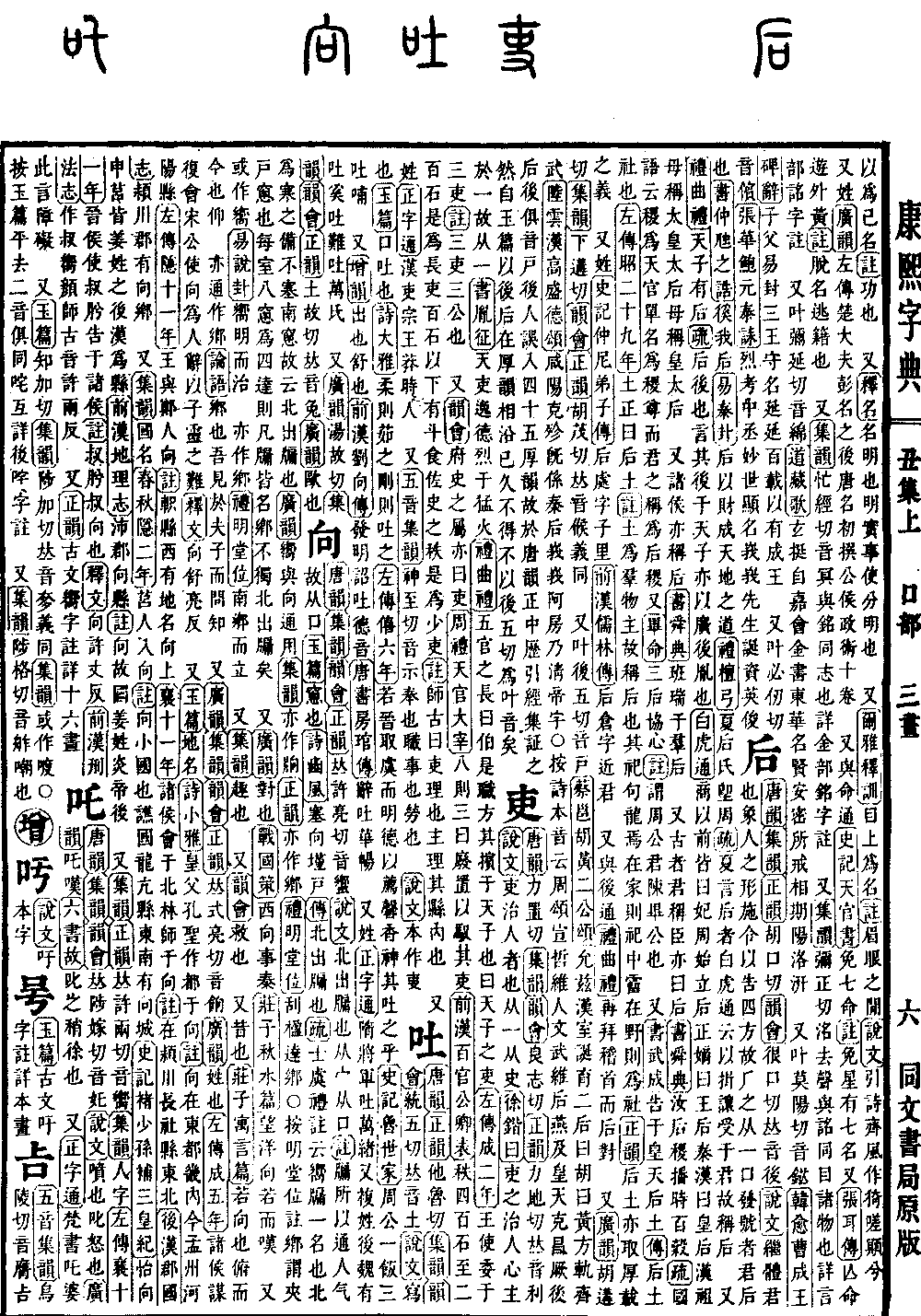
Chou Collection, Upper Volume
Radical: Mouth (kǒu)
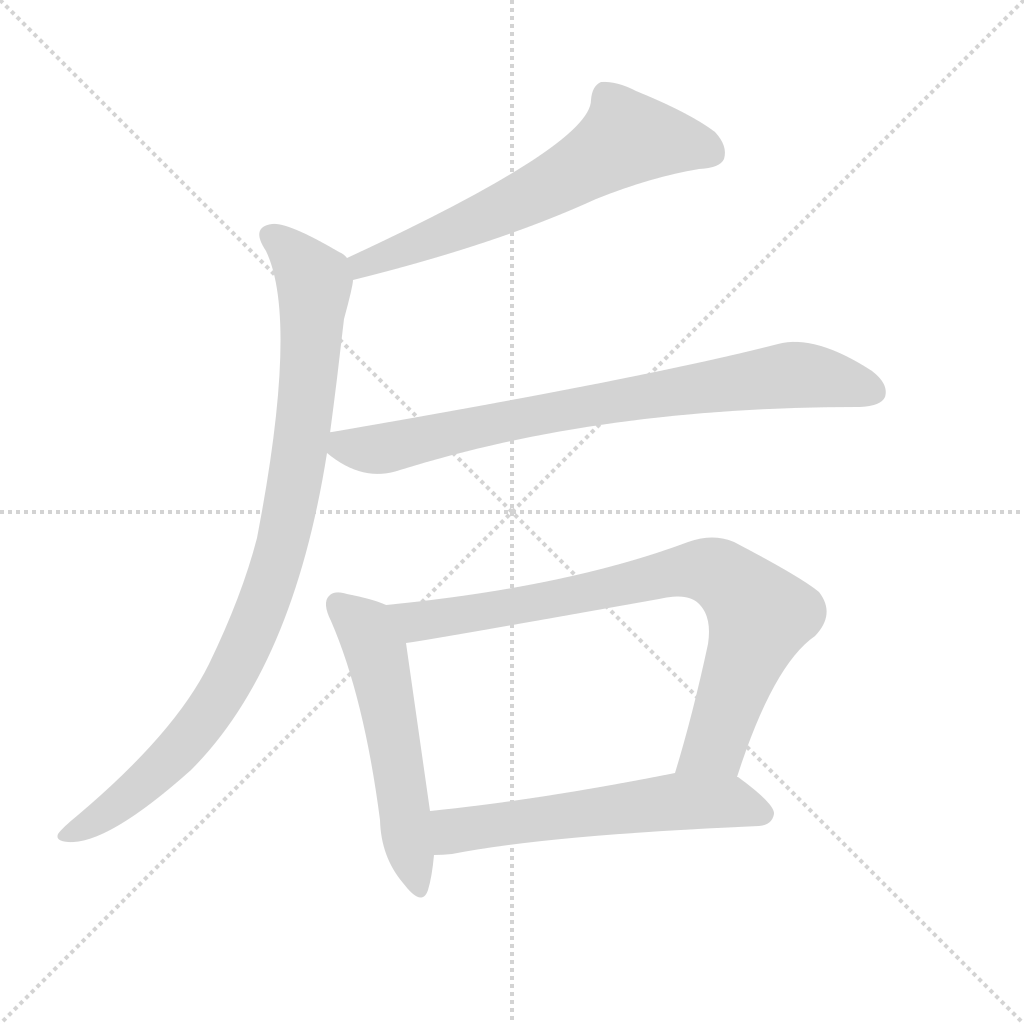
Character: hòu
Kangxi Strokes: 6
Page 176, Entry 01
Pronounced hòu. According to Explaining Graphs and Analyzing Characters (Shuowen Jiezi), it refers to a ruler who succeeds to the throne; the character shape resembles a person. It refers to one who issues commands to inform the four directions, thus it is composed of one and mouth. One who issues orders is a ruler.
Book of Documents (Shujing), Announcement of Zhonghui: Awaiting my ruler.
Book of Changes (Yijing), Tai Hexagram: The ruler uses this path to regulate the ways of heaven and earth.
Book of Rites (Liji), Tangong: The Xia dynasty rulers used fire to bake bricks to surround the coffin.
Commentary: The Xia dynasty used the term hòu. White Tiger Hall Discussions (Baihu Tong) states that because the ruler received the world from the predecessor through abdication, they were called hòu.
Book of Rites (Liji), Qu Li: The Son of Heaven has a consort.
Commentary: Hòu means after. It signifies that her position is behind the Son of Heaven, and it is also for the sake of extending the lineage. White Tiger Hall Discussions (Baihu Tong) states that before the Shang dynasty, they were called concubines, and from the Zhou dynasty, the title hòu was established. The primary wife is called Queen (wánghòu), during the Qin and Han dynasties called Empress (huánghòu), the grandmother of the Han period is called Grand Empress Dowager (tàihuángtàihòu), and the mother is called Empress Dowager (huángtàihòu).
Feudal lords are also called hòu.
Book of Documents (Shujing), Canon of Shun: Distributing jade tokens to the various feudal lords.
In ancient times, rulers addressed ministers as hòu.
Book of Documents (Shujing), Canon of Shun: You, Houji, sow these hundred grains.
Commentary: Discourses of the States (Guoyu) says: Ji was the celestial official in charge of agriculture, whose given name was Ji. He was respected like a ruler, thus called Houji.
Book of Documents (Shujing), Bi Ming: Three rulers working together with one heart.
Commentary: This refers to the Duke of Zhou, Junchen, and the Duke of Bi.
Book of Documents (Shujing), Wucheng: Praying to August Heaven and Houtu.
Commentary: Houtu is the deity of the soil. Zuo Tradition (Zuozhuan), 29th Year of Duke Zhao: The official in charge of earth is called Houtu.
Note: Earth is the master of all things, hence it is called hòu. The one sacrificed to is Goulong; at home, one sacrifices to the god of the central drain, and in the field, it is the god of the soil. Correct Rhymes (Zhengyun) states that Houtu also carries the meaning of the earth being deep and capable of supporting all things.
A surname.
Records of the Grand Historian (Shiji), Biographies of Confucius' Disciples: Hou Chu, courtesy name Zili.
History of the Former Han (Qian Hanshu), Biographies of Confucian Scholars: Hou Cang, courtesy name Jinjun.
Also interchangeable with the character for behind (hòu).
Book of Rites (Liji), Qu Li: Bowed twice with head to the ground, and then replied.
Pronounced gòu. The meaning is the same.
Also used as a phonetic loan (yèyīn) and pronounced hù.
Cai Yong, Eulogy for the Two Dukes of Hu and Huang: Protecting this Han house, birthing and raising two rulers. One Duke Hu and one Duke Huang, their achievements running parallel.
Lu Yun, Eulogy for the Great Virtue of Han Gaozu: Xianyang was captured and pacified, having already captured the ruler of Qin. The towering Epang Palace was thus swept clean to become the residence of the Emperor.
According to the original pronunciation in the Book of Odes (Shijing): In the Zhou Eulogies, the characters for hòu and hòu in "Wise and sagacious are the men, civil and martial are the rulers, extending to August Heaven, able to flourish their descendants" are both pronounced hù. Later generations mistakenly categorized them into the 45th hou rhyme, so in the Corrected Tang Rhymes (Tangyun Zheng), scriptures were cited one by one to prove this. However, since the Jade Chapters (Yupian), the character hòu has long been categorized under the hou rhyme, so the pronunciation hù must be treated as a phonetic loan.