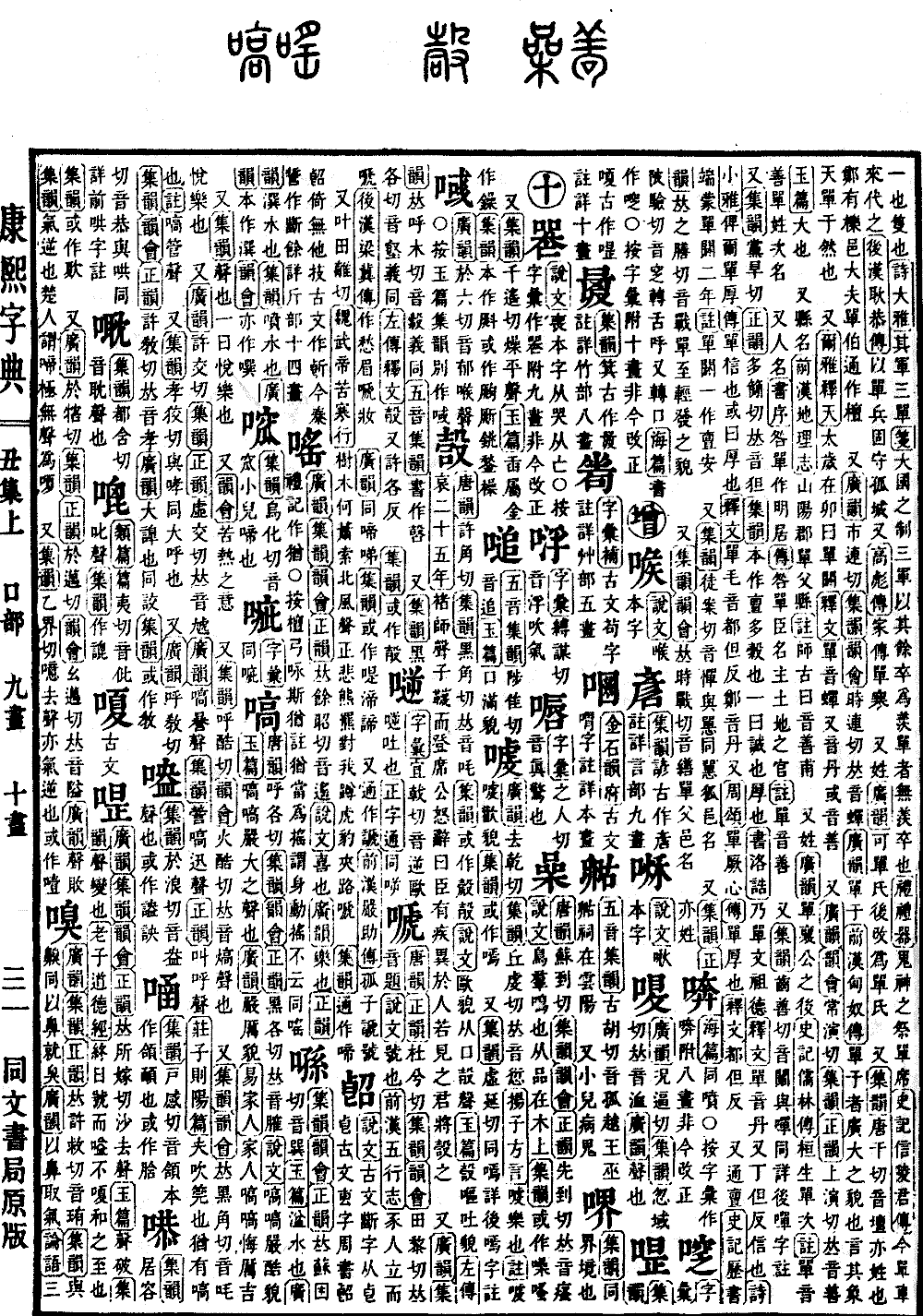
Chou Collection, Upper Volume
Radical: Mouth (kǒu)
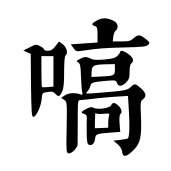
Character: Hao
Kangxi Stroke Count: 13
Page 201, Entry 28
Pronounced hao.
According to the Explaining Graphs and Analyzing Characters (Shuowen Jiezi), hao-hao indicates a severe and harsh appearance.
According to the Jade Chapters (Yupian), hao-hao describes a severe and imposing sound.
According to the Expanded Rhymes (Guangyun), it refers to a severe and stern appearance.
In the Book of Changes (Yijing), section on the Family (Jiaren): The family is severe and stern (hao-hao); although there is regret and danger, it is auspicious.
Also, according to the Collected Rhymes (Jiyun), it refers to a sound. Another source states it means to be pleased and happy.
According to the Rhyme Compendium (Yunhui), it implies the sensation of bitter heat.
Pronounced hao.
Also, according to the Collected Rhymes (Jiyun) and the Rhyme Compendium (Yunhui), it refers to being pleased and happy.
Pronounced xiao.
According to the Expanded Rhymes (Guangyun), it is the sound of shouting or calling out. According to the Collected Rhymes (Jiyun), it refers to a rapid or sudden sound. According to the Correct Rhymes (Zhengyun), it refers to a loud cry or shout.
In the Zhuangzi, section on Zeyang: The blowing of a bamboo pipe still produces a hao sound. Commentary: Hao refers to the sound of a pipe.
Also, according to the Collected Rhymes (Jiyun), it is equivalent to the character meaning to roar or wail. It refers to a loud shout.
Pronounced xiao.
According to the Expanded Rhymes (Guangyun), it means great. It is identical to the character meaning to call out loudly. According to the Collected Rhymes (Jiyun), it is sometimes written as the character for teach.