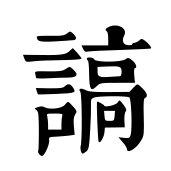
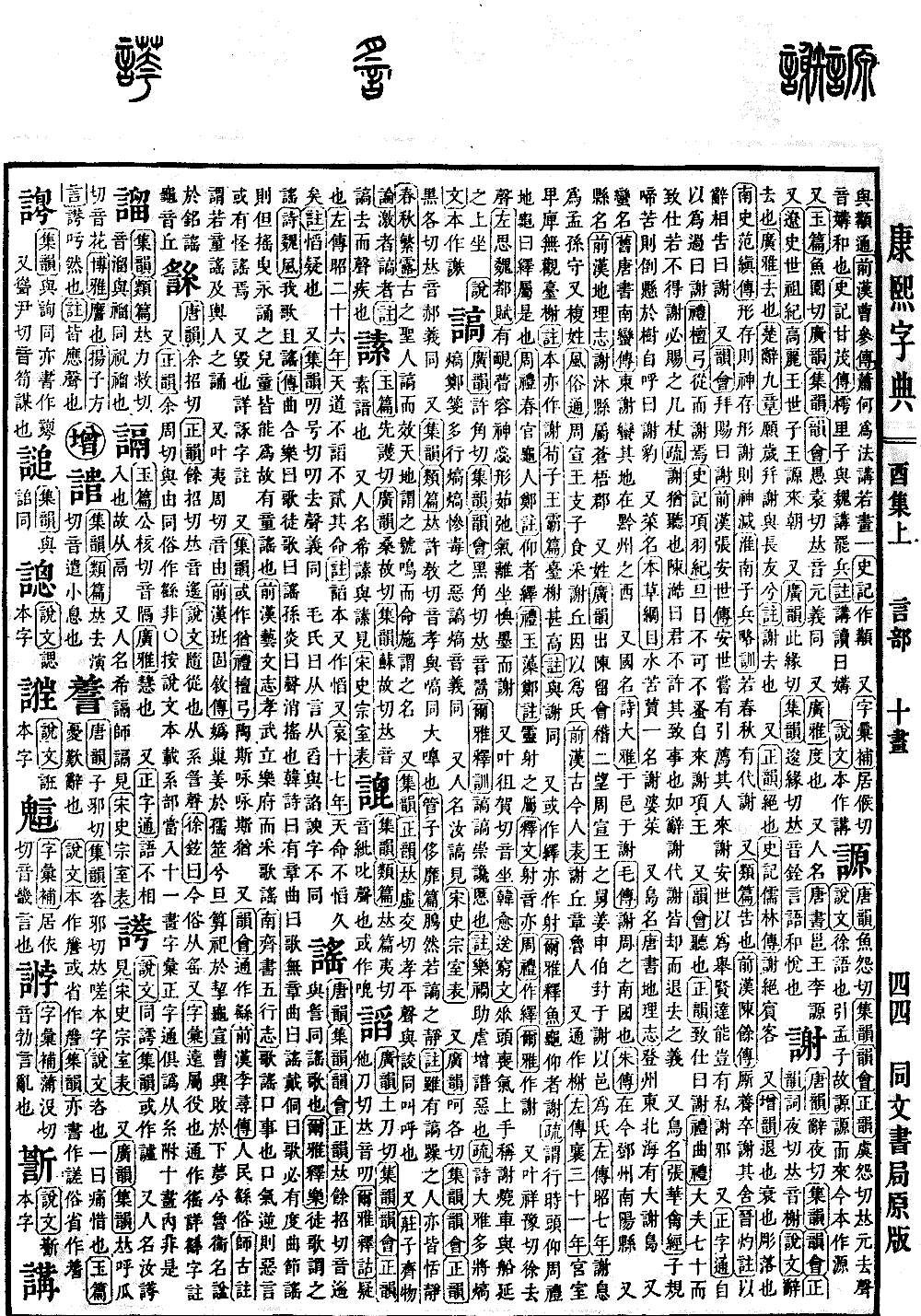
You Collection, Upper Volume
Radical: Speech (yán)
Jiao (tone unspecified)
Kangxi stroke count: 17
Page 1176, Entry 03
Broad Rimes (Guangyun): Pronounced he (rising tone). Collected Rimes (Jiyun) and Rhyme Anthology (Yunhui): Pronounced he (rising tone).
Exegesis of Teaching (Erya, Shixun): Jiao jiao means to revere or indulge in slander and wickedness.
Commentary: To enjoy calamity and aid in tyranny is to increase slander and evil.
Sub-commentary: Book of Odes (Shijing), Greater Odes (Daya): many will be scorched. Zheng’s Note: To often practice scorched and oppressive evil. The sounds and meanings of jiao and he are the same.
Also a personal name. Ru Jiao, appears in History of Song (Songshi), Table of the Imperial Clan.
Also Broad Rimes (Guangyun): Pronounced hao (falling tone). Collected Rimes (Jiyun), Rhyme Anthology (Yunhui), and Correct Rimes (Zhengyun): Pronounced hao (falling tone). The meaning is the same.
Also Collected Rimes (Jiyun) and Classified Chapters (Leipian): Pronounced xiao (falling tone). The same as he. Refers to a great cry.
Guanzi, Extravagance Chapter (Chimi Pian): Thus, even as if it were still and quiet.
Commentary: Although there are clamorous and restless people, they all become peaceful and quiet.
Spring and Autumn Annals, Luxuriant Dew (Chunqiu Fanlu): The sages of antiquity cried out and modeled themselves after heaven and earth, which is called a cry; they made a sound and commanded that it be applied, which is called a name.
Also Collected Rimes (Jiyun) and Correct Rimes (Zhengyun): Pronounced xiao (level tone). The same as xiao. To call out.
Also Zhuangzi, Discourse on the Uniformity of All Things (Qiwulun): Those who are agitated, those who are clamorous.
Commentary: Jiao refers to a sound that departs and is rapid.