Hai Collection, Middle Volume
Radical: Bird (niǎo)
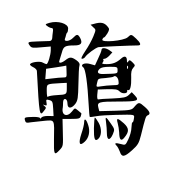
Character: Han
Kangxi stroke count: 21
Page 1497, Entry 03
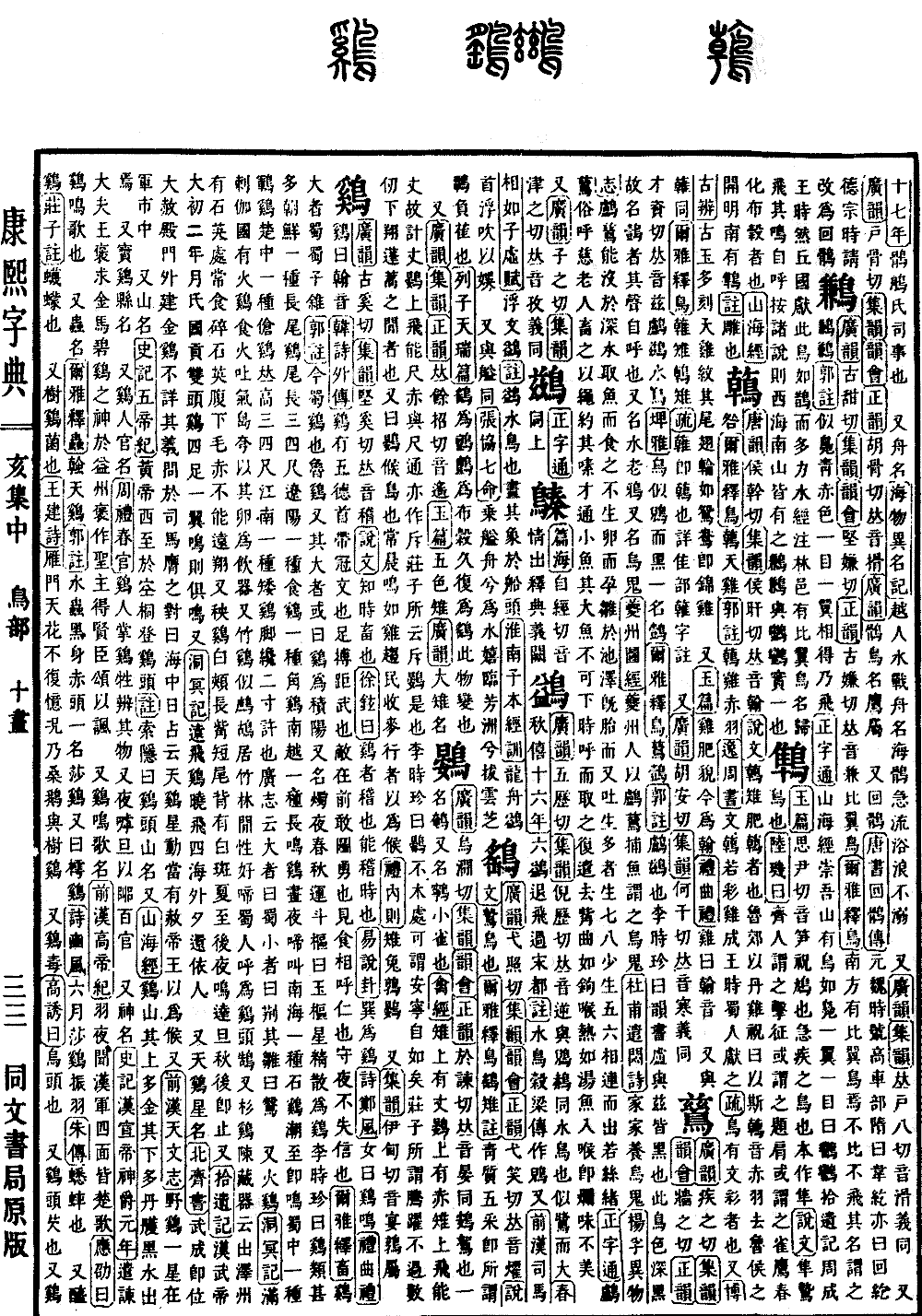
Pronounced han. According to the Analytical Dictionary of Characters (Shuowen Jiezi), this refers to a fat, robust wild pheasant. During the suburban sacrifices in the State of Lu, a crimson chicken was used for prayer, with the incantation: May the cry and red feathers of this bird remove the misfortunes of the Duke of Lu.
According to the Literary Expositor (Erya), in the section explaining birds, this is known as the heavenly chicken. The commentary by Guo notes that this chicken has red feathers. The Lost Book of Zhou (Yi Zhoushu) states that the patterned bird resembles a colorful chicken; it was offered as tribute by the people of Shu during the reign of King Cheng of Zhou. The commentary explains that this is a bird with patterned plumage.
Furthermore, according to the Examination of Antiquities (Bogu Bian), ancient jade artifacts often feature carvings of the heavenly chicken. Its tail and wing contours resemble those of a mandarin duck, which is also identified as a golden pheasant.
According to the Jade Chapters (Yupian), it describes a chicken that is fat and robust. It is now written as the character han. In the Record of Rites (Liji), specifically the section on summary rules of deportment, the chicken is referred to as the sounding-han.
It is also identical to the character huan. According to the Literary Expositor, the huan pheasant is a type of pheasant. The commentary explains that huan is the same as this character. See the detailed entry under the short-tailed bird radical for the character huan.
Pronounced han. The meaning is the same.