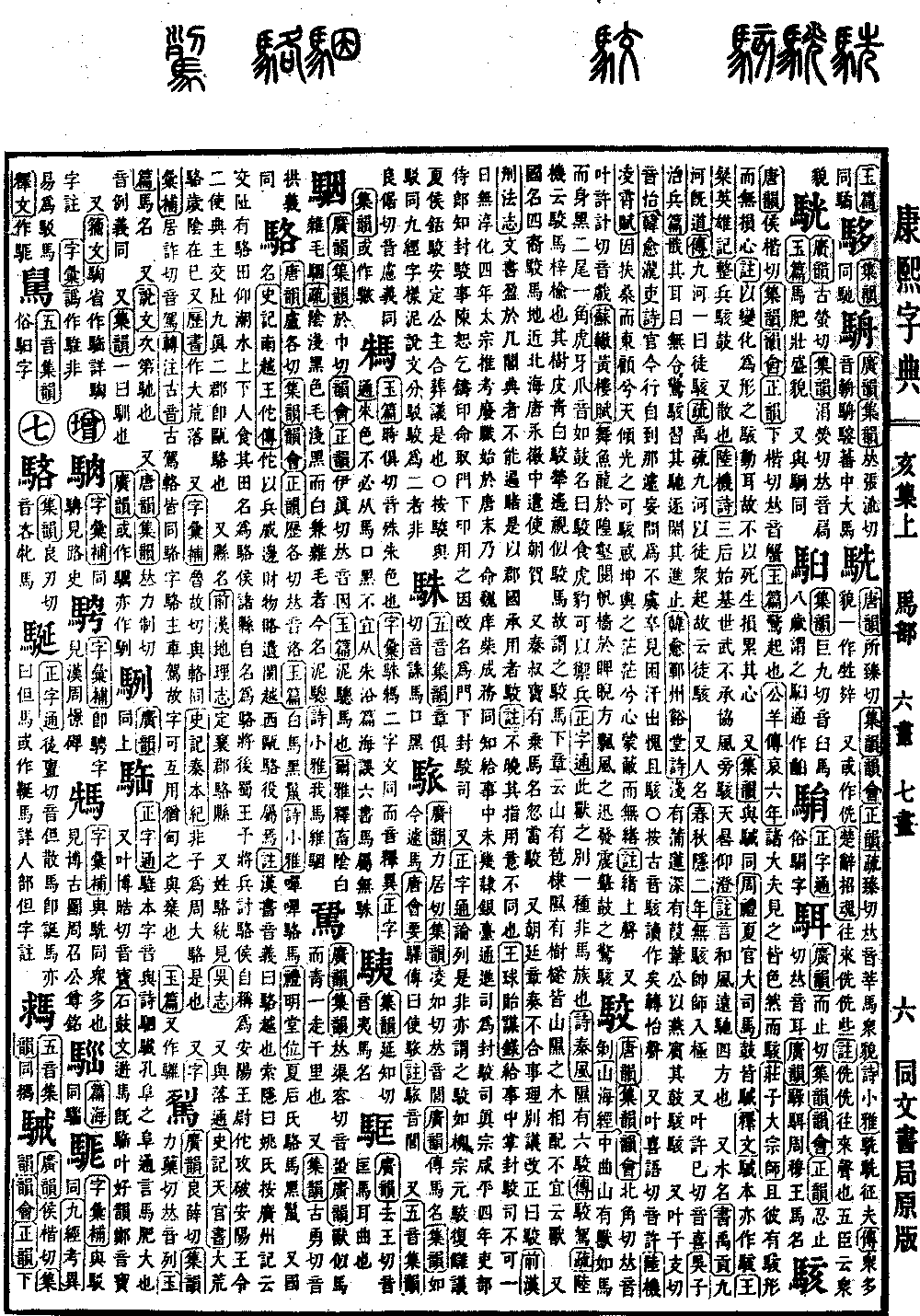
Hai Collection, Upper Volume
Radical: Horse (mǎ)
Entry: Hai
Kangxi strokes: 16
Page 1438, Entry 08
Pronounced xie (falling tone).
In Yupian (Jade Chapters), it means to startle or to be startled.
Gongyang Zhuan (Commentary of Gongyang) on the sixth year of Duke Ai: All the high officials saw this, and all changed their expressions in fear.
Zhuangzi (The Great and Venerable Teacher): He has a startled form but no damaged heart. Commentary: It means he considers the change of shape to be a startling movement, thus he does not let life or death damage or weary his heart.
Also, Jiyun (Collected Rhymes) notes it is the same as the variant character hai (pronounced hai).
Zhou Li (Rites of Zhou), Summer Ministry, Great Director of Horses: The drums all sounded with a startling crash.
Commentary: The original text of the sound gloss also uses hai (pronounced hai).
Wang Can, Heroic Records: Putting the troops in order and beating drums with a startling sound.
Also means to disperse.
Lu Ji poem: The three rulers established the foundation, the successive warriors greatly inherited it, the harmonious wind spread to the sides, and the sky’s sun was looked up to with clarity. Commentary: This refers to the harmonious wind blowing far into the four directions.
Also the name of a river.
Shang Shu (Classic of History), Tribute of Yu: The nine rivers were channeled. Commentary: Among the nine rivers, one is called Tuhai. Commentary: Yu channeled the nine rivers using the common people, therefore it is called Tuhai.
Also a name.
Spring and Autumn Annals (Chunqiu), second year of Duke Yin: Wuhai led the army to enter Ji.
Also rhymes with the sound xi (rising tone).
Wu Qi (Art of War), Chapter on Training Troops: Restrain their hearing and sight, do not let them be startled. Train them in riding and running, keep them practiced in advancing and stopping.
Han Yu, Yunzhou Xitang Poem: In the shallows there are reeds and lotus, in the depths there are rushes and reeds. The Duke entertains guests, and the drums sound with a startling beat.
Also rhymes with the sound yi (level tone).
Han Yu, Longli Poem: I am an official now and will arrive myself, why should I suddenly and recklessly ask why? I did not expect to be suddenly trapped, sweating from shame and fear. According to ancient pronunciation, hai is read as yi, shifting to the yi sound.
Also rhymes with the sound xu (rising tone).
Lu Ji, Lingxiao Fu (Rhapsody on Rising to the Heavens): Looking east toward the Fusang tree, the sun leans toward the sky, a sight to be feared. Confused by the vastness of the earth, my heart is clouded and without order. Commentary: Xu is in the rising tone.
Also rhymes with the sound xi (falling tone).
Su Zhe, Huanglou Fu (Rhapsody on the Yellow Tower): Dancing fish and dragons in the moats and gullies, inspecting the sails and masts at the ramparts. Suddenly a fierce wind arises, shaking the drums with a startling sound.
Textual research: In the poem by Lu Ji, the text reads greatly inherited instead of not inherited. I have corrected the text to greatly inherited accordingly.