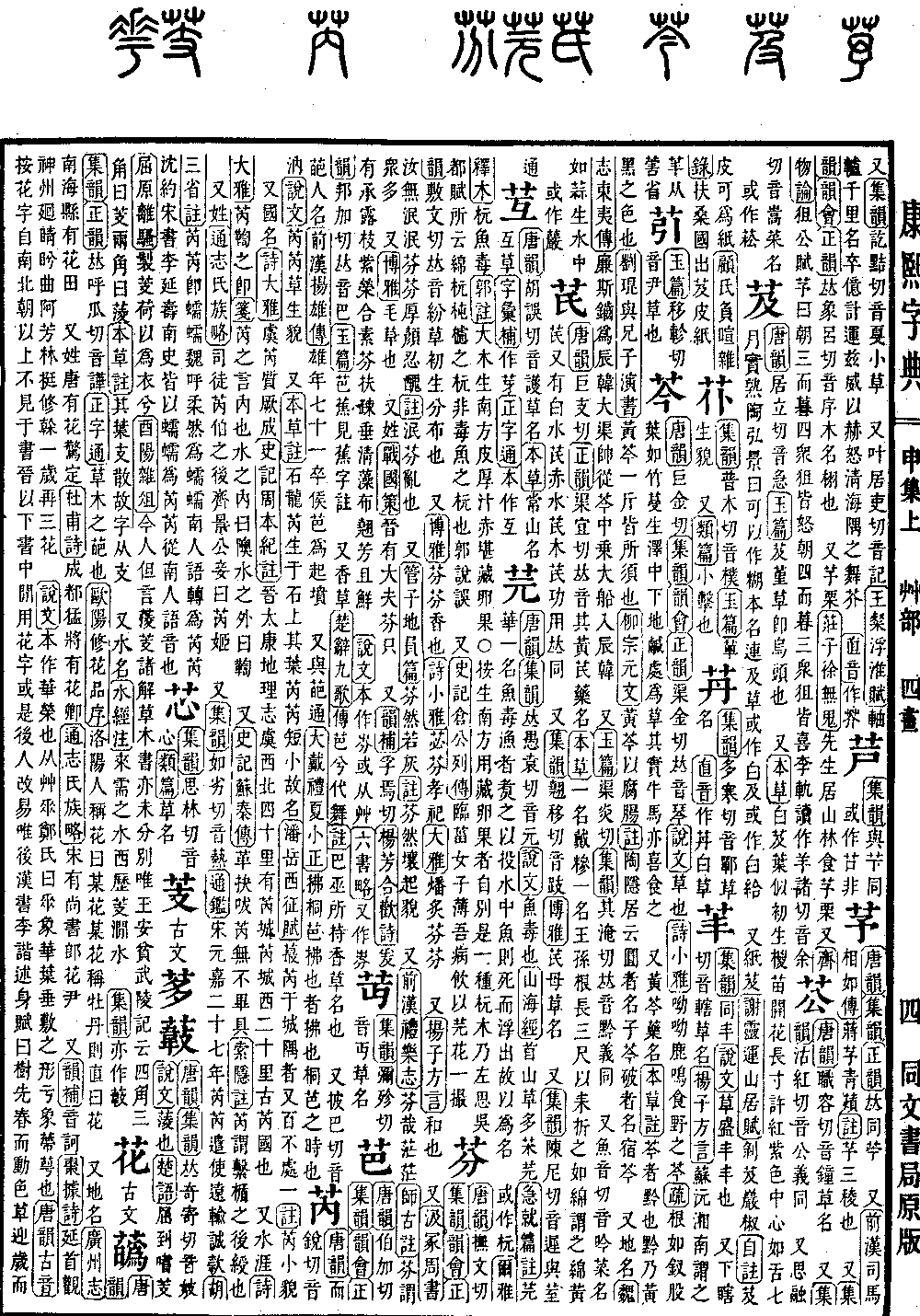
Shen Collection, Upper Volume
Radical: Grass (cǎo)
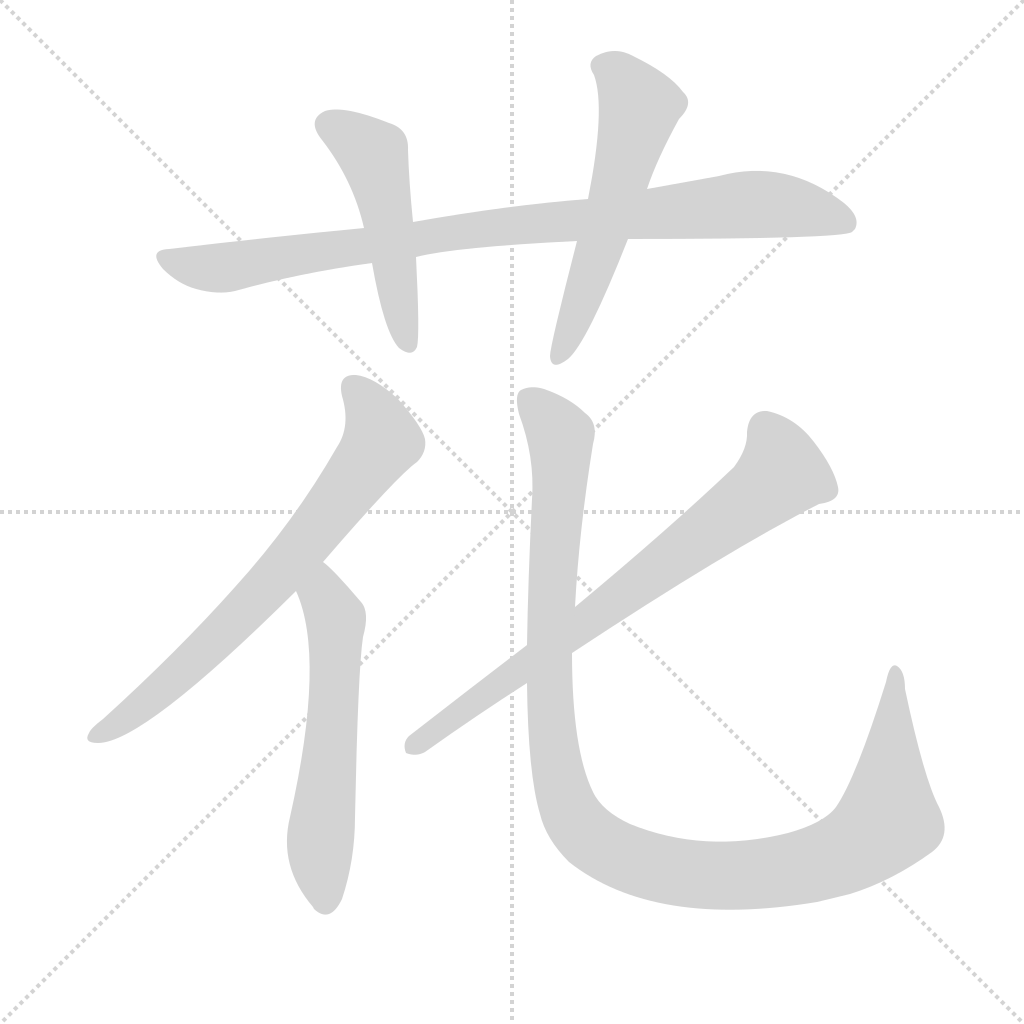
Character: Flower
Kangxi Strokes: 10
Page 1020, Entry 21
Ancient form written as (huā).
According to Tang Rhymes (Tangyun), Collected Rhymes (Jiyun), and Correct Rhymes (Zhengyun), it is pronounced hua.
Correct Compendium of Characters (Zhengzitong) explains it as the blossoms of plants and trees.
Ouyang Xiu, Preface to the Record of Flowers (Huapinxu) records: The people of Luoyang refer to flowers by specific names, but when speaking of the peony, they simply call it the flower.
There is also usage as a place name. Guangzhou Records (Guangzhouzhi) records: Nanhai County has Flower Field.
There is also usage as a surname. During the Tang dynasty, there was Hua Jingding. Du Fu’s poetry contains the line: In Chengdu, the fierce general is Lord Hua. Comprehensive Record (Tongzhi), Clan Biographies (Shizulue) records: During the Song dynasty, there was the Minister Hua Yin.
Also, according to Rhyme Supplement (Yunbu), it is pronounced he. Zao Ju’s poetry writes: Stretching the neck to gaze at the Divine Land, turning the head to gaze upon the winding river. Fragrant trees stand with long branches, flowering many times within a year.
Discussion of Writing and Explanation of Characters (Shuowen Jiezi) originally wrote it as (huá). It means glory or splendor. The character structure is from the Grass radical. Zheng says: The form resembles the shape of flower petals and leaves hanging down, with the (kuī) component symbolizing the flower base and calyx.
Tang Rhymes Ancient Sounds (Tangyunguyin) observes: The character for flower is not seen in literature prior to the Southern and Northern Dynasties. It appears occasionally in books after the Jin dynasty, perhaps modified or substituted by later generations. Only in the Book of the Later Han (Houhanshu), Li Xie, Essay on Describing the Self (Shushenfu), is it written: Trees already glow with color before spring arrives, plants and trees welcome the new year and bloom with flowers. It further writes: Fully express the rich meaning of beautiful prose, and savor the essence of literary art. Here, the character for flower is used interchangeably with the character for splendor (huá). However, the Five Classics, the works of the various philosophers, the Songs of Chu (Chuci), and books from the pre-Qin and Han periods have all been transmitted in ancient scripts, and none of the original characters for splendor (huá) have been changed to the character for flower. Researching the reign of Emperor Taiwu, in the second year of the Shiguang era, over one thousand new characters were first created and promulgated to all regions as writing standards. Could characters like the flower character be newly created characters from the Wei and Jin dynasties onwards?