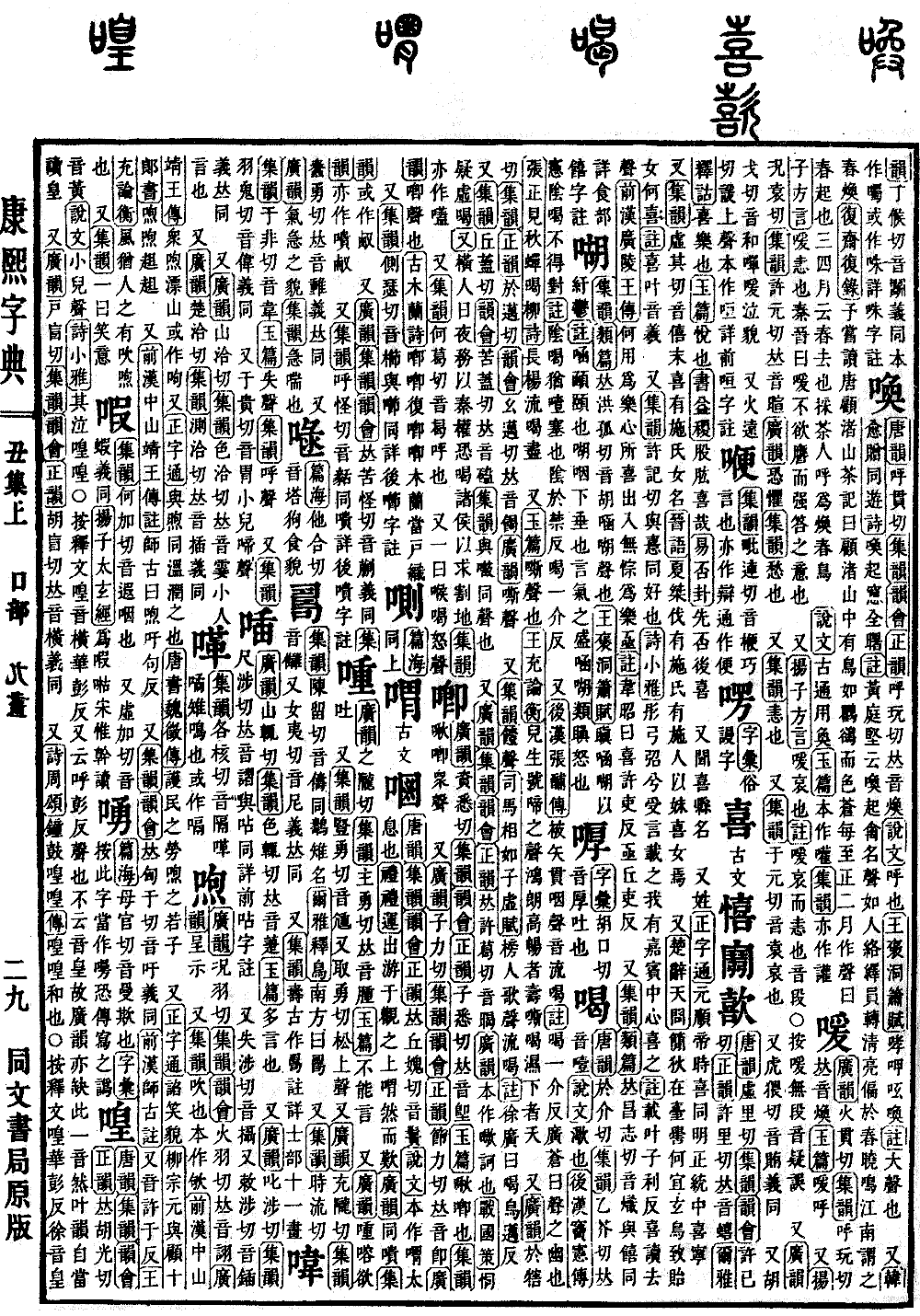
Chou Collection, Upper Volume
Radical: Mouth (kǒu)
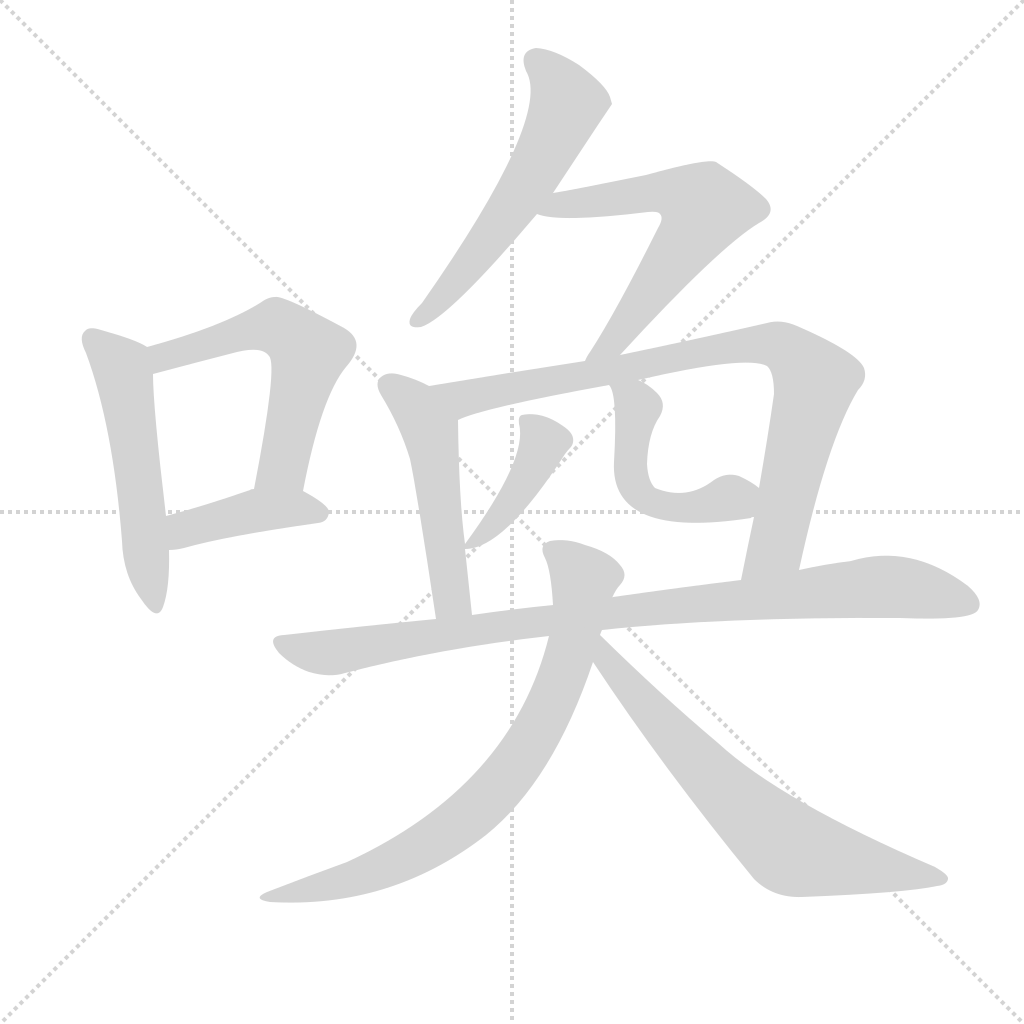
Huan
Kangxi strokes: 12
Page 199, Entry 01
Pronounced huan
According to the Shuowen Jiezi (Shuowen), it means to call out.
In the Rhapsody on the Bamboo Flute (Dongxiao Fu) by Wang Bao, it is written: howls, gasps, and calls. The commentary states: it refers to a loud sound.
Also, in the poem Gift to Fellow Travelers by Han Yu, it is written: calling out as the window grows bright. The commentary notes: Huang Tingjian stated: Call-out is the name of a bird; its sound resembles a human voice, continuous and melodious, typically singing at the arrival of spring; in the Jiangnan region, it is called the Spring-Huan.
In the Fuzhai Fulu, it is recorded: I once read the Tang dynasty Record of Gu Zhu Mountain Tea, which states: In Gu Zhu Mountain, there is a bird resembling a myna but gray in color. Every first or second lunar month, it makes a sound saying, Spring has arrived. In the third or fourth month, it says, Spring has departed. Tea pickers call it the Spring-Huan bird.
The Shuowen Jiezi notes that in ancient times it was also written as huan.
The Yupian dictionary states the original form was huan.
The Jiyun dictionary notes it is also written as huan.