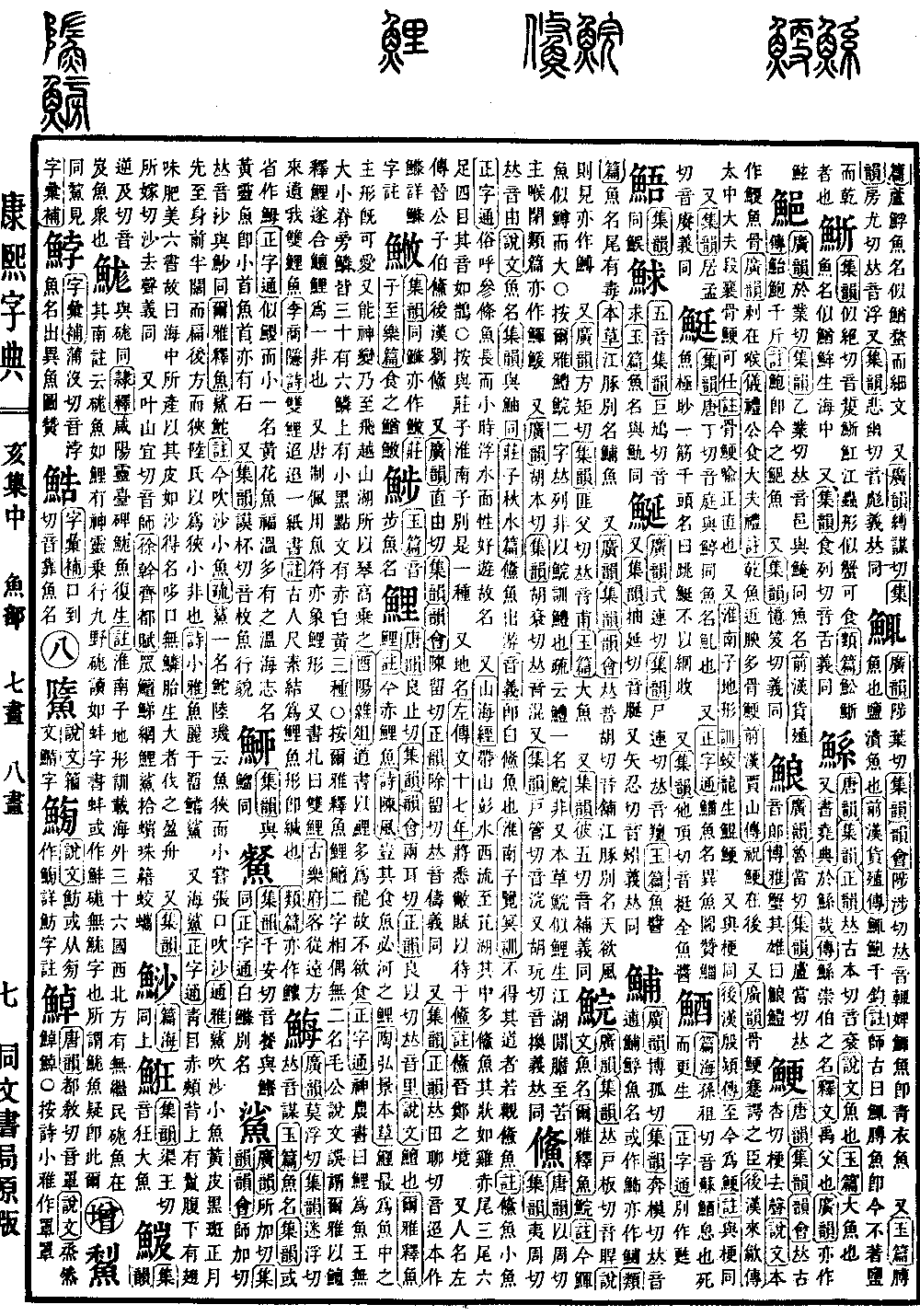
Hai Collection, Middle Volume
Radical: Fish (yú)
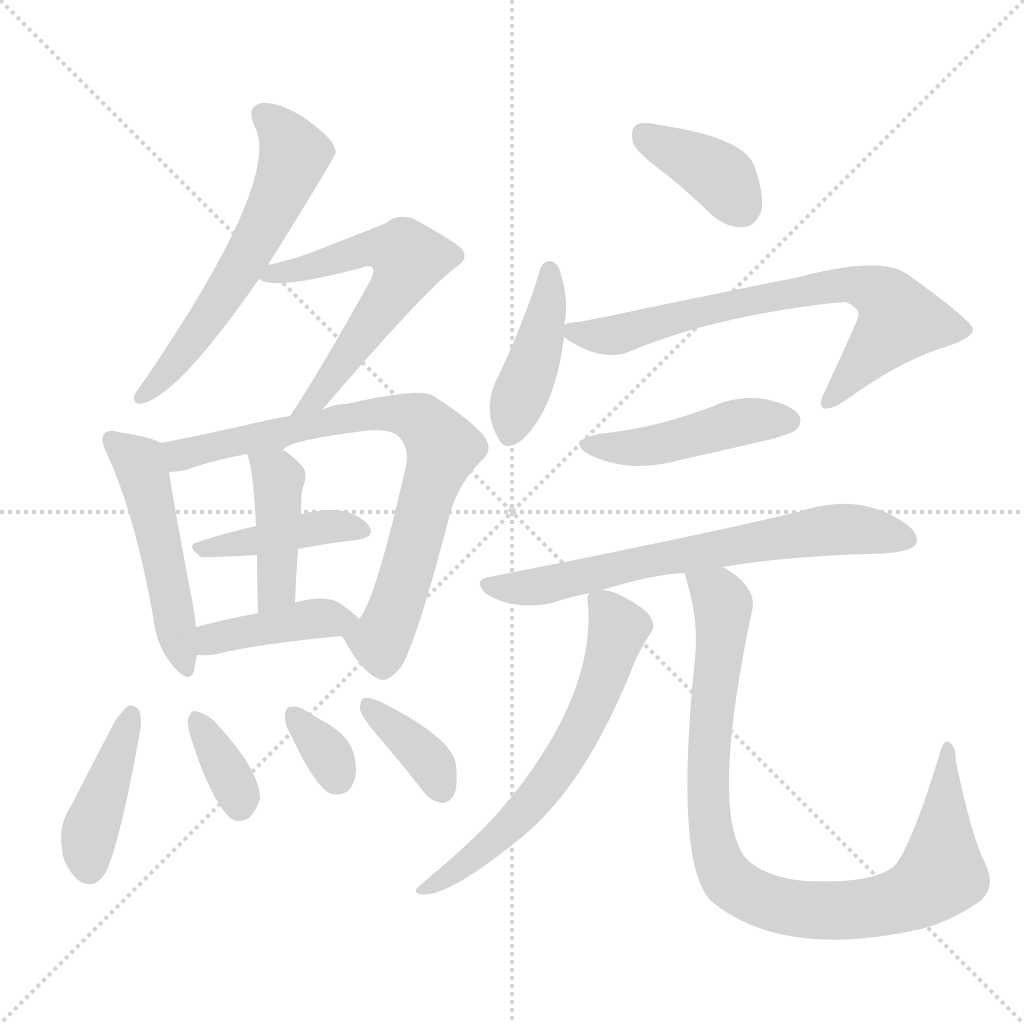
Character: Huan
Kangxi strokes: 18
Page 1471, Entry 13
According to the Extensive Rhymes (Guangyun) and Collected Rhymes (Jiyun), pronounced huan (falling-rising tone), with the same sound as huan (falling-rising tone).
According to the Explaining Graphs and Analyzing Characters (Shuowen), it is the name of a type of fish.
According to the Erya, Explaining Fishes (Erya, Shiyu), it is recorded as huan. The commentary notes that it is the fish known today as the grass carp, which resembles the trout but is larger in size. Note: In the Erya, the characters for snakehead and grass carp are listed separately; the latter is not used to explain the former. The sub-commentary states that the snakehead is also called grass carp, which is incorrect.
Also, the Materia Medica (Bencao) records: The grass carp resembles the carp, lives in rivers and lakes, has a very bitter gall, and is used to treat throat obstructions.
The Categorized Chapters (Leipian) also writes it as huan or huan.
Also, according to the Extensive Rhymes (Guangyun), pronounced hun (falling tone); according to the Collected Rhymes (Jiyun), pronounced hun (rising tone), with the same sound as hun (rising tone).
Also, according to the Collected Rhymes (Jiyun), pronounced huan (falling tone), with the same sound as huan (falling tone).
Also pronounced huan (falling tone), with the same sound as huan (falling tone). The meanings are the same.