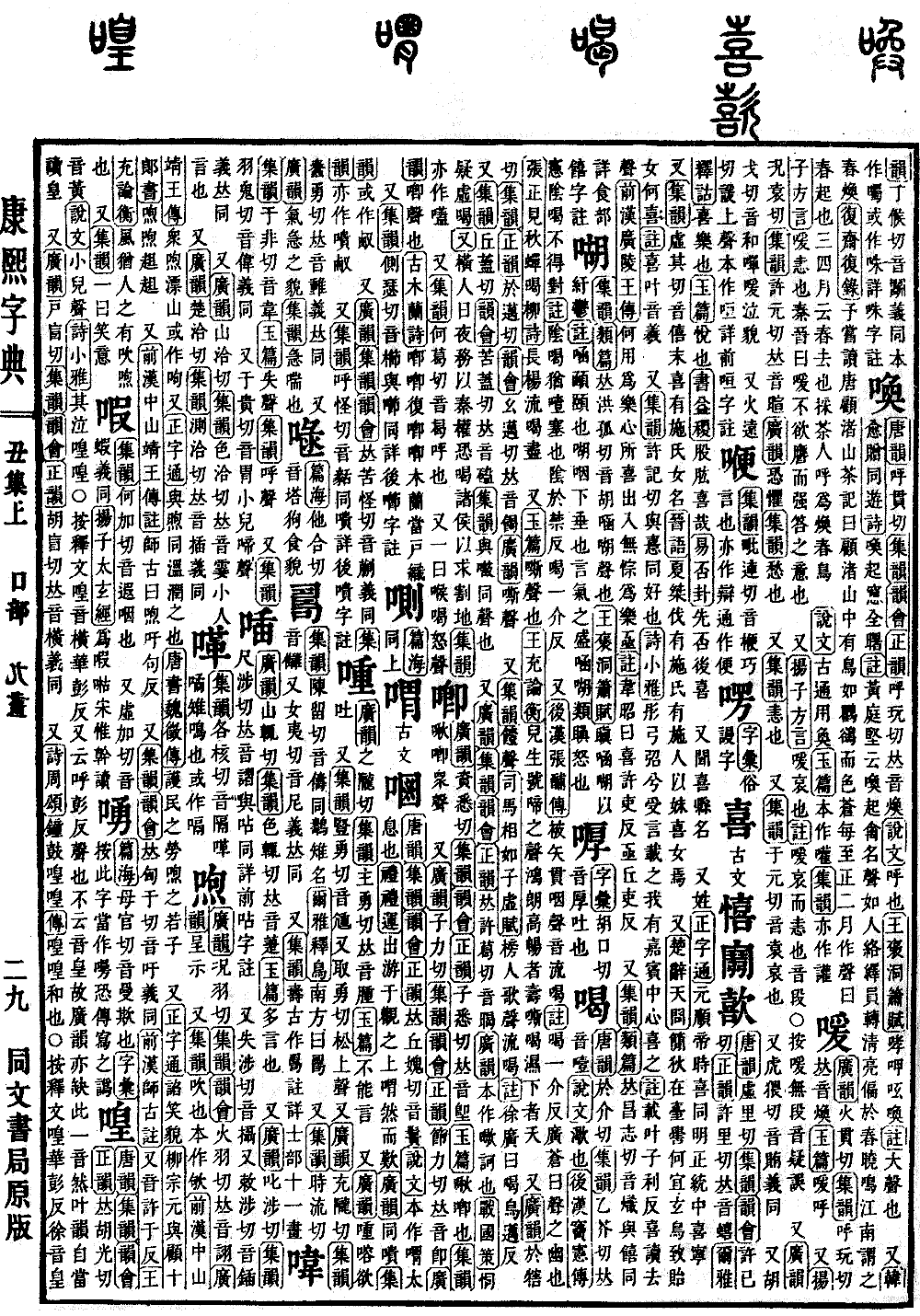
Chou Collection, Upper Volume
Radical: Mouth (kǒu)
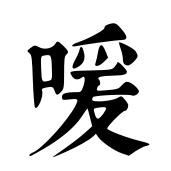
Huan
Kangxi strokes: 12
Page 199, Entry 02
According to the Extensive Dictionary of Sounds and Meanings (Guangyun), it is pronounced huan. According to the Collected Rimes (Jiyun), it is pronounced huan. The pronunciation is the same as huan.
The Jade Pieces (Yupian) defines it as a sound of sighing.
Also appearing in Master Yang's Dialects (Fangyan): huan indicates resentment. In the Qin and Jin regions, people say huan, referring to a reluctant response without a genuine desire to answer.
Also appearing in Master Yang's Dialects (Fangyan): huan indicates sorrow.
Note: huan means sorrow and resentment, and is pronounced duan. Editor's note: huan does not have the pronunciation duan; this is suspected to be an error.
Also according to the Extensive Dictionary of Sounds and Meanings (Guangyun), it is pronounced xuan. According to the Collected Rimes (Jiyun), it is pronounced xuan. The pronunciation is the same as xuan.
The Extensive Dictionary of Sounds and Meanings (Guangyun) defines it as fear.
The Collected Rimes (Jiyun) defines it as anxiety.
Also, the Collected Rimes (Jiyun) defines it as resentment.
Also, according to the Collected Rimes (Jiyun), it is pronounced yuan. It expresses sorrow.
Also, it is pronounced hui. The meaning is the same.
Also, it is pronounced he. It refers to the phrase tan huan, describing the appearance of weeping.
Also, it is pronounced xuan (rising tone). The original character is huan. See the detailed entry for the character huan previously provided.