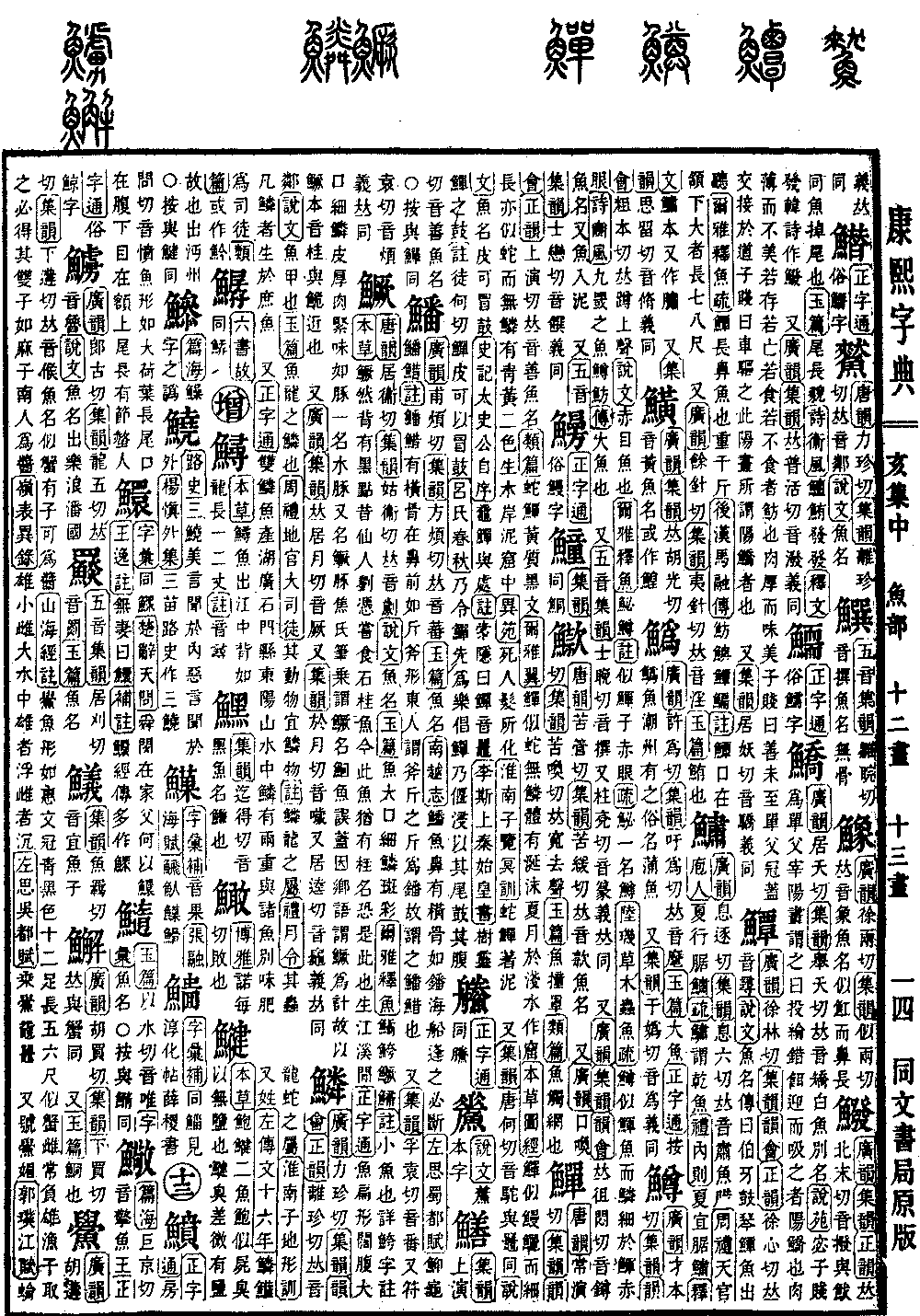
Hai Collection, Middle Volume
Radical: Fish (yú)
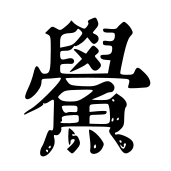
Character: Horseshoe crab (hòu)
Kangxi strokes: 24
Page 1478, Entry 40
According to the Extensive Rhymes (Guangyun), pronounced hou (falling tone); according to the Collected Rhymes (Jiyun), pronounced hou (falling tone). The name of a fish. It resembles a crab, and its roe can be made into a paste.
According to the Commentary to the Classic of Mountains and Seas (Shanhaijing zhu), the horseshoe crab resembles a Huiwen-style ceremonial cap; it is blue-black, has twelve legs, and measures five or six feet in length. It resembles a crab, and the female often carries the male on its back. When fishermen catch one, they are sure to get a pair. Its roe resembles hemp seeds; people in the south use it to make paste.
According to the Records of Strange Things from Beyond the Southern Mountains (Lingbiao yilu), the male is small and the female is large; in the water, the male floats while the female sinks.
According to Zuo Si in the Rhapsody on the Capital of Wu (Wudu fu), one rides on horseshoe crabs, soft-shelled turtles, and crocodiles. It is also called houmei.
According to Guo Pu in the Rhapsody on the Yangtze River (Jiang fu), it is referred to as luhoumei.
Also, according to the Extensive Rhymes (Guangyun) and the Collected Rhymes (Jiyun), pronounced wo (falling tone).
Also, according to the Collected Rhymes (Jiyun) and the Correct Rhymes (Zhengyun), pronounced gou (falling tone).
Also, according to the Collected Rhymes (Jiyun), pronounced wo (entering tone). The meanings are the same.