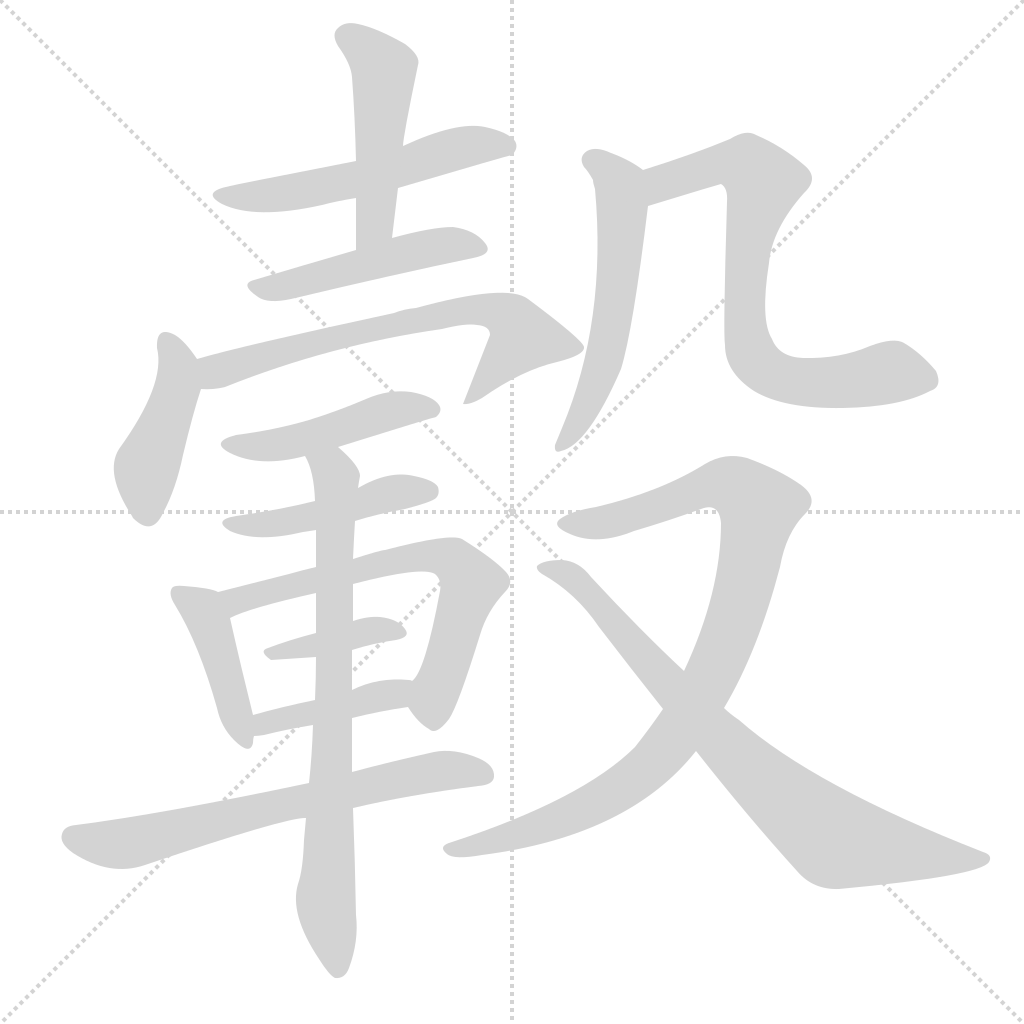
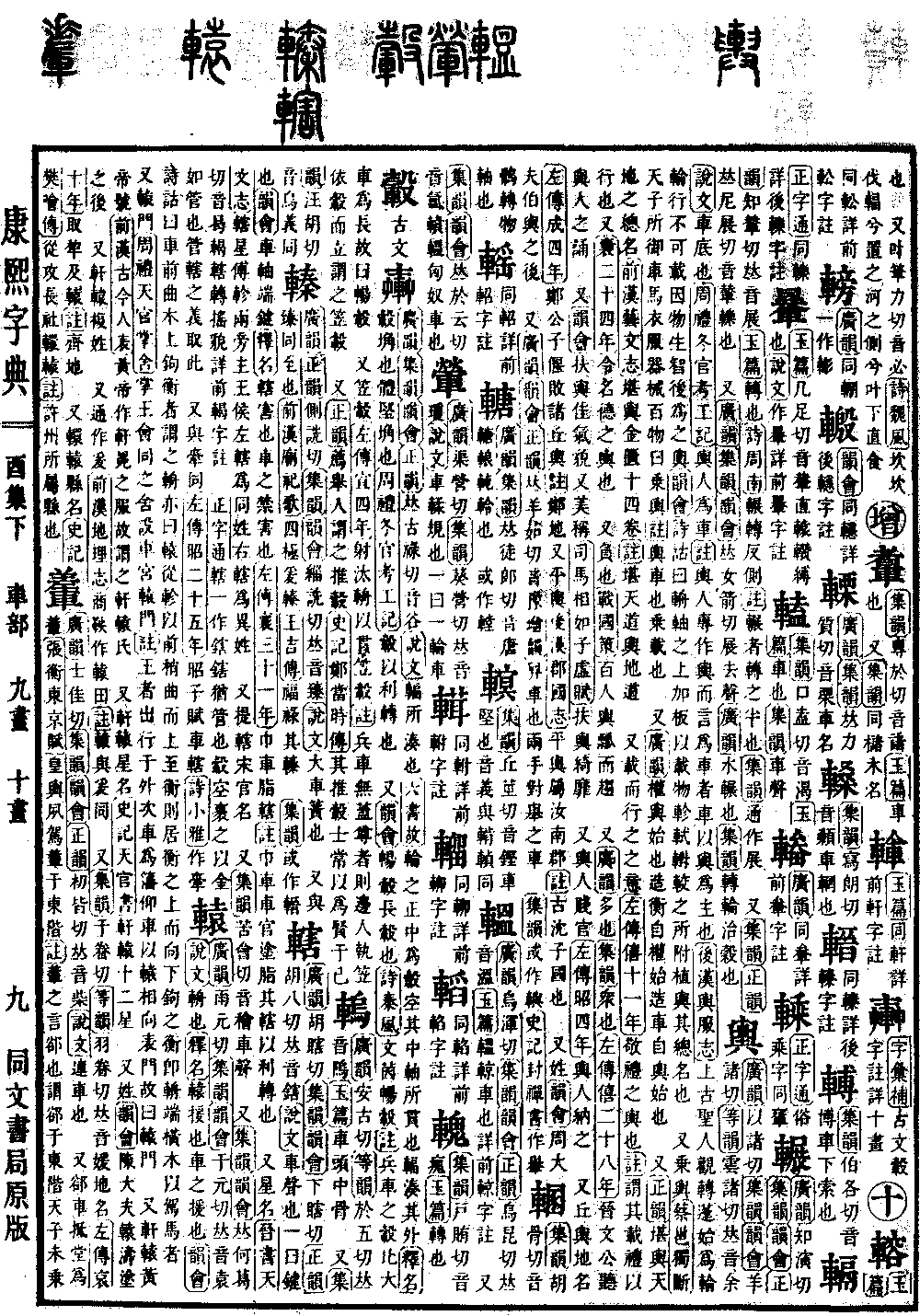
You Collection, Lower Volume
Radical: Carriage (chē)
Gǔ
Kangxi Strokes: 17
Page 1247, Entry 28
Ancient textual records:
Broad Rhymes (Guangyun), Collection of Rhymes (Jiyun), Rhyme Compilation (Yunhui), and Orthodox Rhymes (Zhengyun) state the pronunciation is gu.
Explication of Written Characters (Shuowen Jiezi) defines it as the central part of the wheel where the spokes gather.
Explication of the Six Writings (Liushu Gu) explains that the very center of a carriage wheel is called the hub, which is hollow in the middle to accommodate the axle, while the outer circumference is where the spokes converge.
Explanation of Names (Shiming) explains that the meaning of hub is hardness and firmness, due to its solid texture.
Record of Trades (Kaogongji) within the Rites of Zhou (Zhouli) mentions that the function of the wheel hub is to allow the wheel to rotate smoothly.
Additionally, the Rhyme Compilation (Yunhui) records that a long hub refers to an extended wheel hub.
Book of Odes (Shijing) in the Odes of Qin (Qin Feng) contains the phrase, "Patterned cushions and long hubs."
Commentary explains that the wheel hubs of chariots are longer than those of common carts, hence they are called long hubs.
There is also the term, umbrella hub.
The Zuo Tradition (Zuo Zhuan), in the fourth year of Duke Xuan, records, "Shooting at the carriage pole to pierce the umbrella hub."
Commentary explains that military chariots lacked covers; honorable individuals would have attendants hold a bamboo hat while leaning against the hub, which is known as an umbrella hub.
Additionally, the Orthodox Rhymes (Zhengyun) records that recommending and promoting talented individuals is called pushing the hub.
Records of the Grand Historian (Shiji), in the Biography of Zheng Dangshi, mentions that when he recommended talented people, he often considered them more capable than himself.