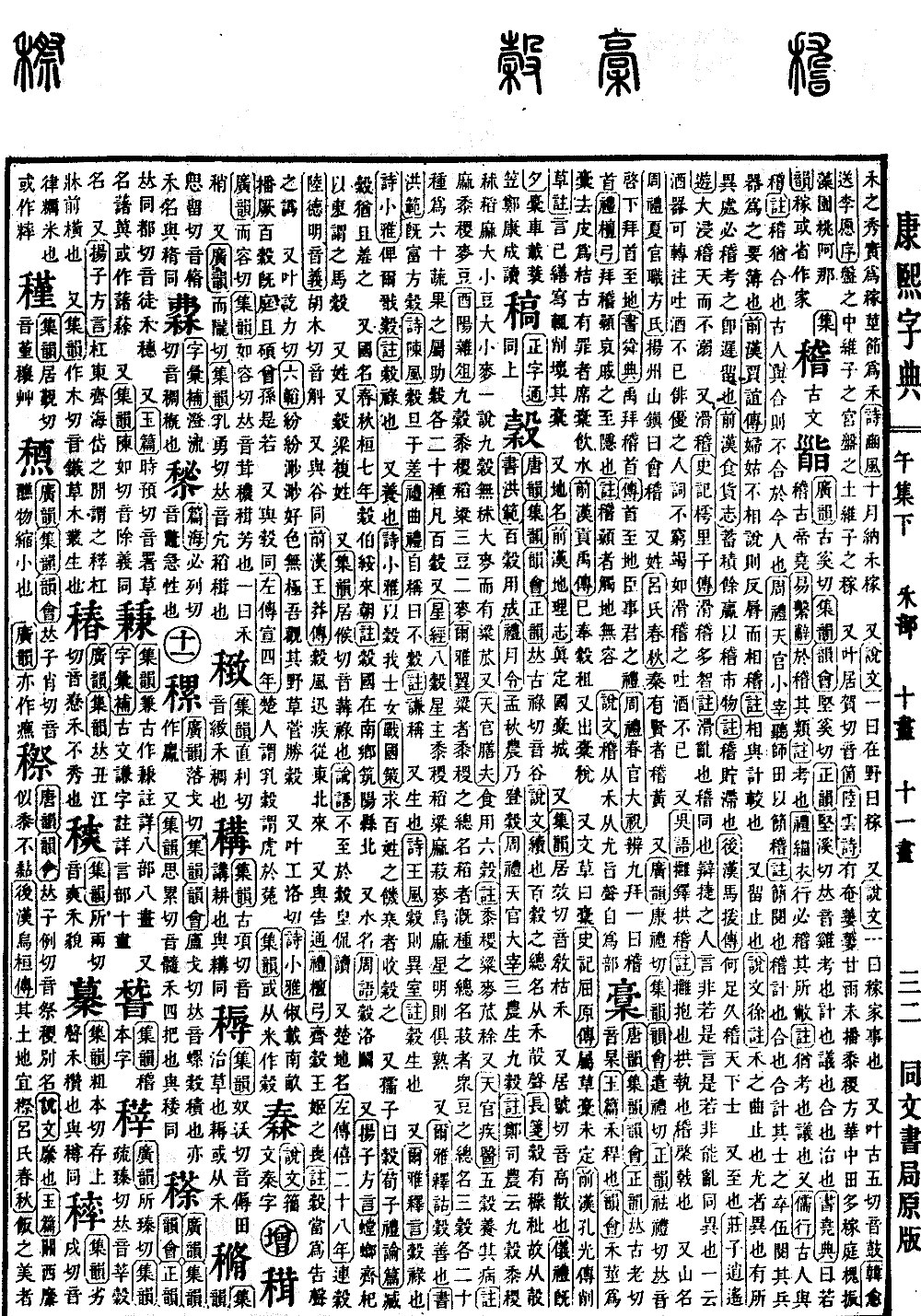
Wu Collection, Lower Volume
Radical: Grain (hé)
Page 858, Entry 05
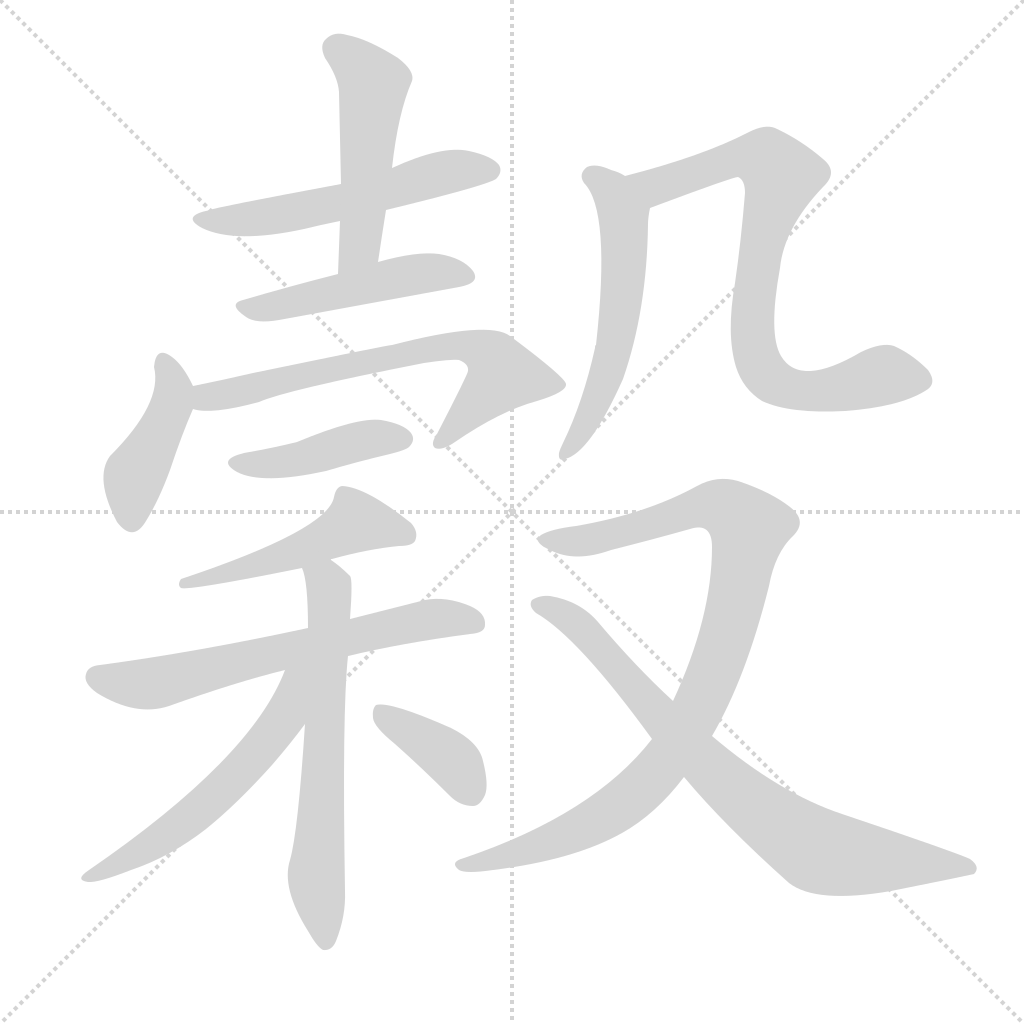
Pronounced gu.
According to the Shuowen Jiezi (Explanation of Simple and Compound Characters), it means to continue. It is the collective name for all grains. Formed from the grain radical, with a phonetic indicator.
According to the Changjian (Long Commentary), grain contains chaff and husk, hence the radical.
Book of Documents (Shangshu): The hundred grains are thus brought to fruition.
Book of Rites (Liji): In the first month of autumn, the farmers harvest the grain.
Rites of Zhou (Zhouli): The three categories of farmers produce the nine grains. The commentary by Zheng Sinong states: The nine grains are broomcorn millet, proso millet, glutinous millet, rice, hemp, large and small beans, and large and small wheat. Another theory states the nine grains exclude glutinous millet and large wheat, but include kaoliang and wild rice.
Rites of Zhou (Zhouli): Food utilizes the six grains. The commentary lists: broomcorn millet, proso millet, kaoliang, wheat, wild rice, and glutinous rice.
Rites of Zhou (Zhouli): The five grains nourish the illness. The commentary lists: hemp, broomcorn millet, proso millet, wheat, and beans.
Youyang Zazu (Miscellaneous Morsels from Youyang): The nine grains are broomcorn millet, proso millet, rice, and kaoliang, with three types of beans and two types of wheat.
Erya Yi (Expanded Erya): Liang is the collective name for broomcorn and proso millet. Rice is the collective name for irrigated crops. Shu (legumes) is the collective name for various beans. Each of these three categories of grains has twenty varieties, totaling sixty; together with twenty types of vegetables and twenty types of fruits, these constitute the hundred grains.
According to the Xing Jing (Classic of Stars), the Eight Grains star oversees broomcorn millet, proso millet, rice, kaoliang, hemp, legumes, wheat, and black sesame; if the star is bright, all these will ripen.
According to the Erya (Approaching Elegance), the classic lexicon, grain means good.
Book of Documents (Shangshu): Once you are wealthy, you should be good.
Book of Odes (Shijing): On this good morning, the time is set.
Book of Rites (Liji): Referring to oneself as not-good (bu gu). The commentary explains this as a humble term.
It also means to live.
Book of Odes (Shijing): To live in different rooms. The commentary states: Gu means to live.
According to the Erya (Approaching Elegance), it means salary or prosperity.
Book of Odes (Shijing): Bestowing upon you happiness and prosperity. The commentary states: Gu means salary.
It also means to nurture.
Book of Odes (Shijing): To nurture our men and women.
Strategies of the Warring States (Zhan Guo Ce): Seeking out those among the people suffering from hunger and cold to nurture them.
A young child is also called gu.
Xunzi (Master Xun): Zang and Gu would still be ashamed of it.
Name of a state.
Spring and Autumn Annals (Chunqiu): The Earl of Gu, Sui, came to pay homage. The commentary states: The State of Gu was located north of Zhuyang County in Nanxiang.
Name of a river.
Discourses of the States (Guoyu): The Gu and Luo rivers flow into each other.
According to the Fangyan (Regional Speech), the praying mantis is called ma-gu in the regions east of Qi and Qi.
Also a surname.
Guliang is a double-surname.
Also pronounced gou. Meaning salary.
Analects (Lunyu): Not concerned with salary. As read by Huang Kan.
Name of a place in Chu.
Zuo Commentary (Zuozhuan): Lian-gu. Lu Deming in his Sound and Meaning notes it is pronounced hu.
Also used interchangeably with gu.
History of the Former Han (Qianhan): The strong east wind came from the northeast.
Also used interchangeably with gao (to announce).
Book of Rites (Liji): Performing the mourning rites for the Princess of the King. The commentary states: Gu should be read as gao, due to a phonetic error.
Also rhymes with the sound ji (entering tone).
Six Secret Teachings (Liutao): Vast and drifting, the indulgence in beauty is without end. I look upon the fields, and the reeds and weeds overcome the grain.
Also rhymes with the sound luo (entering tone).
Book of Odes (Shijing): Starting work on the southern fields, sowing their hundred grains. They are orderly and large, and the grandson follows these.
Also used as the same character.
Zuo Commentary (Zuozhuan): The people of Chu call nursing gu, and call a tiger tu-tu.
According to the Jiyun (Rhyme Collection), it is sometimes written with the rice radical.