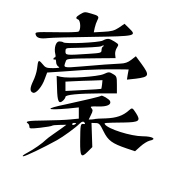
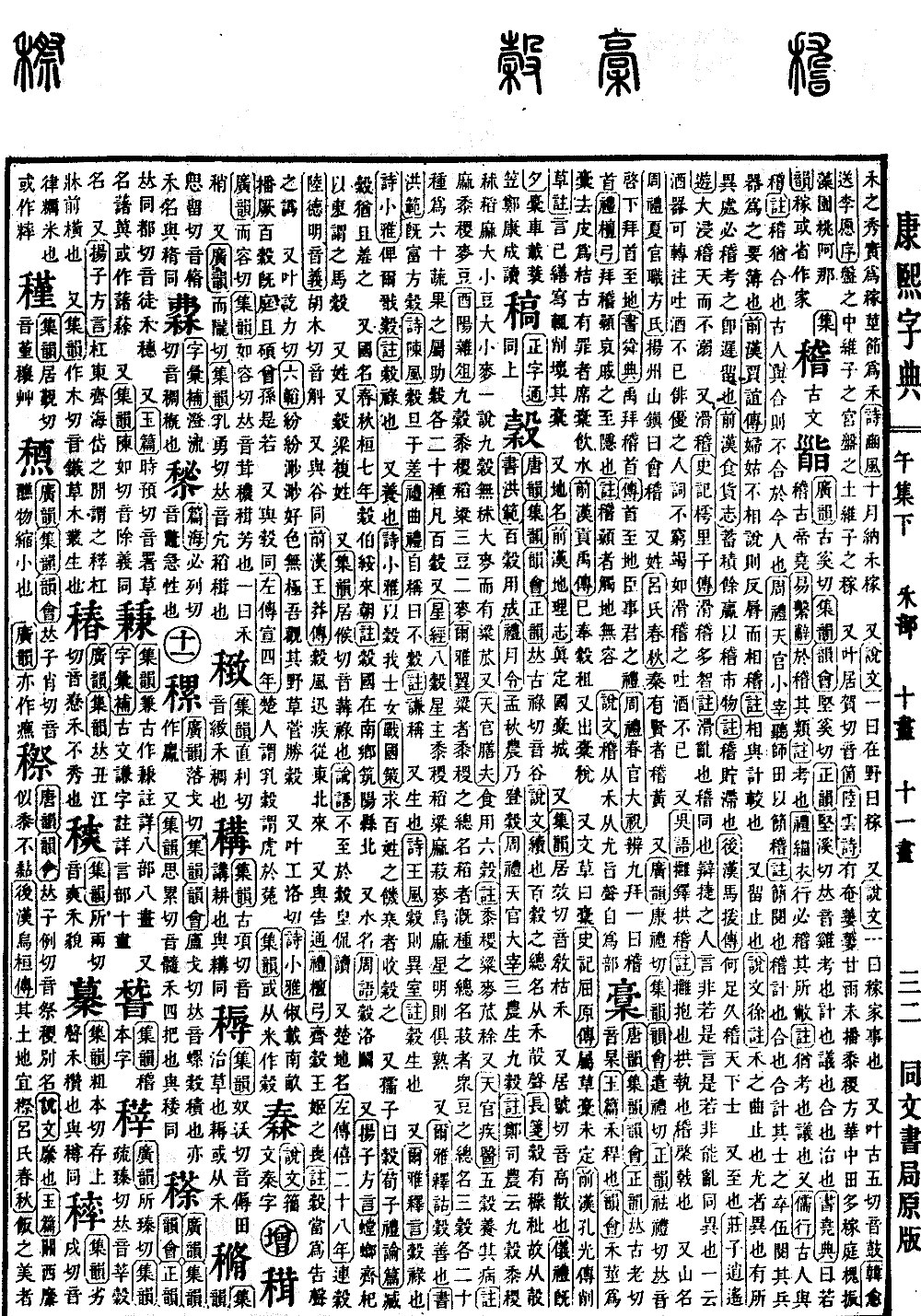
Wu Collection, Lower Volume
Radical: Grain (hé)
Gao
Kangxi Strokes: 15
Page 858, Entry 03
According to the Tang Rhyme (Tangyun), Collected Rhymes (Jiyun), Rhyme Treasury (Yunhui), and Orthodox Rhymes (Zhengyun), it is pronounced gao, with the same sound as gao.
According to the Jade Chapters (Yupian), it refers to grain stalks. The Rhyme Treasury states that grain stems are called gao, and when the skin is removed, they are called jie. In ancient times, those who committed crimes sat on straw stalks (gao) to drink water.
In the Biography of Gong Yu from the History of the Former Han (Qianhan Shu), it mentions that after paying grain taxes, one must also pay a tax on stalks (gao).
It also refers to a manuscript. In the Biography of Qu Yuan from the Records of the Grand Historian (Shiji), it states the manuscript had not yet been finalized.
In the commentary on the Biography of Kong Guang from the History of the Former Han, it explains that once a text was finalized, the original draft (gao) was scraped clean or destroyed.
It is also the name of a place. The Treatise on Geography in the History of the Former Han records a Gaocheng in the Zhending Kingdom.
According to the Collected Rhymes (Jiyun), it is also pronounced jiao, referring to withered grain.
It is also pronounced gao, meaning to scatter or spread out. In the Book of Etiquette and Ceremonial (Yili), the gao cart carries rain capes and hats made of bamboo strips. Zheng Kangcheng reads it this way.