You Collection, Lower Volume
Radical: Wine (yǒu)
Kangxi strokes: 12
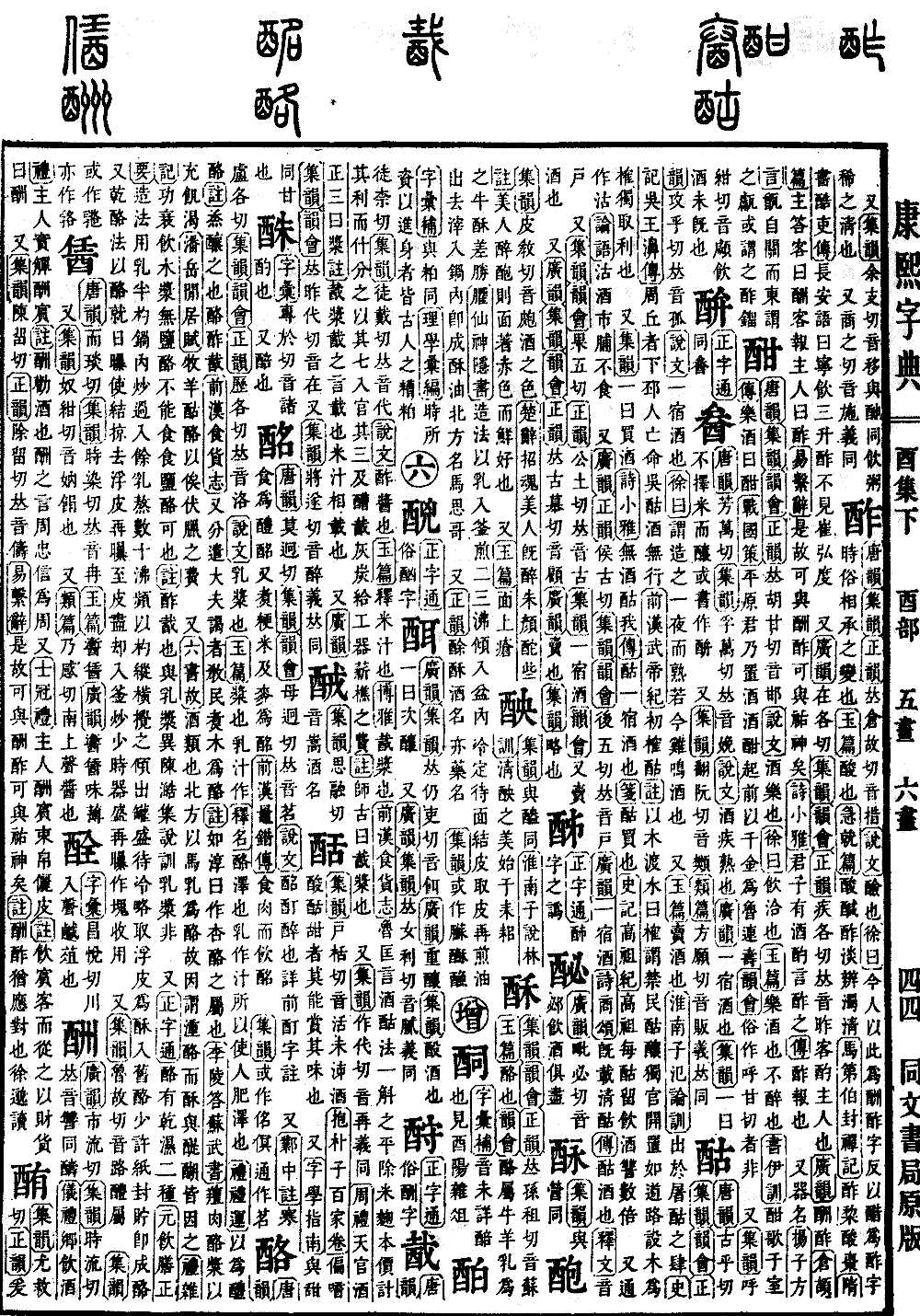
Page 1282, Entry 05
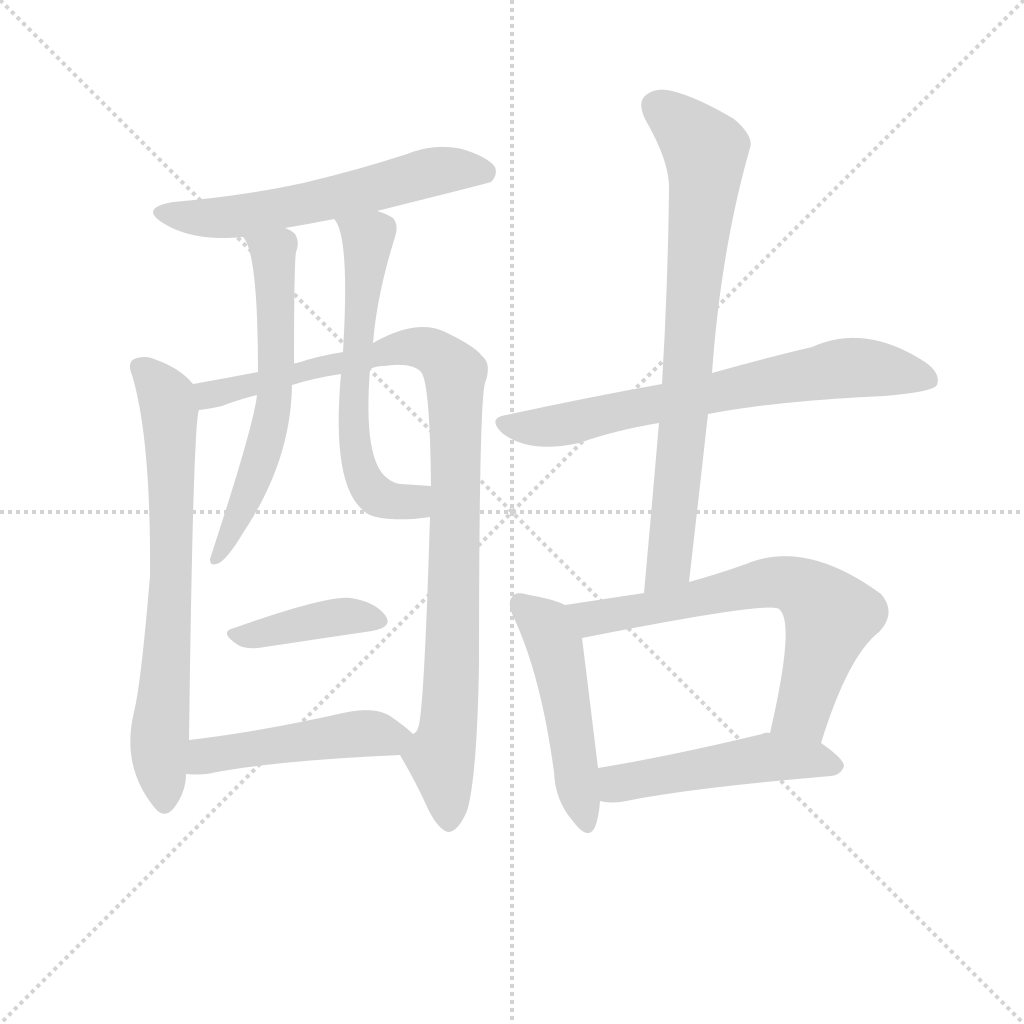
Pronounced gu.
According to the Shuowen Jiezi (Shuowen), it refers to wine fermented for one night. Xu Kai states it means that it is brewed for one night and becomes ready, similar to what is now called cock-crow wine.
It also means to sell wine. In the Huainanzi (Huainanzi), it says: Originated from the stalls of butchers and wine sellers. In the Records of the Grand Historian (Shiji), Biography of King Bi of Wu, it says: Zhou Qiu was a man from Xiapi who fled to Wu and sold wine without proper conduct. In the Book of Han (Hanshu), Annals of Emperor Wu, it says: Initially, the government monopolized wine sales. The commentary explains that bridge-building over water is called que; it means forbidding the common people from brewing wine and having the government alone open such shops, like setting up a bridge on a road to collect all the profit for oneself.
Also, according to the Yupian, it means to buy wine. In the Book of Odes (Shijing), it says: There is no wine to buy for me. The commentary explains that gu means wine fermented for one night. The Mao commentary says: Gu means to buy. In the Records of the Grand Historian (Shiji), Annals of Gaozu, it says: Every time Gaozu bought wine and stayed to drink, the payment was several times the usual amount.
It is also commonly written in the variant form gu (gū). In the Analects (Lunyu), it says: He would not eat wine bought at a market or dried meat from a market.
Pronounced hu. According to the Guangyun, it means wine fermented for one night. In the Book of Odes (Shijing), Eulogies of Shang, it says: The clear wine is already ladled. The commentary says: Gu means wine. The explanation of the text says the pronunciation is hu.
Pronounced gu. According to the Jiyun, it means wine fermented for one night. The Rhyme Dictionary (Yunhui) also defines it as selling wine.
Pronounced gu. According to the Guangyun, it means to sell. According to the Jiyun, it means to be negligent.