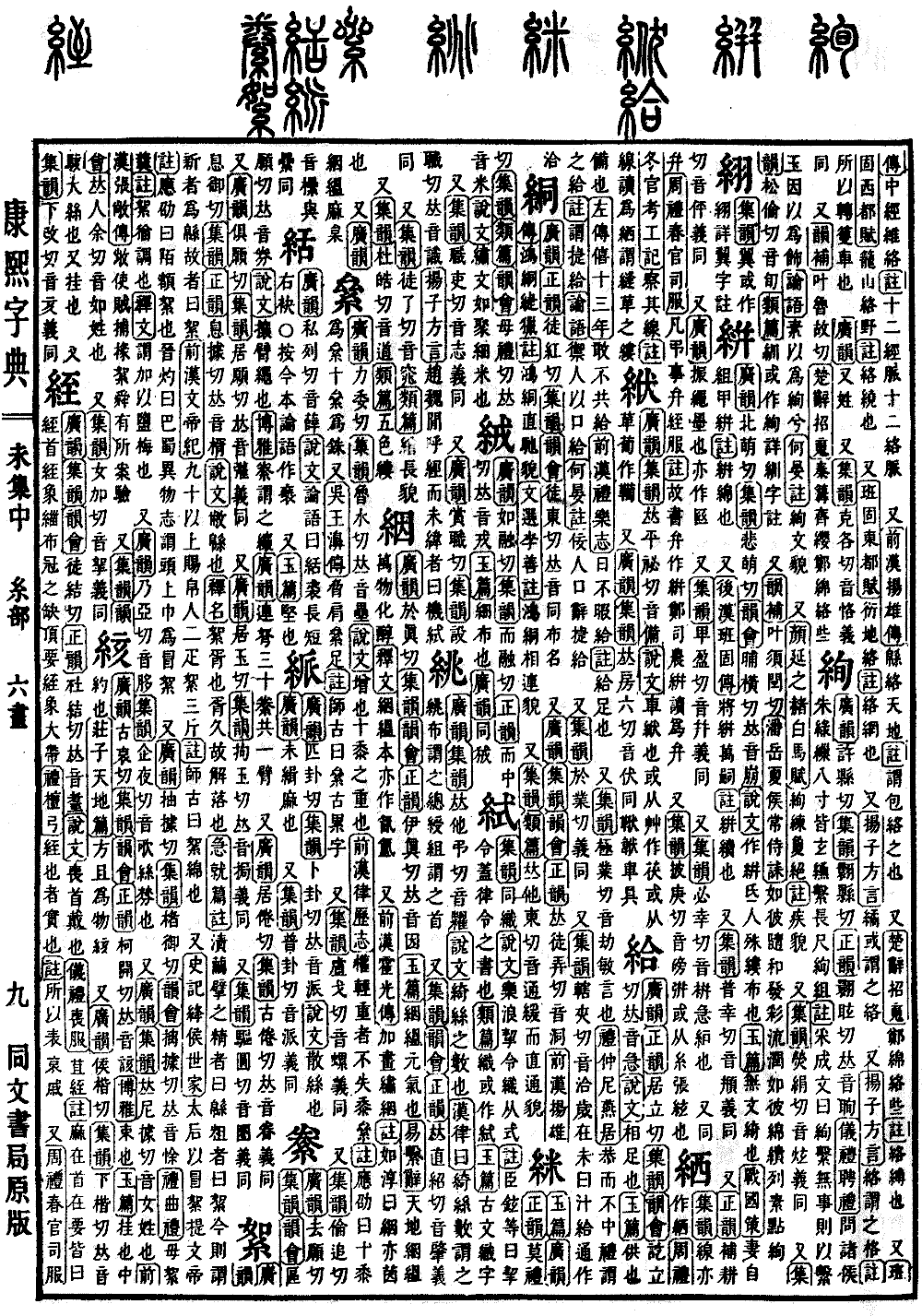
Wei Collection, Middle Volume
Radical: Silk (mì)
Kangxi Strokes: 12
Page 923, Entry 06
Pronounced ji (falling tone).
According to the Explaining Graphs and Analyzing Characters (Shuowen Jiezi), it means to suffice one another. According to the Jade Chapters (Yupian), it means to provide or to prepare.
In the Commentary of Zuo (Zuozhuan), during the thirteenth year of Duke Xi: Dare we not provide together.
In the History of the Former Han (Qianhanshu), Treatise on Rites and Music: Daily there is no time to be provided for. The commentary states that this means to suffice.
Also pronounced jie (entering tone), meaning quick of speech.
In the Book of Rites (Liji), in the chapter Zhongni Yanju: To be respectful but not conforming to ritual is called being too quick of speech. The commentary states that this refers to being glib.
In the Analects of Confucius (Lunyu): To oppose others with glibness of mouth. He Yan’s commentary states that this refers to the glib speech of a sycophant.
Also pronounced ye (entering tone), with the same meaning.
Also pronounced qia (entering tone). When the year is in the position of the ram, it is called zhiqia. Commonly written as qia.