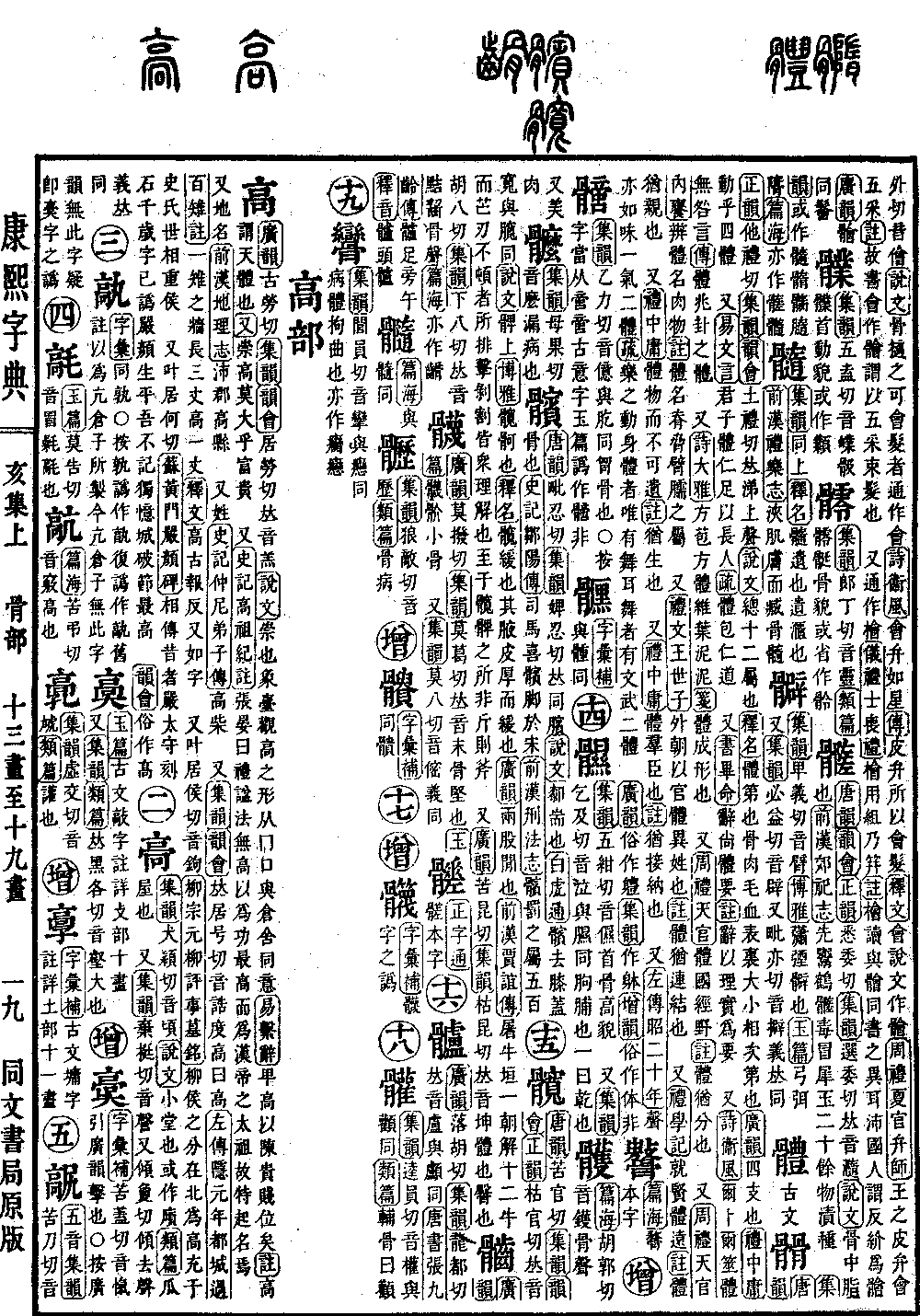
Hai Collection, Upper Volume
Radical: Tall (gāo)
Kangxi Strokes: 10
Page 1451, Entry 26
Guangyun: Pronounced gao. Jiyun and Yunhui: Pronounced gao.
Shuowen Jiezi: Lofty. It resembles the shape of a high tower or pavilion. It is composed of the radical for roof and the character for mouth. It carries the same meaning as a storehouse or dwelling.
Book of Changes (Yijing), Xici: When the high and the low are established, the positions of the noble and the humble are set.
Commentary: High refers to the celestial bodies.
Also: There is nothing more lofty and great than wealth and status.
Also: Records of the Grand Historian (Shiji), Annals of Emperor Gaozu, Commentary: Zhang Yan says: According to the ritual system of posthumous titles, the title Gao (High) is not typically used; however, as the highest in achievement and the great progenitor of the Han dynasty, the name was specially created.
Also: A place name.
History of the Former Han (Qian Hanshu), Treatise on Geography: Gao County in Pei Commandery.
Also: A surname.
Records of the Grand Historian (Shiji), Biography of Confucius' Disciples: Gao Chai.
Also: Jiyun and Yunhui: Pronounced gao. Measuring height is called gao.
Zuo Tradition (Zuozhuan), First Year of Duke Yin: The commentary on the passage regarding the capital city exceeding one hundred zhi states: A wall of one zhi is three zhang in length and one zhang in height.
Shuowen Jingdian Shiwen: Gao is pronounced gao.
Also: Pronounced as the character itself.
Also: Rhymes with gou.
Liu Zongyuan, Epitaph for Pingshi Liu: The destiny of Marquis Liu lies in the north as the Gao constellation, fulfilling the history of the clan, for generations holding the rank of marquis.
Also: Rhymes with he.
Su Huangmen, Yan Yan: Tradition says that in the past, Prefect Yan carved stones, though the characters of a thousand years have already faded. I do not remember the life of Yan Yan, but I recall only that when the city fell, his integrity was at its highest.
Yunhui: Commonly written in a variant form.