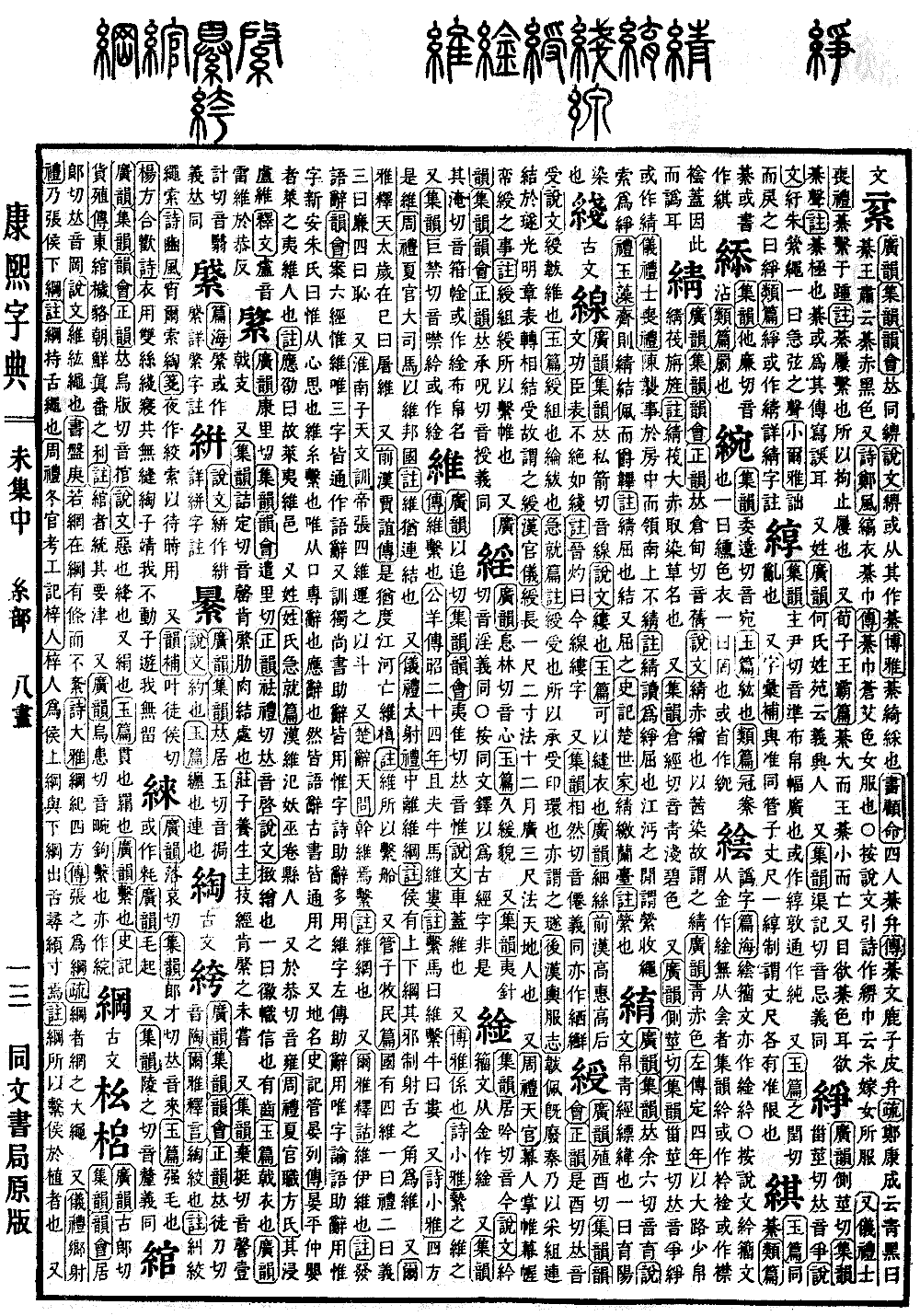
Wei Collection, Middle Volume. Radical: Silk (mì). Character: Gang. Kangxi stroke count: 14. Page 927, Entry 24. Ancient form. According to the Expanded Dictionary of Sounds and Meanings (Guangyun), it is pronounced gang. According to the Collected Rimes (Jiyun) and the Compendium of Rimes (Yunhui), it is pronounced gang. The Great Seal Script (Shuowen) defines it as the main rope of a net. In the Book of Documents (Shangshu), chapter Pan Geng, it is written: like a net having a main rope, it is orderly and not in disarray. In the Book of Odes (Shijing), Great Odes (Daya), it is written: the guiding principles for the four directions. The commentary states: when spread out, it is called a gang. The sub-commentary states: a gang is the large rope of a net. Also, in the Book of Etiquette and Ceremonial (Yili), chapter Archery Rite of the District, it is written: then extend the lower gang of the target. The annotation states: the gang is the rope that holds the tongue of the target. In the Rites of Zhou (Zhouli), chapter Winter Officials, Records of Trades (Kaogongji), section on the Carpenter: the carpenter makes the upper and lower gang for the target, extending the tongue by a xun, with a one-inch band of silk. The annotation states: the gang is used to tie the target to the posts. Also, in the Apocrypha of the Rites (Liwei Hanwenjia), it is written: the ruler is the guiding principle for the subject, the father is the guiding principle for the son, and the husband is the guiding principle for the wife. Textual verification: In the Rites of Zhou (Zhouli), chapter Winter Officials, Records of Trades (Kaogongji), section on the Carpenter: the carpenter makes the upper and lower gang for the target, extending the tongue by a xun, with a one-inch band of silk. Following the original text, the word one inch has been corrected to one-inch band of silk.