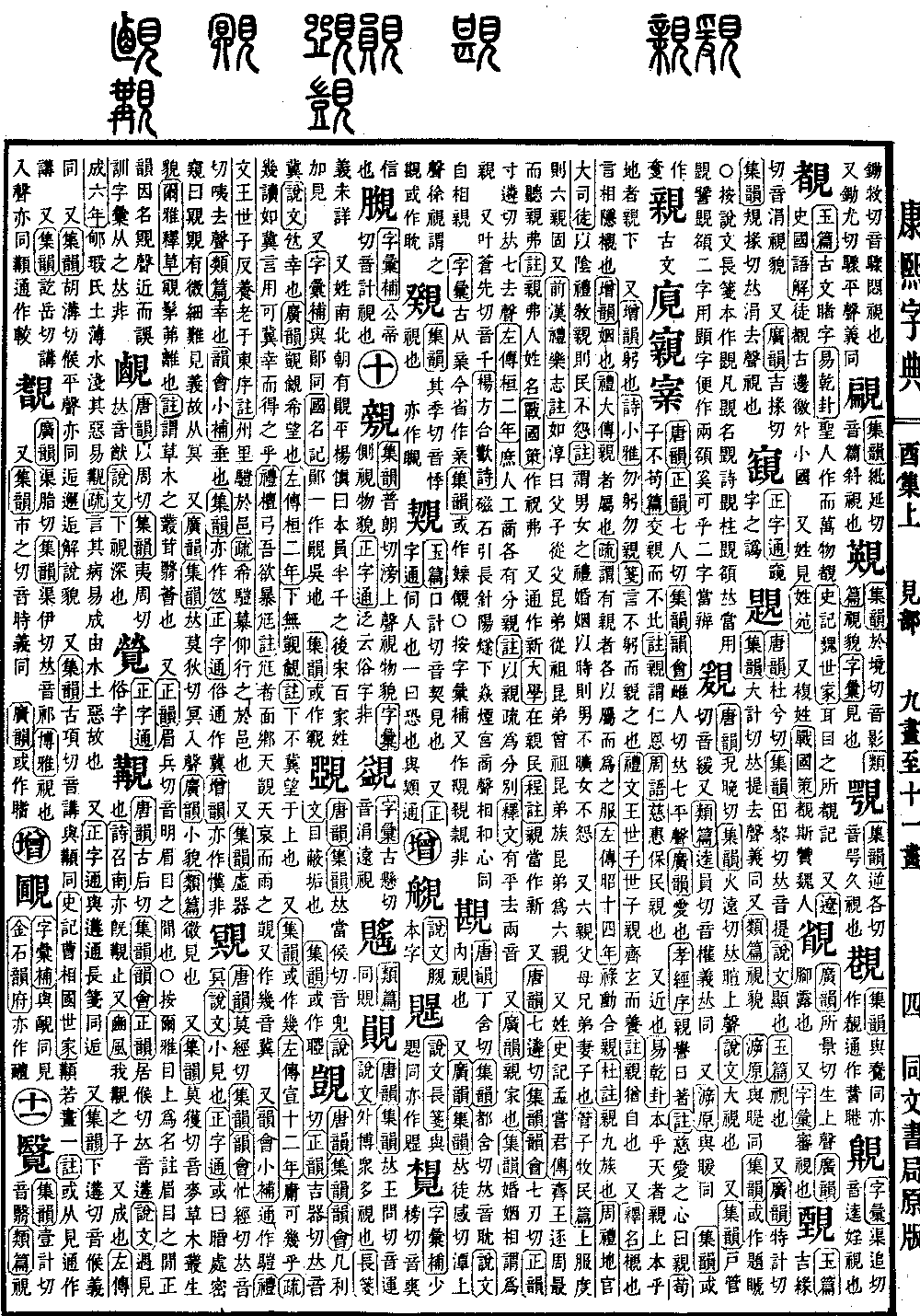
You Collection, Upper Volume
Radical: See (jiàn)
Kangxi Strokes: 17
Page 1136, Entry 01
Pronounced gou (falling tone).
As defined in the Analytical Dictionary of Characters (Shuowen Jiezi), to meet or see.
As recorded in the Book of Odes (Shijing): Already met at the place. Also, I met this person.
Also, to become established. As recorded in the Zuo Commentary (Zuo Zhuan): The lands of the Xun and Yan clans were thin with shallow water; their illnesses were easy to establish. The commentary explains that this means their ailments were easily contracted due to the poor quality of the water and soil.
Also, as noted in the Rectification of Characters (Zhengzitong), it is interchangeable with the character pronounced gou. The Long Qian notes it is also the same as the character pronounced hou.
Also, pronounced gou (falling tone). The meaning is the same.
Also, pronounced gou (level tone). It is also the same as the character pronounced hou, as in the term xiehou, describing a state of being unbound or casual.
Also, pronounced jiang (falling tone). Interchangeable with the character pronounced jiang. As recorded in the Records of the Grand Historian (Shiji): Clear as if drawn with a single stroke. The commentary notes that it is sometimes written with the See radical. It is also used interchangeably with the character pronounced jiang.
Also, pronounced jue (entering tone). It is also the same as the character pronounced jiang. It is also used interchangeably with the character pronounced jiao.