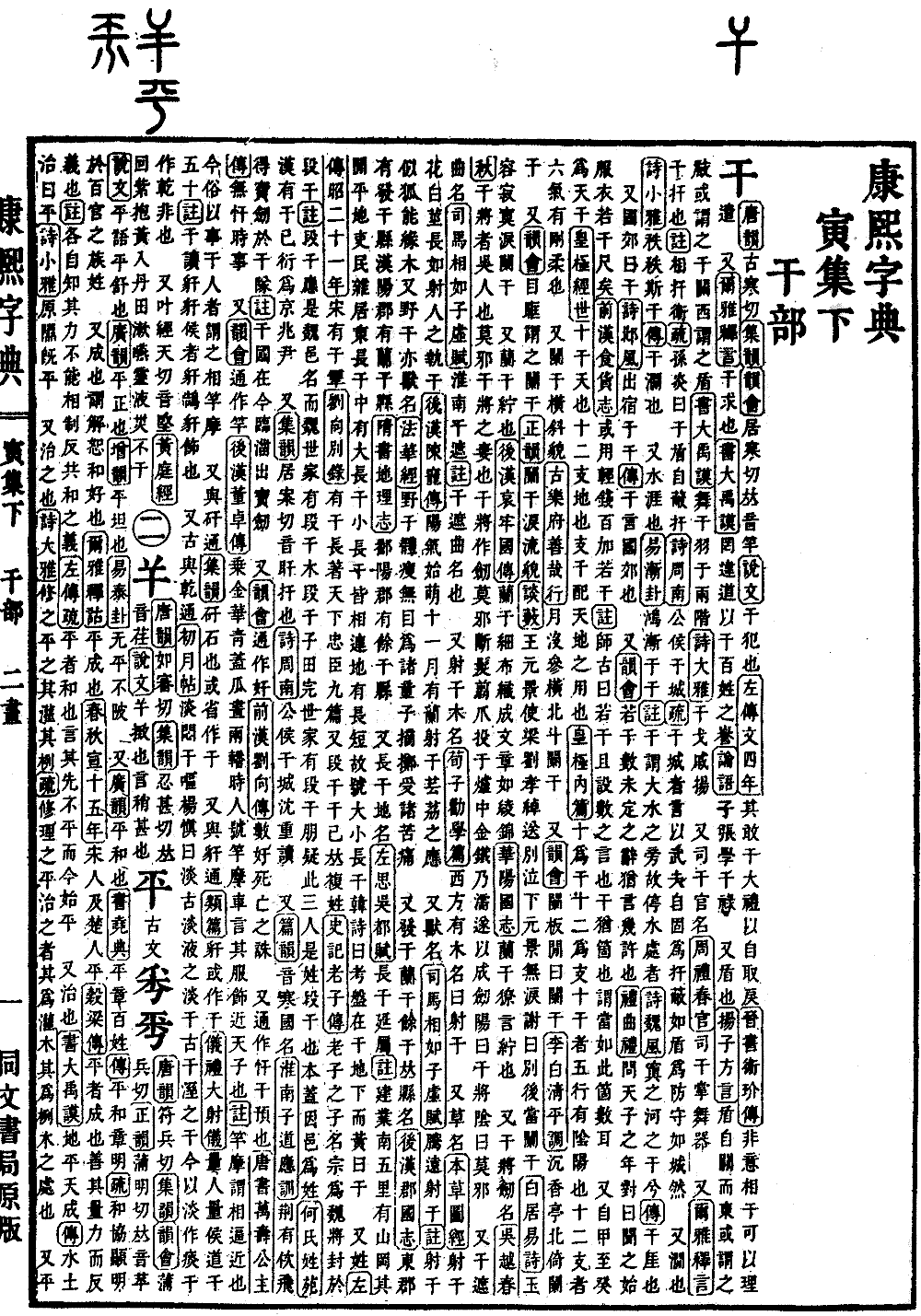
Yin Collection, Lower Volume
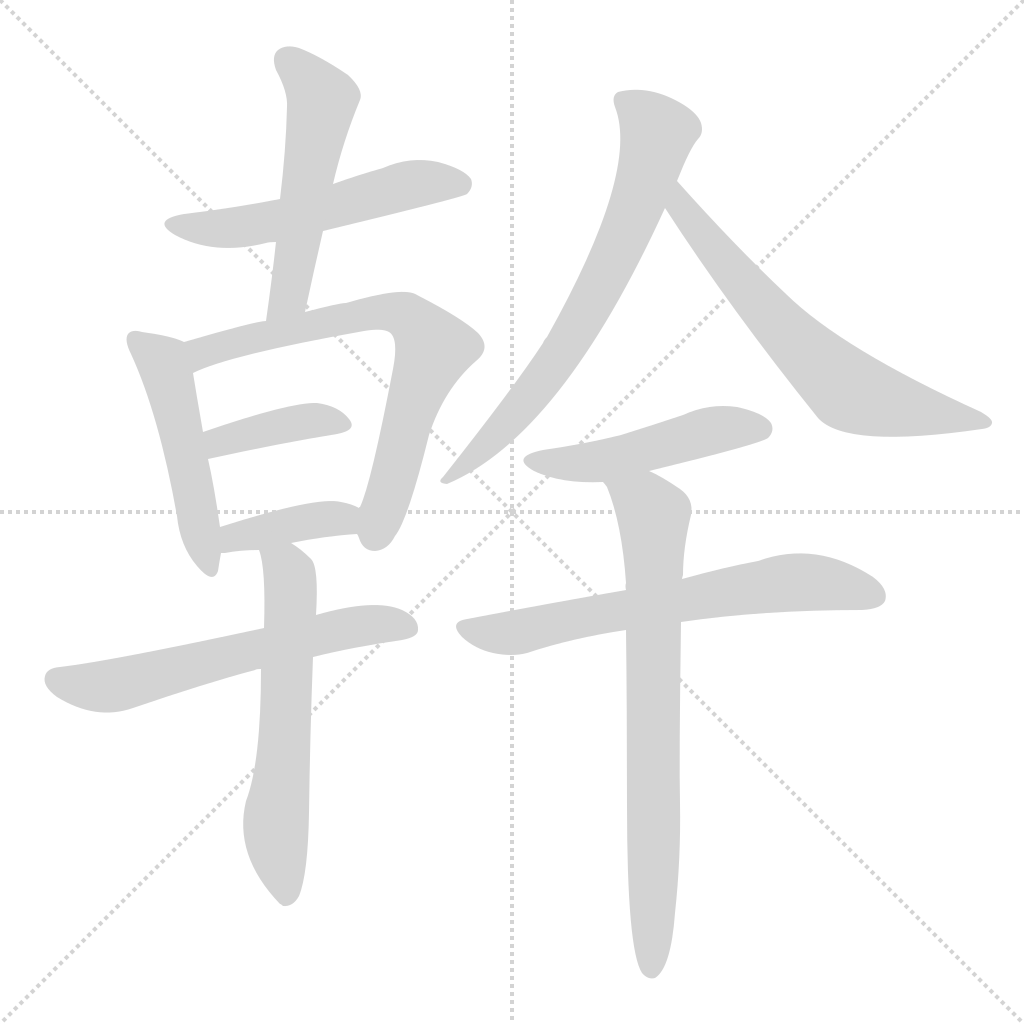
Radical: Stem (gàn)
Kangxi Strokes: 13
Page 339, Entry 01
Pronounced gan (falling tone).
According to Classic of Rhymes (Tangyun), collected Rhymes (Jiyun), and Rhyme Compendium (Yunhui), pronounced gan (falling tone). According to Correct Rhymes (Zhengyun), pronounced gan (falling tone). Read as the falling tone of gan.
Category Compilation (Leipian): Ability to manage affairs.
Book of Changes (Yijing), Gu Hexagram: To manage the work of one's father.
Commentary: Inheriting the father’s enterprise and being able to follow the rules of the ancestors indicates a capable person.
Jade Chapter (Yupian): The main body of a thing.
Book of Changes (Yijing), Qian Hexagram: Integrity is the main trunk of a thing.
Also, the main stem of plants is called gan.
Exegesis of Odes (Shigu): The lateral parts of a tree are called branches, while the straight central part is called gan.
Also, the main structural part of any implement is called gan.
Book of Rites (Liji), Monthly Ordinances (Yueling): The shaft of a feathered arrow.
Commentary: The gan is the main body of the implement.
Sub-commentary: The raw material or blank of an implement is collectively called gan.
Rites of Zhou (Zhouli), Winter Bureau, Artificers Record (Kaogongji): The gan of Jing.
Commentary: Refers to the Zhe wood, which can be used to make the bow stave.
Also, the ten heavenly stems were originally written as gan.
Broad Gloss (Guangya): Jia and Yi are stems. The stem is the essence of the sun.
Also refers to the flank or rib area.
Gongyang Commentary (Gongyangzhuan), First Year of Duke Zhuang: Broke his ribs and killed him.
Approaching Elegance (Erya), Exegesis of Domestic Animals: A whorl of hair on the flank is called fufang.
Sub-commentary: A whorl of hair growing on the flank is called fufang.
Also, Qigan is the name of a country.
Bamboo Annals (Jizhoushushu): Qigan has good fragrance.
Commentary: Qigan is in the north. Shanfang is the name of a bird.
Rhyme Compendium (Yunhui): Refers to the spine.
Zuo Commentary (Zuozhuan), Twenty-fifth Year of Duke Zhao: Only this board beneath the corpse in the coffin is used to support the spine of the corpse.
Also a surname.
Genealogical Compendium (Wanxingtongpu): Appears in the Garden of Surnames (Xingyuan). During the Song Dynasty, in the Western Xia, there was Gan Daochong. His ancestors followed the King of Xia to Xingzhou and were responsible for the state history for generations. Daochong was well-versed in the Five Classics, served as a professor of Fan and Han, and rose to the position of Chancellor. During the Yuan Dynasty, there was Gan Lezhong, who studied the Jurchen and Khitan scripts, was well-versed in the law, and rose to the position of Assistant Prefect of the Privy Council.
Collected Rhymes (Jiyun) and Correct Rhymes (Zhengyun): Pronounced han (level tone).
Collected Rhymes (Jiyun): Refers to a well curb.
Rhyme Compendium (Yunhui): Refers to the wooden railing above a well. Its shape can be four-sided or eight-sided. Also called a silver bed.
Zhuangzi, Autumn Floods (Qiushui): I jump about on the well curb.
Also the name of a type of tower.
Former Han History (Qianhanji), Treatise on Suburban Sacrifices: Emperor Wu of Han built the Jinggan Tower, fifty zhang high.
Commentary: Built by stacking timber to create a high tower; the shape resembles a well curb.
Ban Gu, Western Capital Rhapsody (Xijingfu): Climbing the Jinggan Tower, before reaching halfway, one feels dizzy and mentally disoriented.
Rhyme Compendium (Yunhui): Interchangable with the character for manage (guan).
Former Han History (Qianhanji), Biography of Liu Xiang: Shi Xian managed the affairs of the Secretariat.
Commentary: Shigu says: Gan is identical to the character for manage.
Later Han History (Houhanji), Biography of Dou Xian: Internally managed the secrets.
Commentary: In ancient times, gan was interchangeable with the character for manage.
Also rhymes as jian (falling tone).
Yangzi, Great Mystery (Taixuanjing): If a well lacks a well curb, the water flows straight away.
Also rhymes as jian (falling tone).
Su Zhe, Poem on the Ink Hall: On the whitewashed wall of the central hall, the frosted bamboo stalks are painted in a desolate manner. Capturing the spirit of the bamboo in accordance with one's heart, every brushstroke appears lush and distinct.