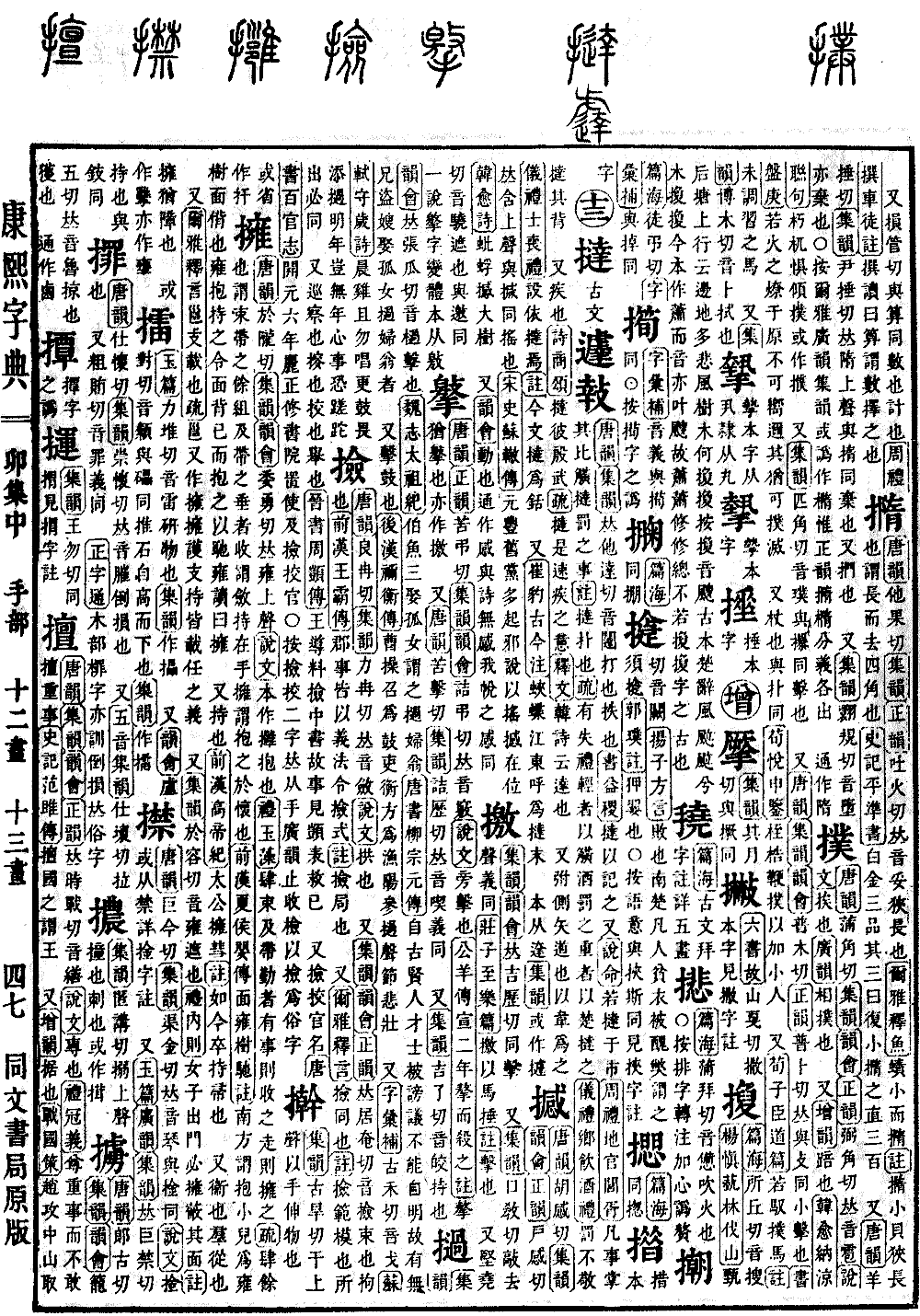
Mao Collection, Middle Volume
Radical: Hand (shǒu)
Page 457, Entry 25
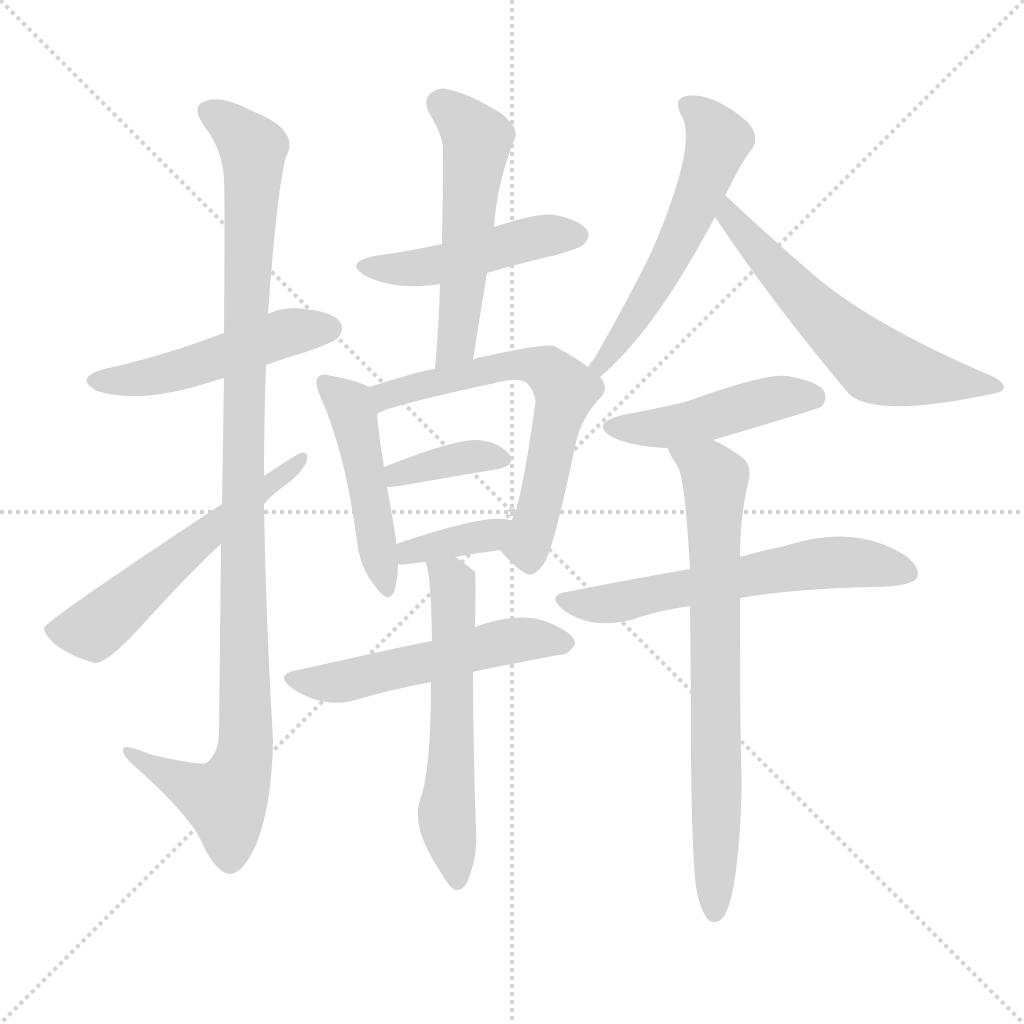
Dictionary of Chinese Sounds and Rhymes (Jiyun): Pronounced gan (rising tone). It means to use the hands to spread or straighten something out. Sometimes written in a variant form (han).
Dictionary of Chinese Sounds and Rhymes (Jiyun): Also pronounced xian (dipping tone), which is identical in meaning to the character xian.
Book of the Former Han (Qianhan shu) by Yang Xiong, Rhapsody on the Longyang Palace (Changyang fu): Contains the phrase, to gesture toward cities and pull at districts. The commentary explains that this means to raise the hands to gesture or point. The pronunciation is similar to that of the character xian in the compound xian.
Correctness of Characters (Zhengzitong): Points out that this character is actually a misspelling of the character cha. Ancient editions of the Rhapsody on the Longyang Palace use the character cha. For further details, see the entry for the character cha.
Another theory suggests that since the pronunciations of xin and xuan are similar, the character xian is often colloquially written as this character, which is distinct from the character cha.