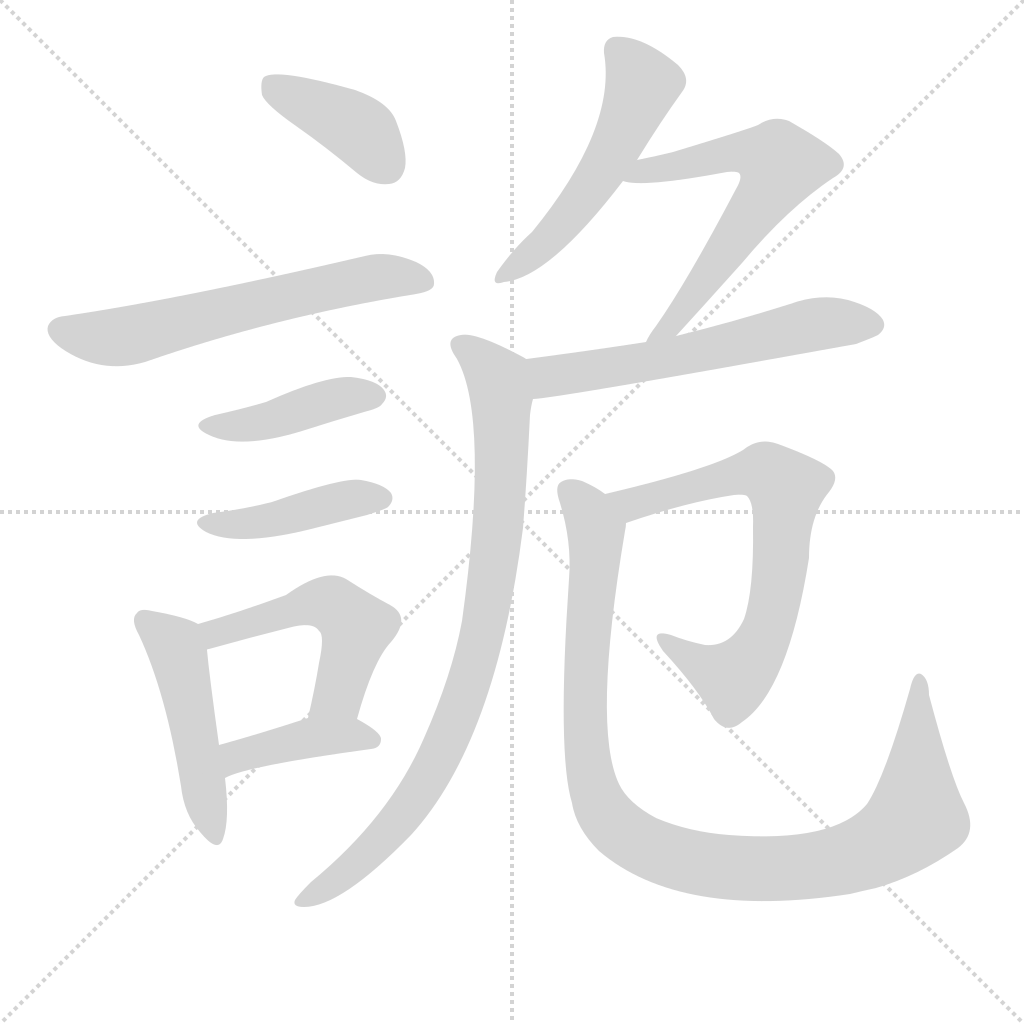
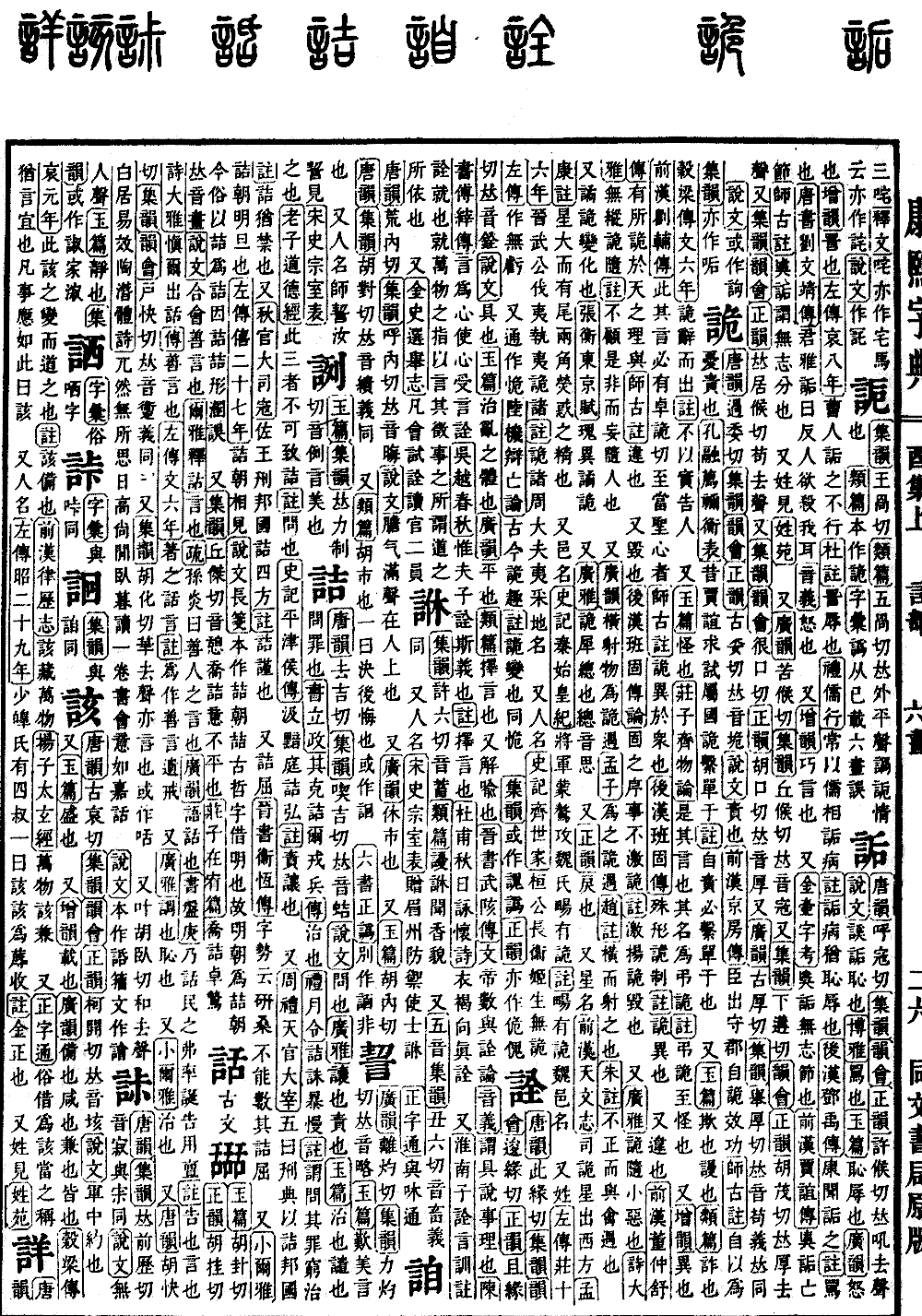
You Collection, Upper Volume
Radical: Speech (yán)
Kangxi Strokes: 13
Page 1158, Entry 03
Pronounced gui.
From the Analytical Dictionary of Characters (Shuowen Jiezi): To hold accountable.
From the History of the Former Han (Qianhan Shu), Biography of Jing Fang: I shall leave to govern the commandery, and personally commit to achieving results.
Commentary by Shigu: To take upon oneself the responsibility and blame.
From Kong Rong’s Memorial Recommending Mi Heng: In the past, Jia Yi requested to be tested in the dependent states, and insisted on capturing the Chanyu.
Commentary: To insist upon oneself the task of capturing the Chanyu.
Also, from the Jade Chapters (Yupian): To deceive, to hoodwink.
From the Categorized Compilation (Leipian): To swindle.
From the Gongyang Commentary (Guliang Zhuan), Year 6 of Duke Wen: To speak with deceptive words and depart.
Commentary: To not inform others truthfully.
Also, from the Jade Chapters (Yupian): Strange.
From the Master Zhuang (Zhuangzi), Discussion on Making All Things Equal (Qiwulun): These words of his are called eccentric and strange.
Commentary: Eccentric and strange means extremely odd.
Also, from the Supplement to the Rhymes (Zengyun): Different.
From the History of the Former Han (Qianhan Shu), Biography of Liu Fu: These words must contain something outstanding and different that reaches the sagely mind.
Commentary by Shigu: Different from the masses.
From the History of the Later Han (Houhan Shu), Biography of Ban Gu: Extraordinary shapes and different systems.
Commentary: Different.
Also, to violate.
From the History of the Former Han (Qianhan Shu), Biography of Dong Zhongshu: Is there any violation of the principles of Heaven?
Commentary by Shigu: To violate.
Also, to slander.
From the History of the Later Han (Houhan Shu), Treatise on the Biography of Ban Gu: Gu’s ordering of events was neither overly critical nor slanderous.
Commentary: To criticize; to slander.
Also, from the Erya (Guangya): Deceptive compliance is a minor evil.
From the Book of Odes (Shijing), Greater Odes (Daya): Do not indulge in deceptive compliance.
Commentary: To disregard right and wrong and blindly follow others.
Also, from the Extensive Rhymes (Guangyun): To shoot at creatures from the side is called a deceptive encounter.
From the Mencius (Mengzi): To have a deceptive encounter with the game.
Commentary by Zhao: To shoot at them sideways.
Commentary by Zhu: To meet with game in an improper way.
Also, deceptive and strange: constant change.
From Zhang Heng’s Western Capital Rhapsody (Dongjing Fu): Rare, strange, deceptive, and fluctuating.
Also, from the Erya (Guangya): Guixi means to gather together. Total means sound si.
Also, from the Correct Rhymes (Zhengyun): Perverse.
Also, a star name.
From the History of the Former Han (Qianhan Shu), Treatise on Astronomy: The Gui star appears in the west.
Commentary by Meng Kang: A star that is large, has a tail, and two horns; it is the essence of Mars.
Also, a town name.
From the Records of the Grand Historian (Shiji), Annals of Qin Shi Huang: General Meng Ao attacked the Wei town of Gui.
Commentary: A town in the state of Wei.
Also, a surname.
From the Zuo Commentary (Zuo Zhuan), Year 16 of Duke Zhuang: The Duke of Jin attacked Yi and captured Yi Guizhu.
Commentary: Guizhu was a dignitary of the Zhou dynasty. Yi was a fief name.
Also, a personal name.
From the Records of the Grand Historian (Shiji), House of Qi: Duke Huan’s eldest son, born of the Consort of Wei, was named Wugui.
The Zuo Commentary (Zuo Zhuan) writes this as Wukui.
Also, interchangeably written as gui.
From Lu Ji’s Essay on the Fall of Wu (Bianwang Lun): The trends of the past and present are inconsistent.
Commentary: Changes. The same as gui.
In the Collected Rhymes (Jiyun), it is sometimes written as gui.
In the Correct Rhymes (Zhengyun), it is also written as gui and kui.