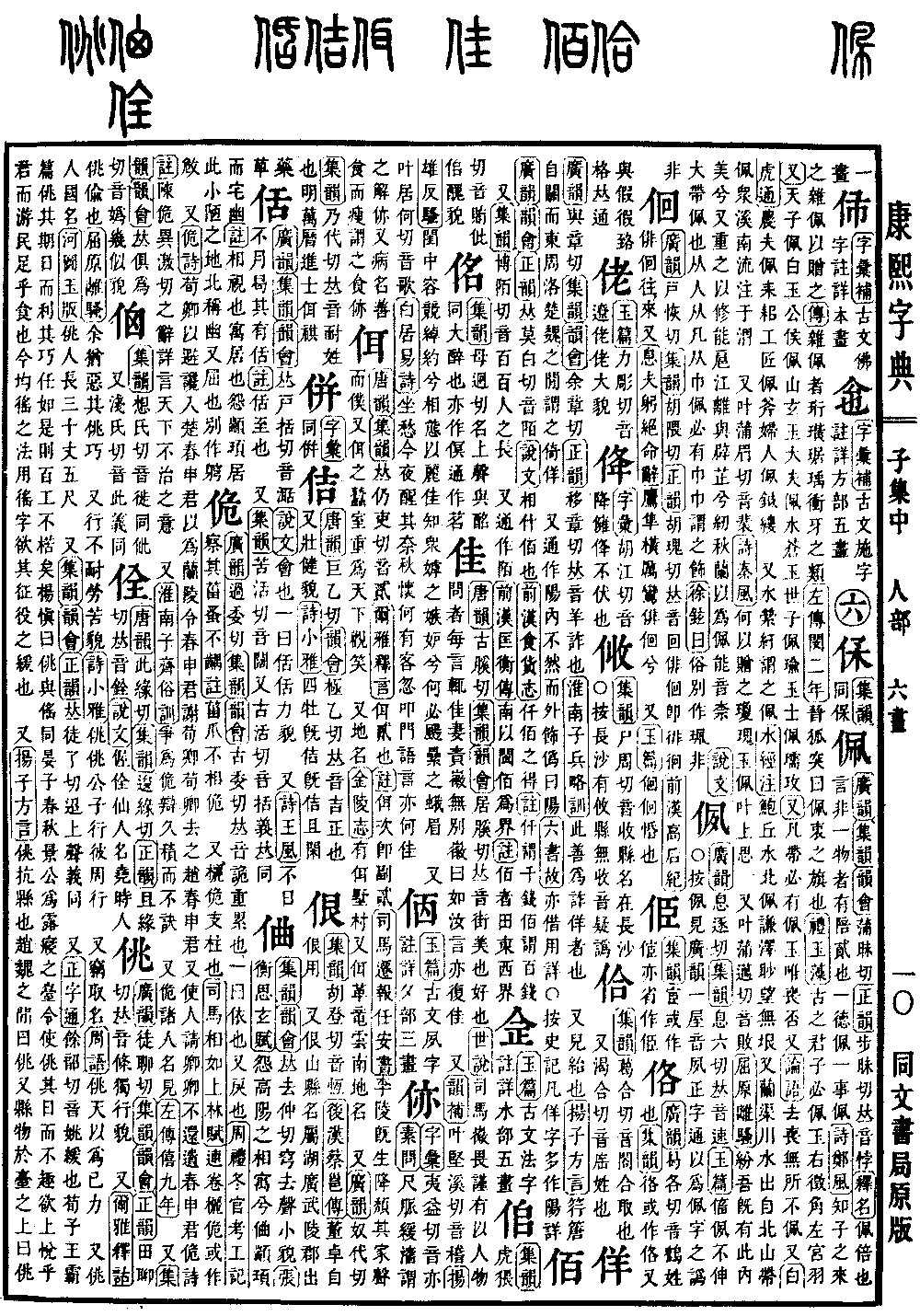
Zi Collection, Middle Volume
Radical: Person (rén)
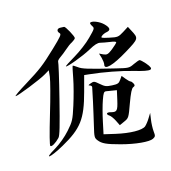
Gui
Kangxi stroke count: 8
Page 100, Entry 27
Pronounced gui. To pile up or repeat. Another definition: to rely upon. Also, perverse.
In the Rites of Zhou (Zhouli), section on Winter Offices (Dongguan Kaogongji), in the note concerning the observation of grain and claws not being crooked (qi), it is written: The grain and claws do not mutually deviate (gui).
Also, li-gui refers to supporting pillars.
In Sima Xiangru's Rhapsody on the Shanglin Park (Shanglin fu), there is the phrase linked and coiled, li-gui. Sometimes written in a variant form.
Also, regarding the poem of gui: Xunzi, in order to avoid slander, entered the state of Chu, where Lord Chunshen appointed him Magistrate of Lanling. Lord Chunshen later apologized to Xunzi, and Xunzi left for the state of Zhao. Lord Chunshen sent someone to invite Xunzi back, but Xunzi did not return and sent a poem of gui to Lord Chunshen. The note states: Gui is a term of excitement and criticism, used to express in detail the belief that the world is not well-governed.
Also, in the Huainanzi, section on Customs of Qi (Qi su xun): Contending to engage in perverse argumentation, accumulated for a long time without resolution.
Also, Guizhu is a person's name. See the Zuo Tradition (Zuo zhuan), ninth year of Duke Xi.
Also, pronounced gui. The appearance of being near or similar.