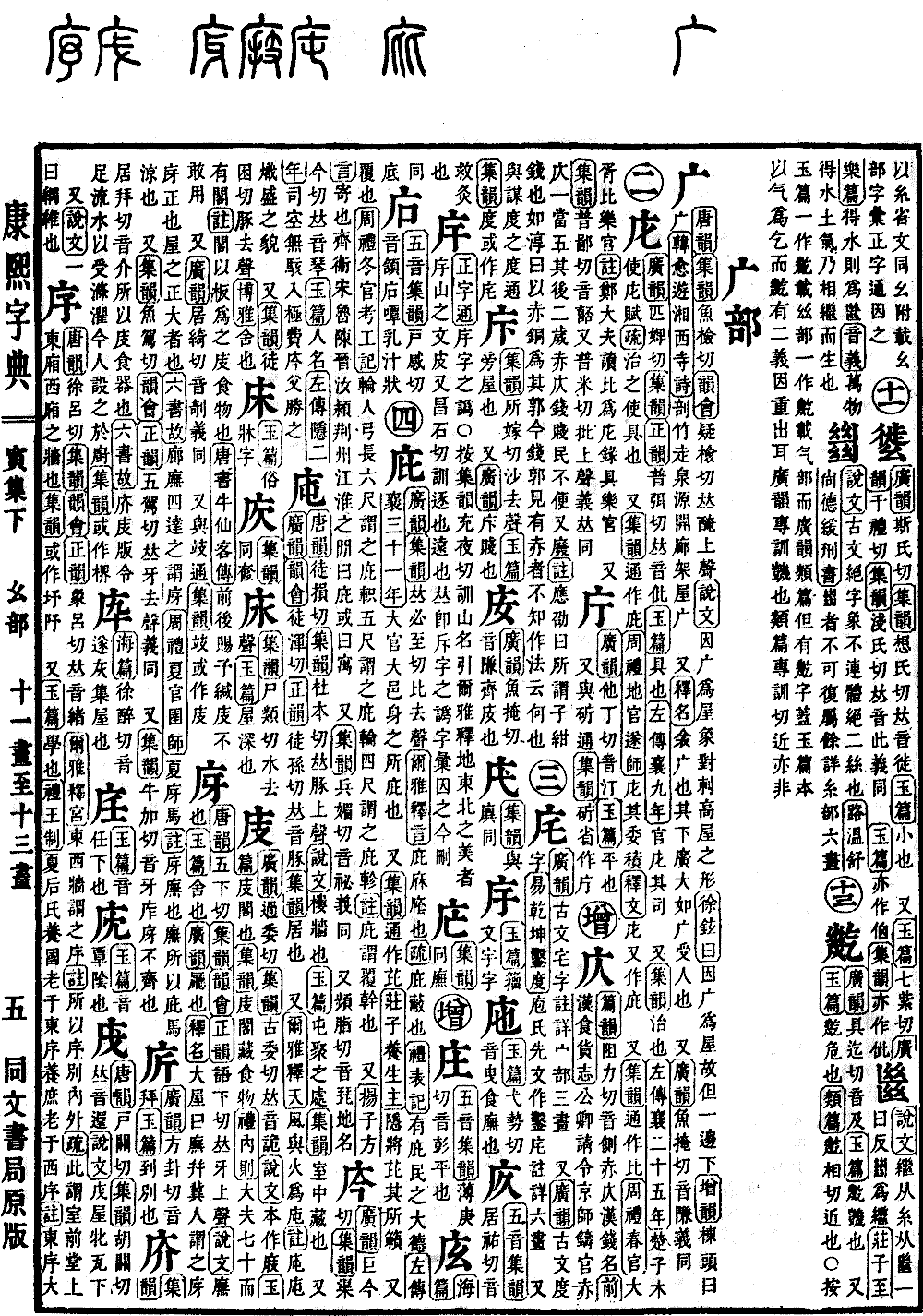
Yin Collection, Lower Volume
Radical: Broad (guǎng)
Kangxi Strokes: 15
Page 343, Entry 01
Pronounced guǎng (rising tone).
Shuowen Jiezi (Shuowen): Refers to the large roof of a palace.
Also, Yupian: Broad, meaning large.
Guangyun: Broad, meaning wide.
Book of Changes (Yijing), Xici: Broad and great, it can match heaven and earth.
Commentary: Great is used to match heaven; broad is used to match earth.
Also refers to a prefecture name.
Old Book of Tang (Tangshu), Treatise on Geography: Guangzhou was established in the Lingnan Circuit.
Also refers to a surname.
Xingpu: Descended from Danyang, the descendants of Guangchengzi; during the Song dynasty, there was a person named Guang Han.
Pronounced guàng (falling tone).
Rites of Zhou (Zhouli), Earth Officer, Grand Tutor: Fully understand the measurements of breadth and length of the nine provinces.
Commentary: Ma Rong stated: The east-west direction is called breadth, and the north-south direction is called length.
Exposition of Texts (Shiwen): Guang is pronounced guàng.
Also refers to a type of carriage.
Rites of Zhou (Zhouli), Spring Officer, Carriage Attendant: The gathering of broad carriages.
Annotation: Broad carriages are carriages arranged horizontally.
Exposition of Texts (Shiwen): Guang is pronounced guàng.
Zuo Tradition (Zuozhuan), 28th Year of Duke Xi: The western broad and the eastern palace.
Commentary: The State of Chu had a left broad and a right broad, which were likely names for military carriages.
2nd Year of Duke Xuan: Divided into two broads.
Annotation: Fifteen war chariots are called one broad.
Also, Zhengzitong: Pronounced kuàng.
Xunzi, Wangba Chapter: Why does the monarch not have a broad and open heart?
Annotation: Broad refers to an open and peaceful appearance.
Also interchangeable with kuàng.
Book of Han (Hanshu), Treatise on the Five Elements: When an army goes on an expedition and misses its opportunity, it is called broad.
Pronounced guāng.
Erya, Explanation of Beasts: Having spiraling hair on the back is called queguang.
Commentary: According to Bo Le's method of evaluating horses, a horse with spiraling hair on its back is called queguang.
Pronunciation and Meaning: Guang is pronounced guāng.
Also, Yunbu: Rhymed as gǔ.
Book of Rites (Liji), Record of Music: Modern ancient music is uniform in advancement and retreat, harmonious, upright, and broad; strings, gourds, sheng, and huang instruments coordinate with the percussion of the fu and drum, beginning with civil music and ending with military music.