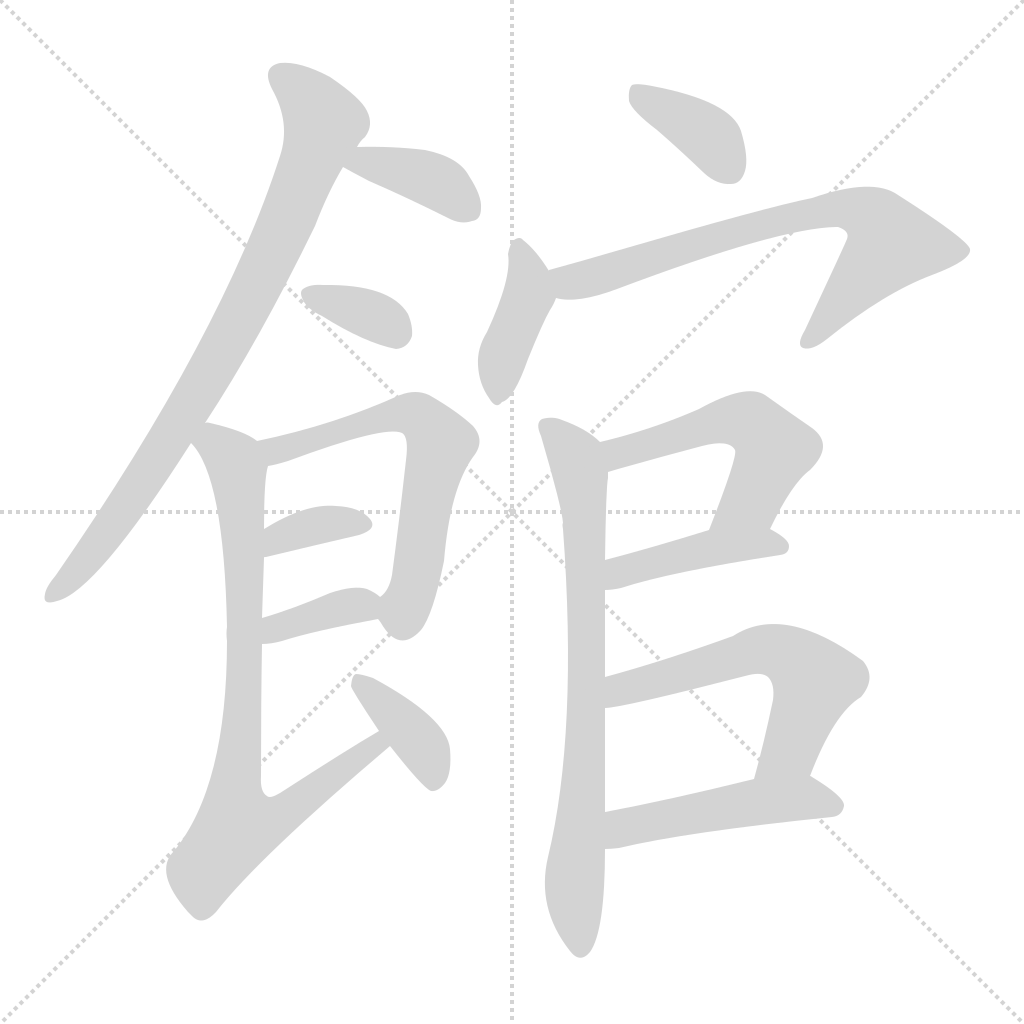
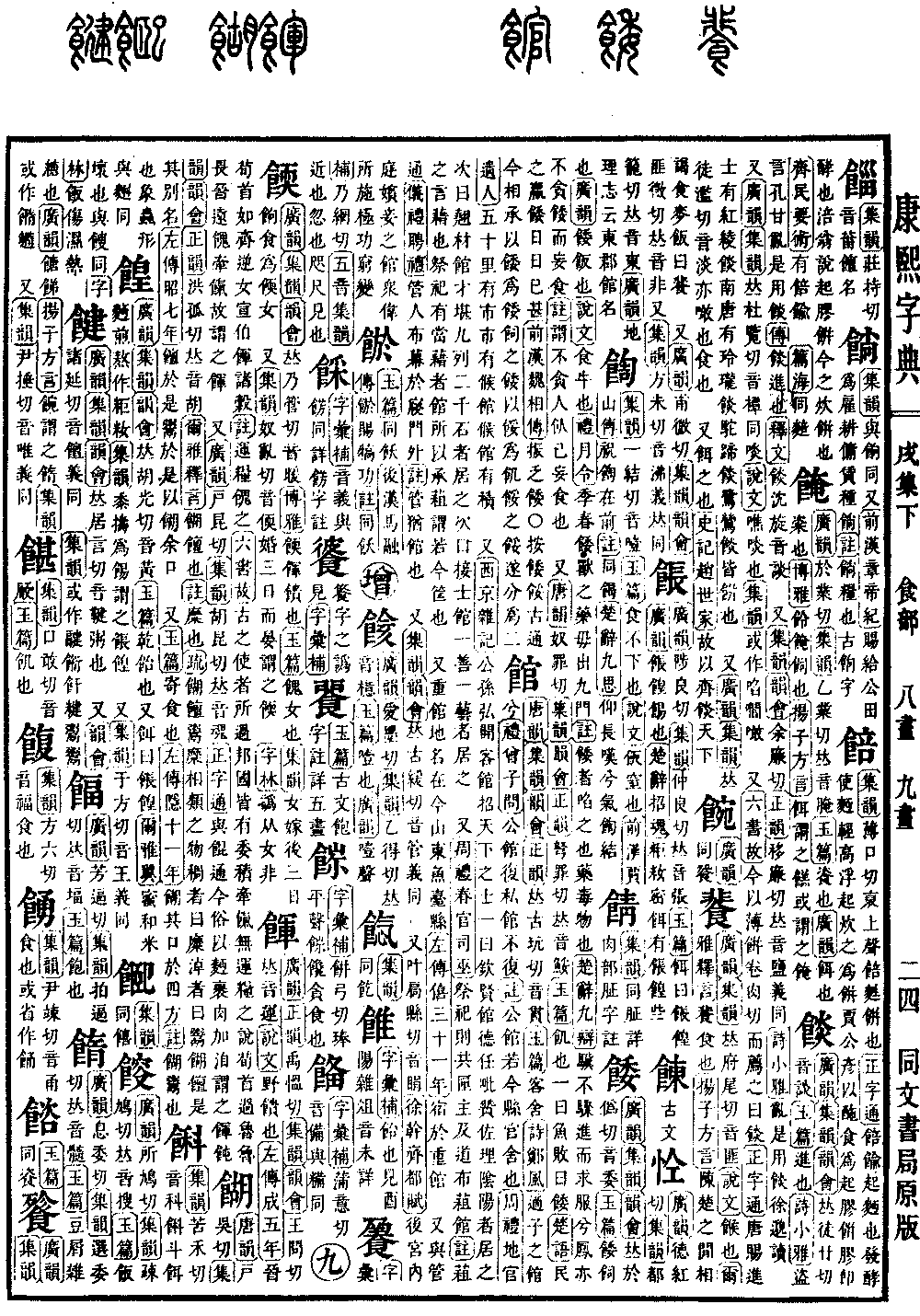
Xu Collection, Lower Volume
Radical: Food (shí)
Kangxi Strokes: 17
Page 1422, Entry 14
Tangyun, Jiyun, Yunhui, Zhengyun: Pronounced guan.
Yupian: A guesthouse or lodging.
Book of Odes (Shijing): Going to your lodging.
Book of Rites (Liji): Regarding the question of Zengzi: Public lodgings must have their rituals repeated; private lodgings do not. Commentary: Public lodgings are like the current official government guest quarters.
Rites of Zhou (Zhouli): Every fifty miles there is a market; the market has a lodging, and the lodging has provisions.
Also, Miscellaneous Records of the Western Capital (Xijing Zaji): Gongsun Hong opened guest lodgings to recruit scholars from across the realm. One was called the Qinxian (Respecting Virtue) Lodging, for those whose conduct was sufficient to assist the ruler and harmonize the yin and yang. The second was called the Qiaocai (Elevating Talent) Lodging, for those with talent sufficient to serve as the Nine Ministers or hold a salary of two thousand shi. The third was called the Jieshi (Welcoming Scholars) Lodging, for those with a specific virtue or skill.
Also, Rites of Zhou (Zhouli): Regarding the Ministry of Spring, the Master of Shamans: During sacrificial rites, provide the ritual vessel, the ritual cloth, and the sacrificial straw mats and mats (zu guan). Commentary: Zu means a cushion; for sacrificial foods that require a base, the guan serves to support the zu, which is like a basket today.
Also, Chongguan, a place name located in modern Yutai County, Shandong Province.
Zuo Commentary (Zuo Zhuan): Stayed overnight at Chongguan.
Also, interchangeable with the character guan (a pipe or tube).
Book of Etiquette and Ceremonial (Yili): The manager of the pipes (guan ren) spreads curtains outside the gate of the sleeping quarters. Commentary: Guan here has the same meaning as guan (lodging).
Also, Jiyun and Yunhui: Pronounced guan. The meaning is the same.
Also, rhyming with jiong and xian: Pronounced juan.
Xu Gan, Rhapsody on the Capital of Qi (Qi Du Fu): The inner chambers of the harem, the lodgings of the concubines. Where many beauties reside, exhausting the ingenuity of craftsmanship and variety.
Textual Research: In the Rites of Zhou (Zhouli), regarding the Master of Shamans: During sacrificial rites, provide the ritual vessel, the ritual cloth, and the sacrificial straw mats and mats. Commentary: Zu means a cushion; for sacrificial foods that require a base, the guan serves to support the zu, which is like a basket today. Note: According to the original text, the word and was added before the sacrificial straw mats and mats, and sacrificial rites was changed to sacrificial food.