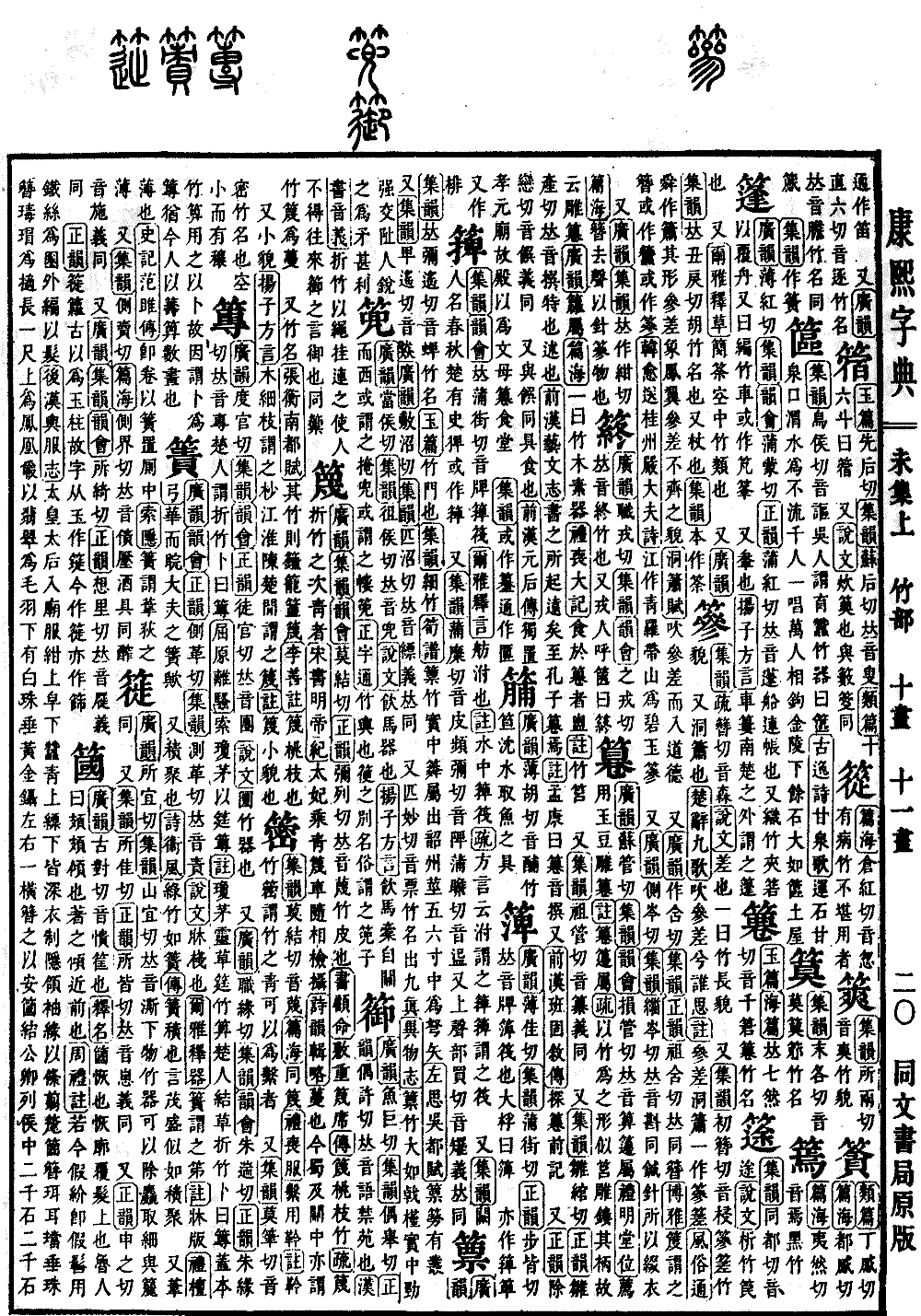
Wei Collection, Upper Volume
Radical: Bamboo (zhú)
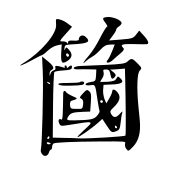
簂
Kangxi stroke count: 17
Page 896, Entry 25
According to the Extensive Rhymes (Guangyun), pronounced dui (falling tone). It is a type of basket. According to Explaining Names (Shiming), it is an expansive covering for the hair; people of Lu call it kui. Kui implies to tilt, meaning it is worn tilted toward the front. According to the Commentary on the Rites of Zhou (Zhouli Zhu), it is like a modern false chignon, which is a fake hair bun. It is made by using iron wire to form a ring, which is then woven with hair on the outside. According to the Record of Carriages and Attire in the Book of the Later Han (Houhan Shu), the Empress Dowager’s attire when entering the temple includes a dark purple upper garment with a black lower garment, or a silkworm-green upper garment with a light green lower garment, all in the deep-robe style, with concealed collars and cuffs bordered with strips, and adorned with yak-hair hairpieces, hairpins, and ear-pendants with hanging beads. The hairpins are made of tortoiseshell and are one foot long, topped with a phoenix figure featuring kingfisher-feather plumage, with white pearls below, and hanging gold tweezers, with horizontal pins on the left and right to secure the hairpiece. The hairpieces of the wives of high officials, marquises, and officials of the two-thousand-shi rank are made of dark purple silk with gold dragons, heads holding white pearls, and fish-whisker hairpins one foot long, accompanied by ear-pendants. According to the Account of the Wuhuan in the Book of the Later Han, when women marry, they grow out their hair, divide it into buns, wear finger-protectors, and adorn them with gold and green jade, similar to the hairpieces and dangling ornaments of the Central Plains. The commentary notes that it is pronounced hui (rising tone). It is sometimes written in a variant form (guo), which is a head ornament for women. Additionally, according to the Classified Chapters (Leipian), it is also described as a mourning cap for women. According to the Extensive Rhymes (Guangyun) and the Collected Rhymes (Jiyun), pronounced guo (entering tone). The meaning is the same. According to the Collected Rhymes (Jiyun), pronounced kui. It is a basket, with the same meaning. It is also written in a variant form (gui).