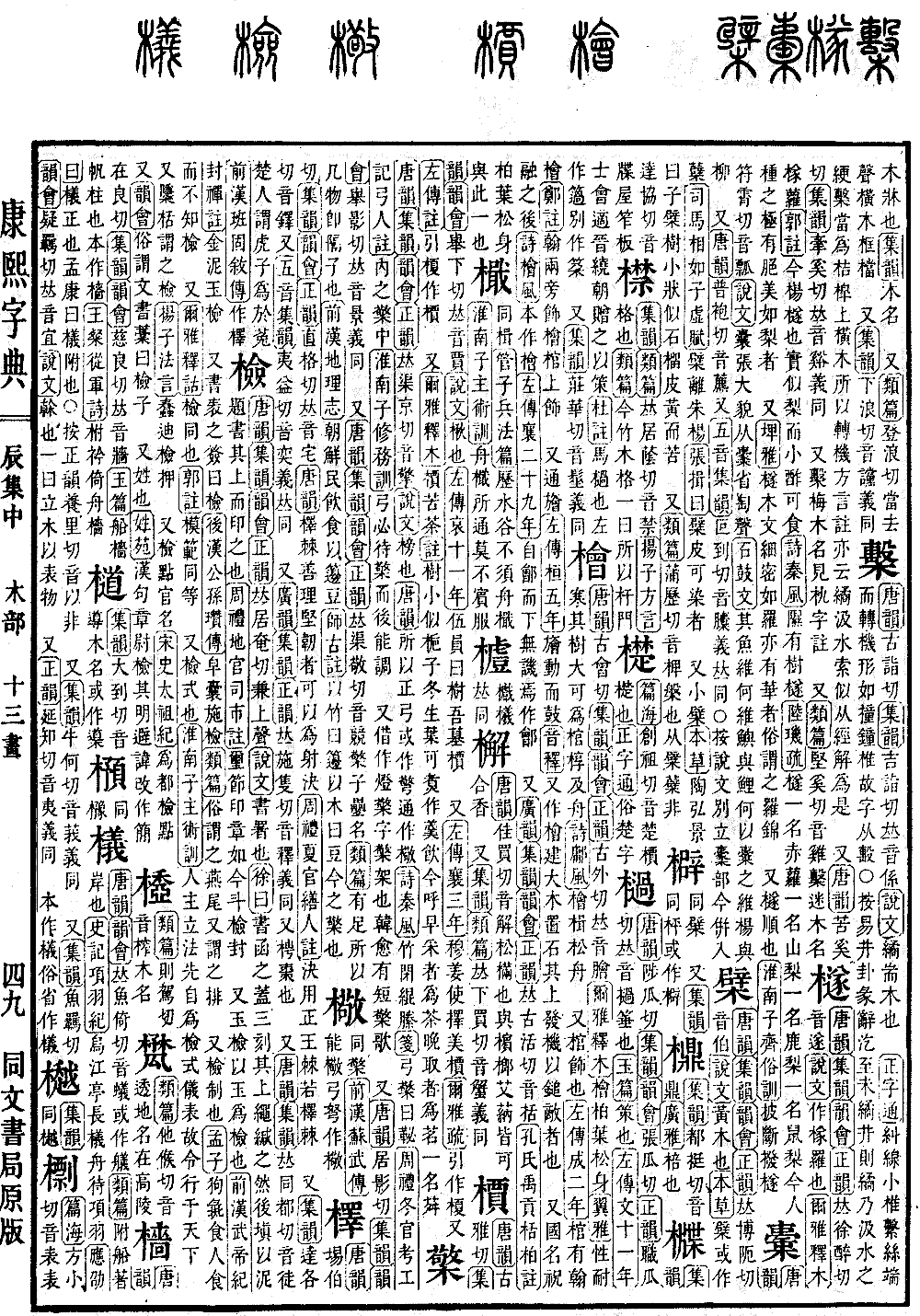
Chen Collection, Middle Volume
Radical: Tree (mù)
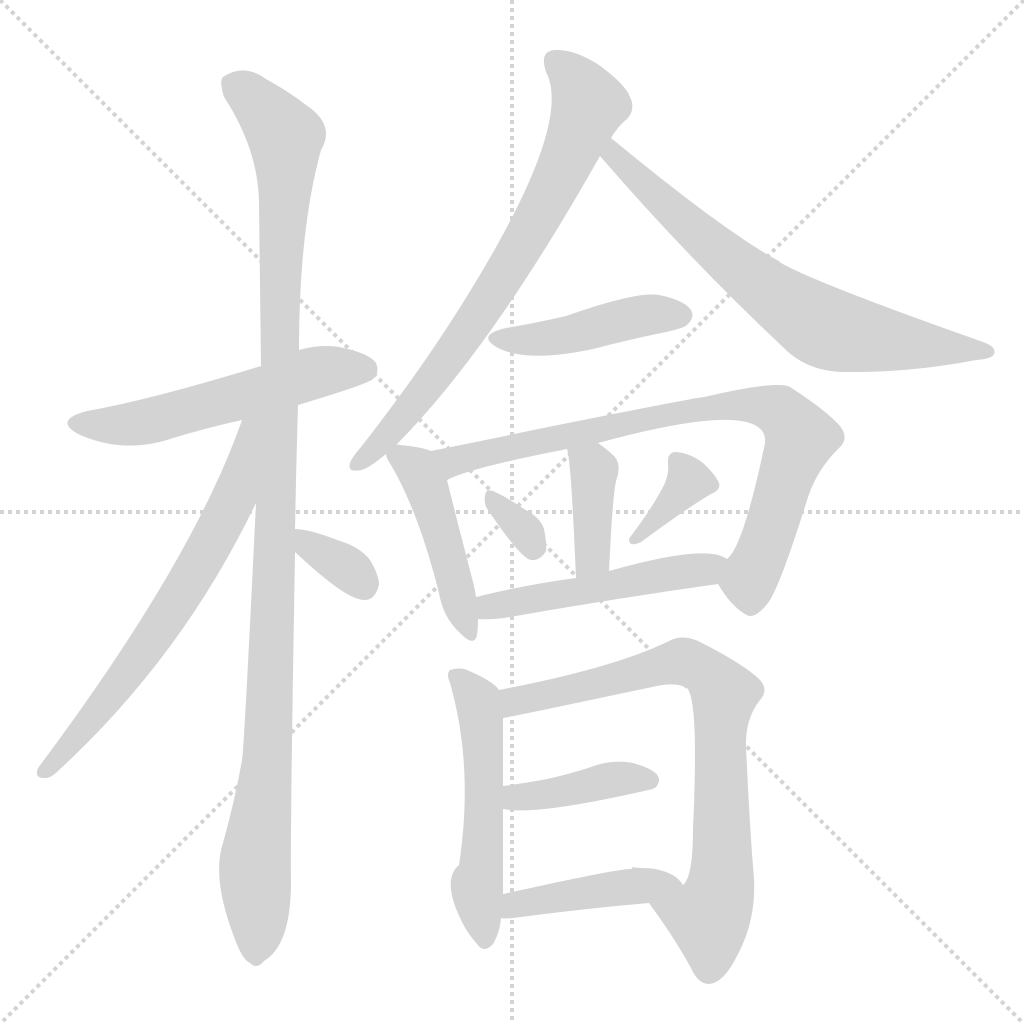
檜
Kangxi strokes: 17
Page 557, Entry 11
Tang Rhymes (Tangyun): Pronounced kuai (falling tone). Collected Rhymes (Jiyun), Rhyme Meetings (Yunhui), and Orthodox Rhymes (Zhengyun): Pronounced kuai (falling tone).
Erya: Explaining Trees (Erya Shimu): The huai is a tree with the leaves of a cypress and the body of a pine.
Winged Erya (Yiya): It is cold-resistant; the tree grows large and can be used for coffins and boats.
Book of Odes (Shijing), Odes of Wei (Weifeng): Oars of huai wood and boats of pine.
Also refers to coffin decorations.
Zuo Tradition (Zuozhuan), Second Year of Duke Cheng: The coffin has side decorations and top decorations (hui).
Du Yu's Commentary: The han are the decorations on the two sides. The huai are the decorations on top of the coffin.
Also interchangeable with the term kuai (a type of ancient banner).
Zuo Tradition (Zuozhuan), Fifth Year of Duke Huan: When the banner (kuai) moves, the drums are sounded.
Sound and Meaning (Yinyi): Also written as huai. It refers to erecting a large timber with a stone placed on top, which is triggered to crush the enemy.
Also a name of a state. A descendant of Zhurong.
Book of Odes (Shijing), Odes of Huai (Huaifeng): Originally written as huai.
Zuo Tradition (Zuozhuan), Twenty-Ninth Year of Duke Xiang: From the state of Kuai downwards, there is no criticism. Written as Kuai.
Also Guangyun, Jiyun, Yunhui, and Zhengyun: Pronounced kuo (entering tone).
Kong's Commentary on the Tribute of Yu (Yugong Guabai Commentary): Pine-bodied with cypress-like leaves. It is the same as the above.
Textual Revisions:
Book of Odes (Shijing), Odes of Yong (Yongfeng): Oars of huai wood and boats of pine. Corrected from Odes of Yong (Yongfeng) to Odes of Wei (Weifeng) according to the original text.
Zheng's Commentary: The han are the decorations on the two sides. Corrected from Zheng's Commentary to Du's Commentary according to the original text.
Sound and Meaning (Yinyi): Also written as huai. It refers to erecting a large timber with a stone placed on top, which is triggered to crush the enemy. Corrected from Sound and Meaning (Yinshi) to Sound and Meaning (Yinyi) according to the original text, and corrected to crush the enemy.