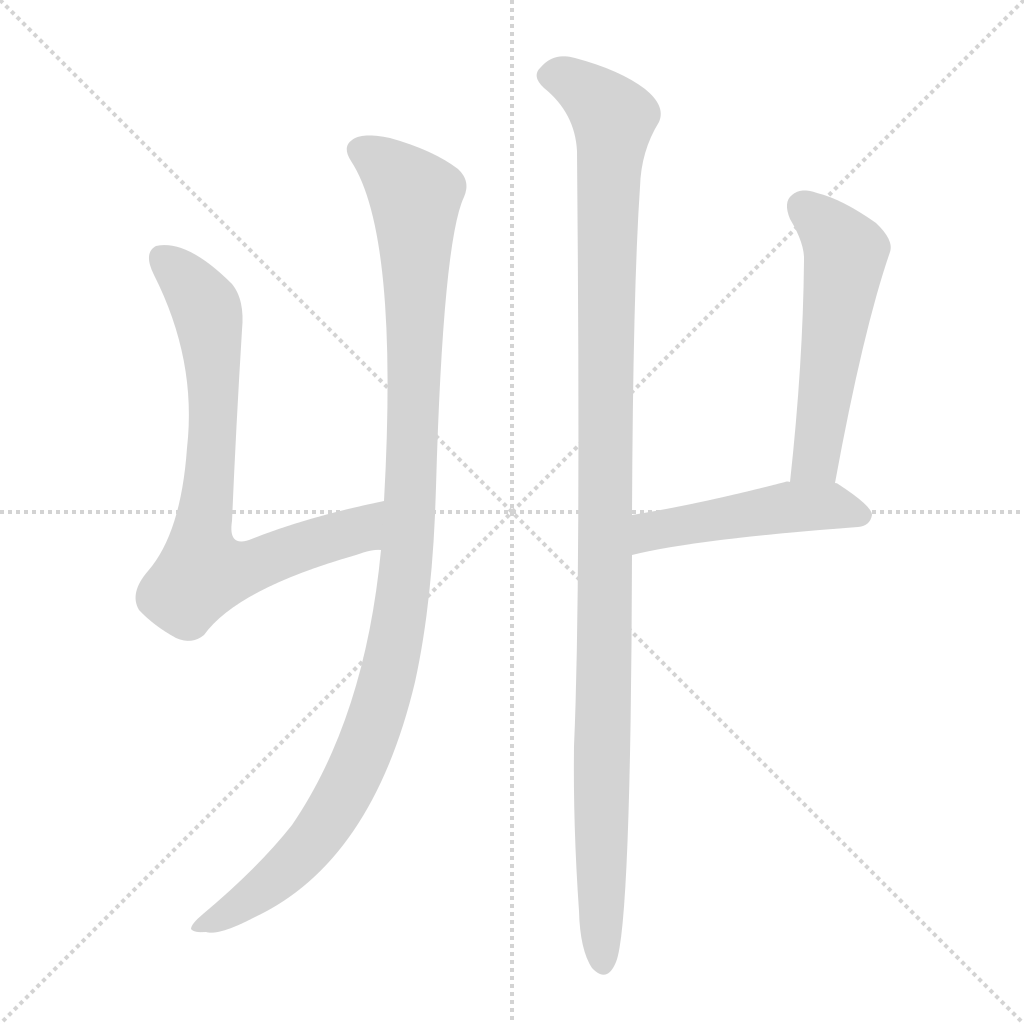
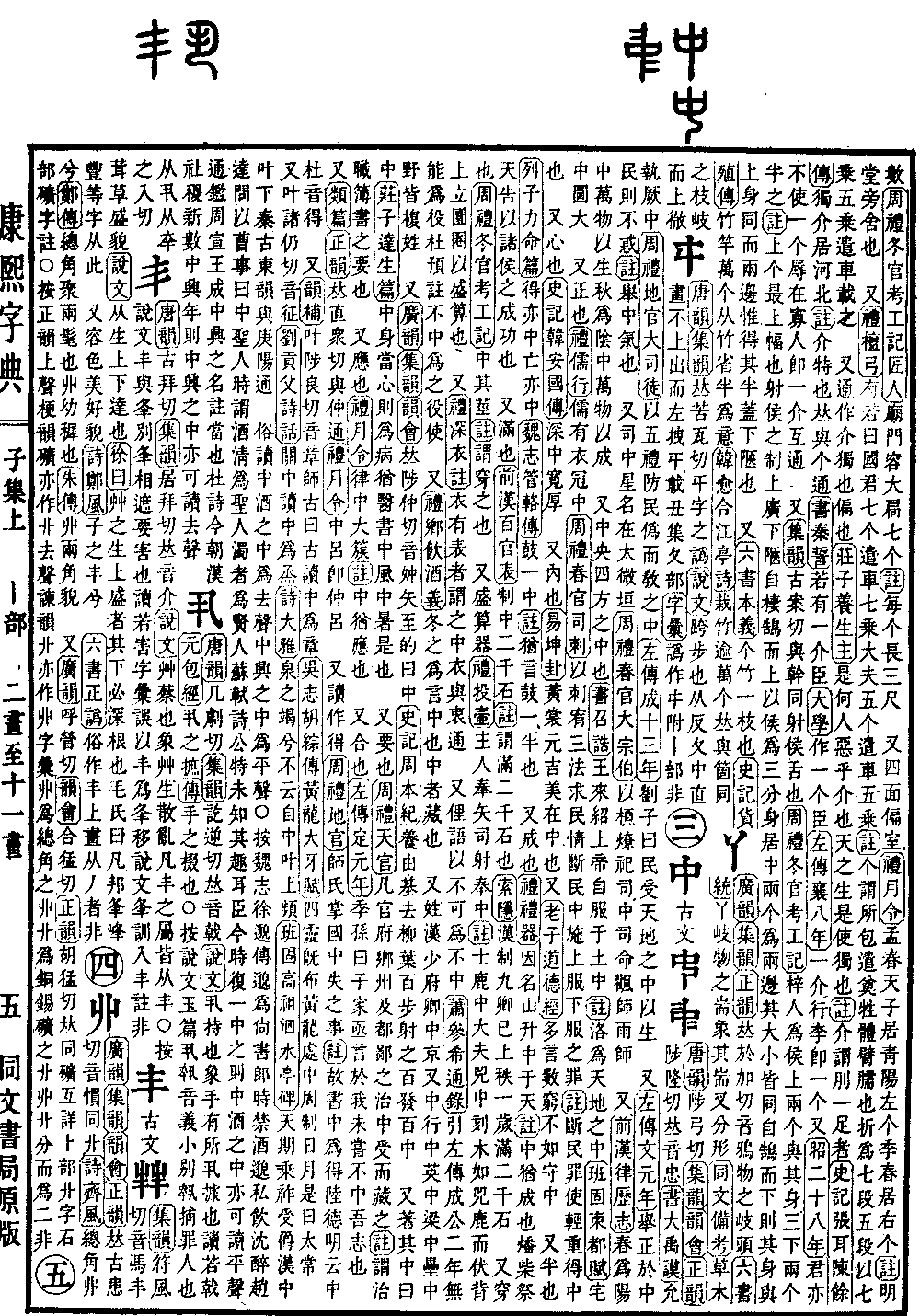
Zi Collection, Page Position: Upper
Radical: Line (gǔn)
Kangxi Stroke Count: 5
Page 79, Number 10
According to the Broad Rhymes (Guangyun), Collected Rhymes (Jiyun), Rhyme Assembly (Yunhui), and Correct Rhymes (Zhengyun), the pronunciation is derived from the initial of gǔ and the final of huàn, sounding like guàn. It is the same as the character guàn.
With hair gathered in tufts like horns — Book of Odes (Shijing), Odes of Qi. Mao's Commentary (Maozhuan) states that zongjiao refers to gathering the hair into two tufts, and guàn means being in one's youth. Zhu's Commentary (Zhuzhuan) states that guàn describes the appearance of two horn-like tufts.
Also, according to the Broad Rhymes, Rhyme Assembly, and Correct Rhymes, it is pronounced with the initial of hū, hé, or hú and the final of qiè or měng. It is the same as the character for ore (kuàng). For further details, see the entries for the character guàn under the Radical: Divination (bǔ) and the character kuàng under the Radical: Stone (shí).
According to the Correct Rhymes, in the rising tone and gěng rhyme, the character for ore (kuàng) is also written as guàn. In the departing tone and jiàn rhyme, the character guàn is also written as the form used for the hairstyle. The Lexicon (Zihui) claims that the first form is for the hairstyle and the second is for copper and tin ore, but separating them into two distinct characters is incorrect.
Textual Research: In the Book of Odes, Odes of Qi, for the line "With hair gathered in tufts like horns," the attribution to Zheng's Commentary has been corrected to Mao's Commentary according to the original source.