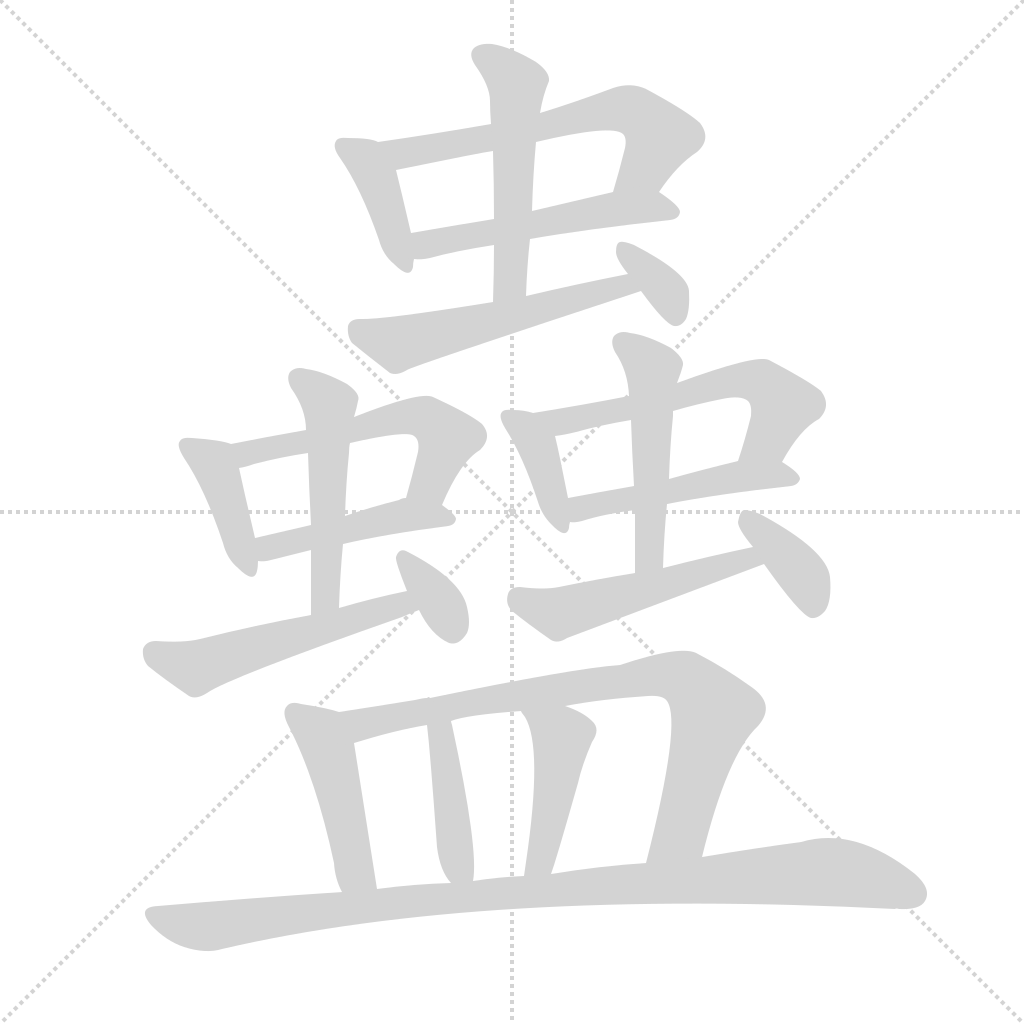
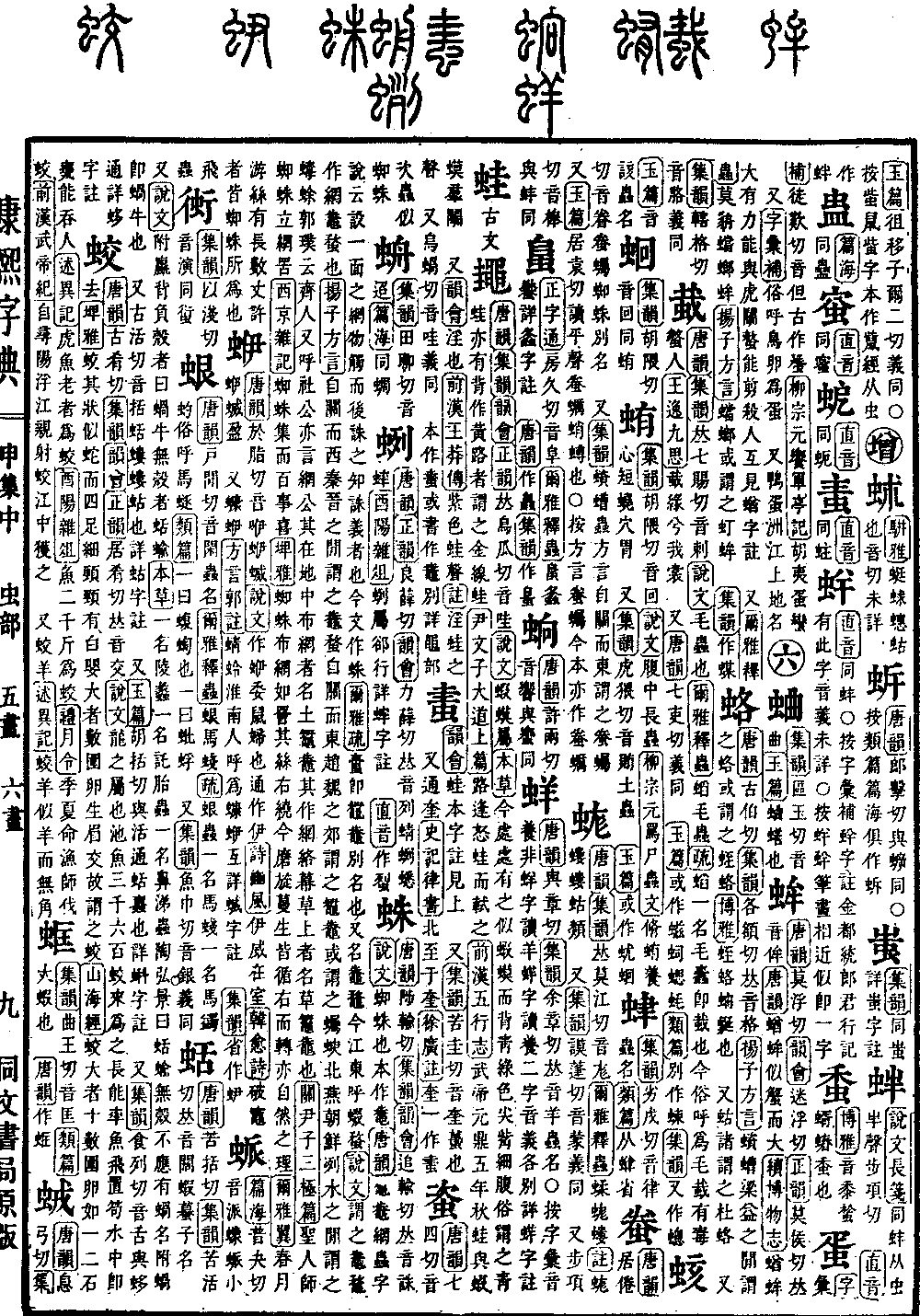
Shen Collection, Middle Volume. Radical: Insect (chóng). Kangxi stroke count: 23. Page 1081, Entry 01.
Pronounced gǔ.
According to the Shuo Wen Jie Zi (Explaining Graphs and Analyzing Characters), it refers to insects inside the abdomen. According to the Tongzhi: Liushu Lue (General Treatise: Summary of the Six Writings), the method of creating gu involves placing various insects into a vessel and allowing them to devour one another; the one that survives is the gu.
As stated in the Zuo Zhuan (Chronicle of Zuo), Year 1 of Duke Zhao, observing the character form, the vessel component combined with the insect component creates the character for gu. The commentary notes that the vessel component represents a container, and when a container suffers from insect infestation, it is called gu.
According to the Zhou Li (Rites of Zhou), Office of Autumn, the Shushi official was responsible for the exorcism of poisonous gu. According to the Shiji (Records of the Grand Historian), Annals of Qin, in the second year of Duke De of Qin, the practice of the dog sacrifice during the dog days of summer was first established to ward off the poison of gu.
Also, as stated in the Zuo Zhuan, Year 1 of Duke Zhao, flying insects that emerge from grains are also called gu. According to the Shuyi Ji (Record of Strange Things), during the late Jin dynasty, there was persistent rain in Jingzhou, and millet grains transformed into gu insects.
Additionally, the Shuo Wen Jie Zi notes that the spirits of those who have been executed or died violent deaths can also transform into gu.
Also, Gudiao is the name of a wild beast. According to the Shan Hai Jing (Classic of Mountains and Seas), there is a beast on Luwu Mountain called the Gudiao; its appearance resembles an eagle but it possesses horns, and its cry is like the wailing of an infant.
According to the Erya: Shigu (Approaching the Standard: Explaining Ancient Terms), gu means to be in doubt. According to the commentary on the Zuo Zhuan, gu refers to a type of bewildering illness, signifying a condition where the mind is confused and chaotic.
It is also the name of a hexagram. In the Book of Changes (Yijing), the Xun hexagram placed below the Gen hexagram forms the Gu hexagram. The Xugu Zhuan (Treatise on the Sequence of Hexagrams) states that Gu refers to the existence of affairs occurring.
Pronounced gù. The meaning is the same.
Pronounced yě. It refers to being charming or bewitching.
According to the Jiyun (Standard Rites), the pronunciation and meaning are identical to ye. In the Hou Hanshu (Book of the Later Han), Biography of Ma Rong, Guangcheng Song (Ode to the Imperial Hunting Park), there is the phrase tian kai gu ye. The commentary notes that gu is synonymous with ye.
Textual Research: According to the Erya: Shigu, gu means to be in doubt. According to the Zuo Zhuan commentary, gu is a bewildering illness, referring to a condition where the mind is confused. Corrected to read chaos according to the original text.