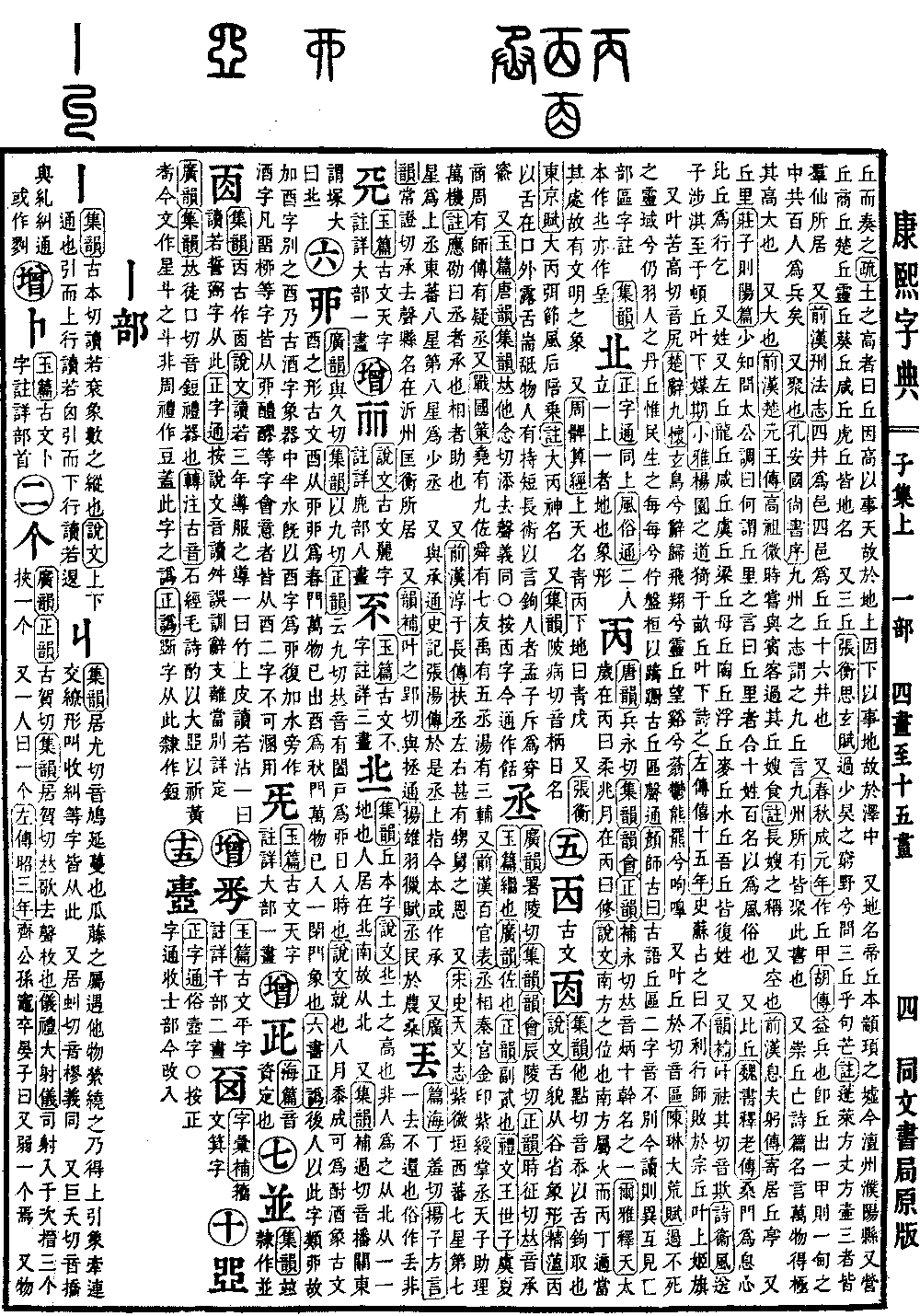
Zi Collection, Page Position: Upper
Radical: Vertical Line (gǔn)
Kangxi stroke count: 10; Page number: 78, entry 23
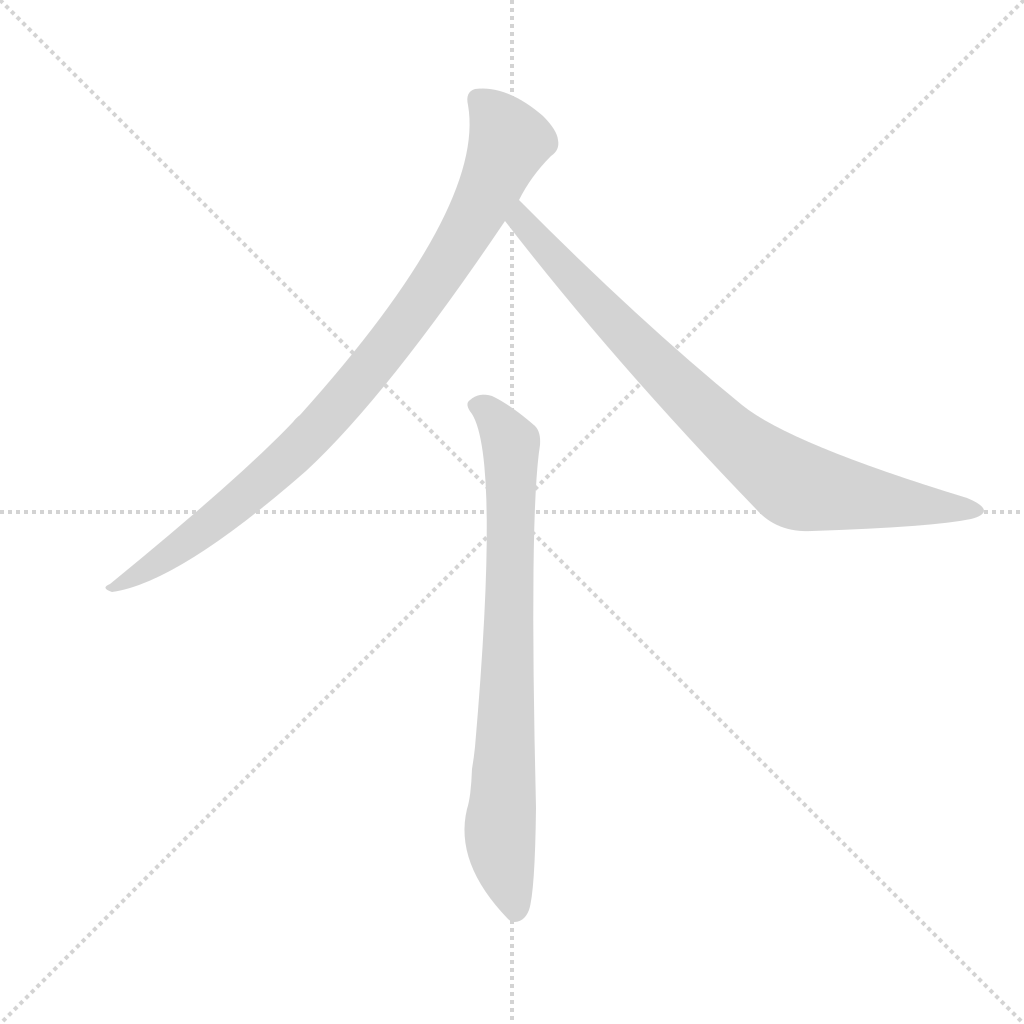
From Guangyun (Guangyun) and Zhengyun (Zhengyun), pronounced in the departing tone (qùshēng) similar to *gē*. It signifies "piece" or "item".
From the Book of Rites (Yili), Great Archery Ceremony (Dàshè Yí): "The Director of Archery enters the changing room, having three arrows stuck in his belt and one held under his arm."
It also refers to a single person.
From the Commentary of Zuo (Zuozhuan), Duke Zhao, third year: "Gongsun Zao of Qi died. Yanzi said: 'Alas, another person is gone!'"
Furthermore, it denotes the quantity of items.
From the Rites of Zhou (Zhouli), Artisans (Kǎogōngjì): "The temple gate can accommodate seven large *jīong* (structural crossbeams)." Note: "Each measures three *chi* in length."
It also refers to the side rooms facing the four directions.
From the Book of Rites, Monthly Ordinances (Yuèlìng): "In the first month of early spring, the Son of Heaven resides in the left *ge* (side room) of the Qingyang Hall. In the third month of late spring, he resides in the right *ge* (side room)." Note: This refers to the side chambers of the Mingtang (Bright Hall).
Furthermore, from the Book of Rites, Tan Gong (Tángōng): "You Ruo said: 'For the ruler, seven *ge* are used, with seven escort carriages. For the grandee, five *ge* are used, with five escort carriages.'" Note: Here, *ge* refers to the arm, shoulder, and other parts of the sacrificial animal's body used for the funeral offering (qiǎndiàn), which are wrapped. These are divided into seven or five portions and loaded onto seven or five escort carriages, respectively.
Also interchangeable with *jiè*. It signifies "single" or "isolated".
From Zhuangzi (Zhuāngzi), The Secret of Caring for Life (Yǎngshēng Zhǔ): "Who is this person? How does he have only one foot? Is it Heaven that made him one-footed?" Note: *Jiè* refers to a person whose foot has been cut off.
From the Records of the Grand Historian (Shiji), Biographies of Zhang Er and Chen Yu (Zhāng'ěr Chényú Lièzhuàn): "He lived alone north of the Yellow River." Note: *Jiè* means "unique" or "singular." It is interchangeable with *ge*.
From the Book of Documents (Shangshu), The Qin Oath (Qínshì): "If there is a minister..."
In the Great Learning (Daxue), it is written as "one minister."
From the Commentary of Zuo, Duke Xiang, eighth year: "a single envoy."
From the Commentary of Zuo, Duke Zhao, twenty-eighth year: "The ruler did not even send a single envoy to inform me, the lonely one."
That is, it is interchangeable with *yī jiè*.
Furthermore, from Jiyun (Jiyun), pronounced *gǔ'ànqiē*. It is the same as *gān*. It refers to the "tongue" part of an archery target.
From the Rites of Zhou, Artisans (Kǎogōngjì): "The artisan who crafts the target makes the two upper *ge*, plus the main body of the target, forming three portions in total. The two lower *ge* are half the size of the upper ones." Note: "Upper *ge*" refers to the topmost part. The shape of an archery target is wider at the top and narrower at the bottom. From the *hú* (stylized bird marking the target center) upwards, the target is divided into three portions: the main body is in the middle, and the two *ge* are on either side, all of which are of the same size. From the *hú* downwards, the main body is the same as the upper main body, but the two *ge* on the sides are only half its size because the bottom is narrow.
Furthermore, from The Original Meaning of the Six Scripts (Liùshū Běnyì): *Ge* refers to a single stalk of bamboo.
From the Records of the Grand Historian, Biographies of Merchants (Huòzhí Lièzhuàn): "ten thousand bamboo poles."
The character form derives from "bamboo" (zhú) with half omitted, to convey this meaning.
From Han Yu (Hán Yù), Poem on Hejiang Pavilion (Héjiāng Tíng Shī): "planted over ten thousand bamboos."
It is the same as *gè*.
Textual Research: In the Book of Rites, Great Archery Ceremony (Dàshè Yí): "The Director of Archery enters the changing room, having three arrows stuck in his belt and one held under his arm." Strictly speaking, the character *ge* is omitted after "stuck three" in the original text.
From the Zihui (Zìhuì) dictionary: The variant form *gè* is the same as *ge*.
In Zheng Xuan's (Zhèng Xuán) commentary on the Book of Rites: "Commonly, *ge* is referred to as *gè*."
Note: The character *gè* was added by later generations. *Ge* and *gè* are considered the correct forms.