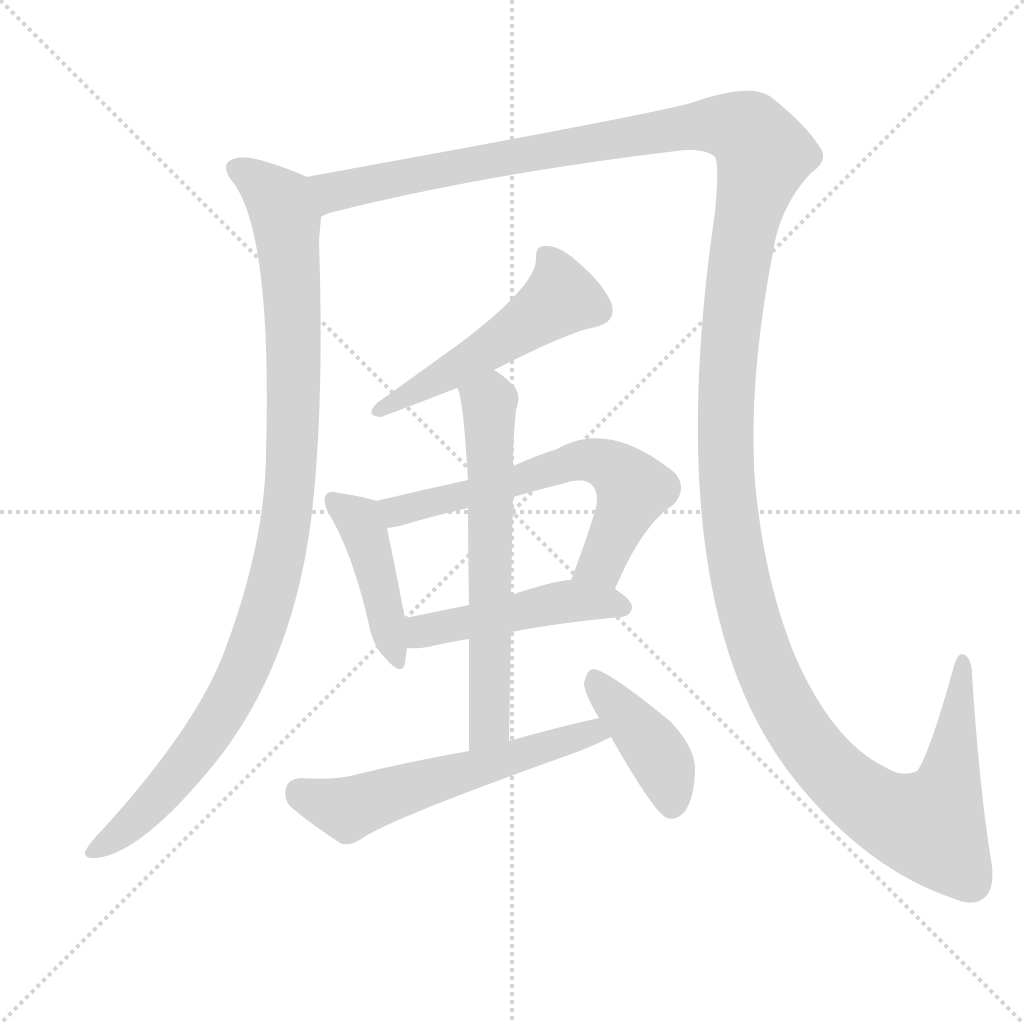
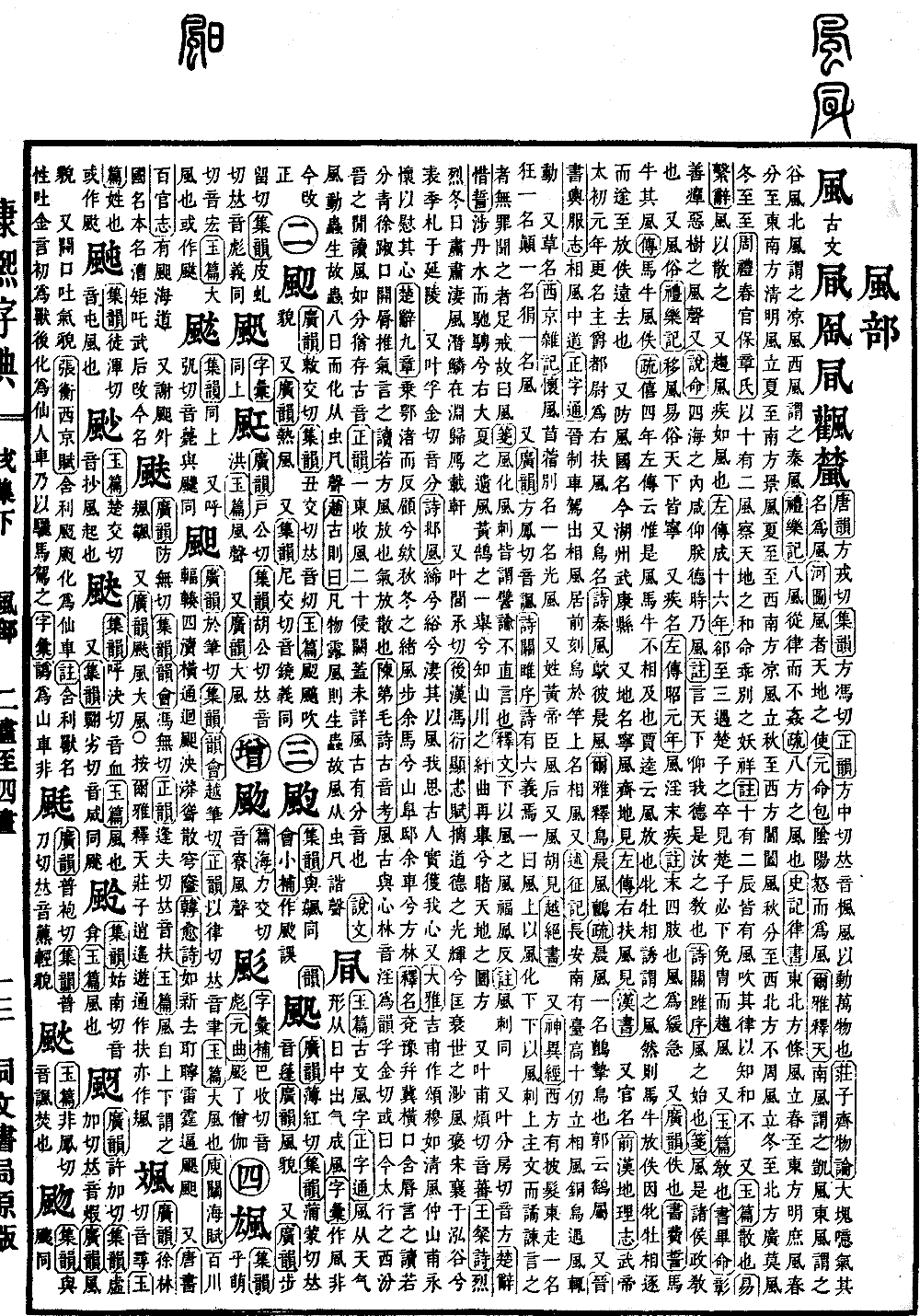
Xu Collection, Lower Volume
Radical: Wind (fēng)
Page 1411, Entry 01
Original form: (Ancient script variants listed)
Pronounced feng
The movement of air that stirs all things. Zhuangzi, Discourses on Making All Things Equal (Zhuangzi Qi Wu Lun): The breath exhaled by the great earth is called wind. River Chart (He Tu): Wind is the messenger of heaven and earth. Records of the Origin of Life (Yuan Ming Bao): The collision of the two qi of yin and yang becomes wind. Literary Expositor (Erya), Explanation of Heaven: The south wind is called kai wind, the east wind is called gu wind, the north wind is called liang wind, the west wind is called tai wind. Book of Rites (Liji), Record of Music: The winds of the eight directions follow the musical scales without confusion. Commentary: Refers to the winds of the eight cardinal and ordinal directions. Records of the Grand Historian (Shiji), Treatise on the Musical Pitch Pipes: The northeast wind is the tiao wind, arriving at the beginning of spring. The east wind is the mingshu wind, arriving at the spring equinox. The southeast wind is the qingming wind, arriving at the beginning of summer. The south wind is the jing wind, arriving at the summer solstice. The southwest wind is the liang wind, arriving at the beginning of autumn. The west wind is the changhe wind, arriving at the autumn equinox. The northwest wind is the buzhou wind, arriving at the beginning of winter. The north wind is the guangmo wind, arriving at the winter solstice. Book of Rites (Zhouli), Spring Offices, Preserver of Astronomical Observations: Use the twelve winds to observe the harmony of heaven and earth and to determine signs of good or ill fortune. Commentary: At each of the twelve double-hours, winds blow through the pitch pipes to determine if there is harmony. Also means to scatter or disseminate. Classic of Changes (Yi Jing), Appended Remarks: Wind is used to scatter things. Also means to move quickly like the wind. Zuo Tradition (Zuozhuan), 16th Year of Duke Cheng: Xie Zhi met the soldiers of the King of Chu three times; upon seeing the King, he would descend from his chariot, remove his helmet, and approach with quick, hurried steps to show respect. Also means moral influence or transformation. Book of Documents (Shujing), Bi's Charge: Commend virtuous actions, hate evil deeds, and establish good customs and reputation. Also, Presentation of the Charge: Within the four seas, all look up to my virtue; this is your teaching. Commentary: It means all under heaven look up to my virtue, which is the result of your teaching. Classic of Poetry (Shijing), Preface to Guan Ju: This is the beginning of the Winds (Feng). Commentary: Wind refers to the political edicts and moral teachings of the feudal lords. Also refers to customs. Book of Rites (Liji), Record of Music: Change the customs and habits, and the world will be at peace. Also refers to a type of illness. Zuo Tradition (Zuozhuan), 1st Year of Duke Zhao: Evil winds cause diseases of the limbs. Commentary: Mo refers to the four limbs. Wind causes illnesses that are either slow or acute. Also, in the broad dictionary (Guangyun), refers to losing, wandering away, or becoming unrestrained. Book of Documents (Shujing), Oath of Fei: Horses and cattle wander away. Commentary: Horses and cattle wander off and become unrestrained. Explanation: The Zuo Tradition (Zuozhuan) 4th year of Duke Xi says: Even if horses and cattle wander away, they will not run into the territory of others. Jia Kui said: Wind means to be unrestrained. When males and females entice each other, it is called wind. Thus, when horses and cattle wander off, it is because the males and females chase each other, eventually leading to them wandering far away. Also refers to Fangfeng, a state name, modern-day Wukang County in Huzhou. Also refers to a place name. Ningfeng was a place in the State of Qi, seen in the Zuo Tradition (Zuozhuan). Youfufeng is seen in the Book of Han (Hanshu). Also refers to an official title. Former Han Dynasty, Treatise on Geography: In the first year of the Taichu era of Emperor Wu of Han, the Chief Commandant of Justice was renamed Youfufeng. Also refers to a bird name. Classic of Poetry (Shijing), Qin Wind: That swift-flying Chenfeng bird. Literary Expositor (Erya), Explanation of Birds: Chenfeng is the zhan bird. Commentary: Chenfeng, also called zhan, is a bird of prey. Guo Pu said: It belongs to the hawk family. Also, Book of Jin (Jinshu), Treatise on Carriages and Attire: The wind-measuring instrument (xiangfeng yi) stands in the center of the road. Accurate Dictionary (Zhengzitong): Under the Jin Dynasty system, when the imperial carriage traveled, the wind-measuring instrument went ahead. A wooden bird was carved on a pole, called the wind-measurer. Also, Records of Descriptions of Travels (Shuzheng Ji): South of Chang'an, there is a tower ten ren high; on top is a copper bird measuring the wind, which turns when it encounters the wind. Also refers to a grass name. Miscellaneous Records of the Western Capital (Xijing Zaji): Huaifeng is another name for alfalfa. It is also called guangfeng. Also refers to a surname. Feng Hou was a minister to the Yellow Emperor. There is also Feng Hu, seen in the Book of Yue Jue (Yuejue Shu). Also, Book of Marvels (Shenyi Jing): In the west, there are people who run east with disheveled hair; one is named Kuang, one is Dian, one is Juan, and one is Feng. Also, in the broad dictionary (Guangyun), pronounced feng. Classic of Poetry (Shijing), Preface to Guan Ju: Poetry has six meanings. The first is called Feng. Those in high positions use the wind to teach the lower classes; the lower classes use the wind to remonstrate with those in high positions, using beautiful language and indirect persuasion; the speaker is not at fault, and the listener is sufficiently warned; therefore, it is called Feng. Commentary: Moral transformation and satirical criticism are both metaphors, not expressed directly. Explanation of Characters: The word wind in "The lower classes use it to wind (teach/influence) them" is pronounced feng. Commentary: The wind in "satirical criticism" (fengci) is pronounced the same. Also rhymes with fang. Songs of Chu (Chuci), Sorrow for the Departed: Crossing the Dan River and galloping on, on the right is the lingering influence of the Great Xia. When the yellow swan flies to the sky, it knows the curves of the mountains and rivers; flying high once more, it sees the square and round of heaven and earth. Also rhymes with fan. Poem by Wang Can: The freezing winter days, the killing cold wind. Fish hide in the deep abyss, returning wild geese fly high. Also rhymes with long. Former Han Dynasty, Feng Yan's Biography: Spreading the radiance of morality, correcting the decadent customs of a declining age. Praising Duke Xiang of Song at Honggu, honoring Jizha at Yanling. Also rhymes with fen. Classic of Poetry (Shijing), Bei Wind: Fine kudzu cloth or coarse kudzu cloth, wearing it on the body is cool like the wind. I miss the ancients; it truly suits my heart. Also, Greater Odes (Daya): Jifu created the songs of praise, harmonious like a clear wind. Zhong Shanfu long remembered this, using it to comfort his heart. Songs of Chu (Chuci), Nine Declarations: Climbing the E Islet and looking back, sighing at the lingering wind of autumn and winter. Letting my horse stroll on the ridge, stopping my carriage at Fanglin. Explaining Names (Shiming): The regions of Yanzhou, Yuzhou, Bingzhou, and Jizhou use the lips to close and sound, sounding like "fen." The regions of Qingzhou and Xuzhou use the pursed lips and open the mouth to release air, sounding like "fang." Feng means to release; the breath is released. Chen Di, Examination of Ancient Sounds in the Book of Poetry: In ancient times, Feng rhymed with the words xin, lin, and yin, and was pronounced fen. Some say that west of the Taihang Mountains, along the Fen River and Jin territory, they still pronounce Feng like "fen," preserving the ancient sound. Accurate Dictionary (Zhengzitong): The word Feng is recorded under the rhyme category "yi dong" (first), but it is missing from the "shier qin" (twelfth) category; this is likely because they were unaware that "Feng" had the "fen" pronunciation in ancient times. Original text: Wind blows, and insects are born; thus, insects transform in eight days. The character form derives from "insect," with "fan" indicating the sound. Zhao Guze said: Whenever objects are exposed to the wind, insects grow; thus, the word Feng is derived from "insect," and "fan" is the phonetic component. Textual correction: Literary Expositor (Erya), "The west wind is called Qin wind." According to the original text, "Qin wind" has been changed to "Tai wind." Book of Documents (Shujing), Oath of Fei: "Horses and cattle, wind (wandering) away." Commentary: Jia Kui said, "Wind means to be unrestrained." When males and females entice each other, it is called wind. Thus, when horses and cattle are unrestrained, it is because males and females chase each other, leading to them wandering far away. According to the original text, "horses and cattle are unrestrained" has been changed to "horses and cattle wind (wander) unrestrained." Chen Di, Examination of Ancient Sounds in the Book of Poetry: "In ancient times, Feng rhymed with xin, lin, and yin, and was pronounced fen." Accurate Dictionary (Zhengzitong): "The word Feng is recorded under the rhyme category 'yi dong' (first), but it is missing from the 'twelve qin' category; this is likely because they were unaware that 'Feng' had the 'fen' pronunciation in ancient times." According to the original text, "twentieth qin" has been changed to "twelfth qin."