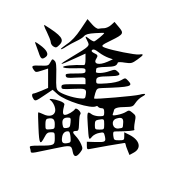
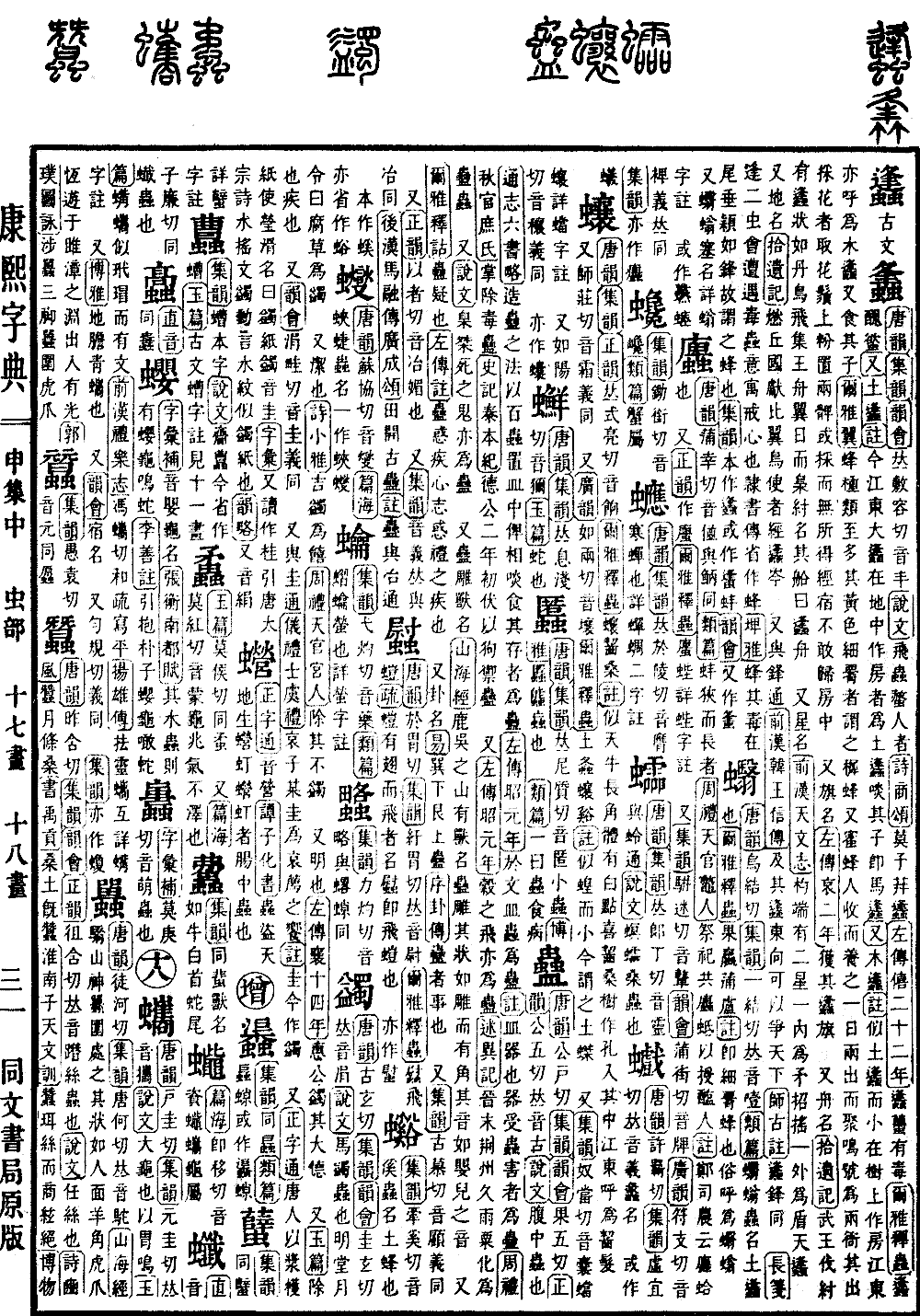
Shen Collection, Middle Volume. Radical: Insect (chóng). Kangxi stroke count: 23. Page 1103, Entry 01.
Ancient texts record: Tang Rhyme (Tangyun) and Collection of Rhymes (Jiyun) and Rhyme Assembly (Yunhui) define the pronunciation as feng (level tone). Explaining Characters and Writing (Shuowen Jiezi) defines it as a flying insect, one that stings. The Book of Odes (Shijing) contains the phrase, "Do not let me suffer from the wasp." The Zuo Commentary (Zuozhuan) records, "Wasps and scorpions have venom." Literary Expositor (Erya) states that for this type of insect, the tail is often curved. It also mentions the earth wasp. The commentary notes that in the Jiangdong region, large bees that nest in the ground are called earth wasps; their larvae are edible, known as horse wasps. It also mentions the wood wasp. The commentary notes that they are like earth wasps but smaller, building nests in trees; Jiangdong also calls these wood wasps, and their larvae are also eaten. The Wing of the Literary Expositor (Eryayi) notes that there are many varieties of wasps, among which the small yellow ones are called Zhi bees. There are also honey bees which people domesticate; they fly out and gather twice a day, which is called two-court duty. Those that go out to gather nectar carry pollen on their hind legs; if they fail to gather nectar, they do not dare return to the hive all night. It also refers to a type of flag. The Zuo Commentary (Zuozhuan) mentions capturing their wasp flags. It also refers to the name of a boat. Gleanings from History (Shiyiji) records that when King Wu of Zhou attacked the Shang King Zhou, a wasp appeared looking like a vermilion bird and landed on King Wu's boat. The next day, King Zhou was slain in the south, so that boat was named the Wasp Boat. It also refers to the name of a star. The History of the Former Han (Qian Hanshu) records that at the tip of the handle of the Big Dipper, there are two stars: the inner one is the Spear Yaoyao star, and the outer one is the Shield Wasp star. It also refers to a place name. Gleanings from History (Shiyiji) records that the Ranqiu state presented birds with wings joined together, and the envoy passed through Wasp Peak. It is also used interchangeably with the character for blade edge (feng). The History of the Former Han (Qian Hanshu) mentions, "When the blade points east, one can contend for the empire." Master Gu's commentary notes that the character here is the same as the one for blade edge. Long Draft (Changjian) interprets it as meeting two insects, implying an encounter with venomous creatures and symbolizing a state of caution. In the evolution of the clerical script, it is simplified as the character for bee (feng). The Amplification of the Literary Expositor (Piya) states that the poison of the bee is in the tail, the tip of which is as sharp as a blade edge, which is why it is called a bee. The Collection of Rhymes (Jiyun) states the original character is this one, sometimes written as the character for clam (bang). The Rhyme Assembly (Yunhui) notes it is also written in other forms.
Textual research: In the commentary to the Literary Expositor (Erya), the phrase "Today in Jiangdong there is the large wasp" has been corrected based on the original text to "Jiangdong calls them large wasps."