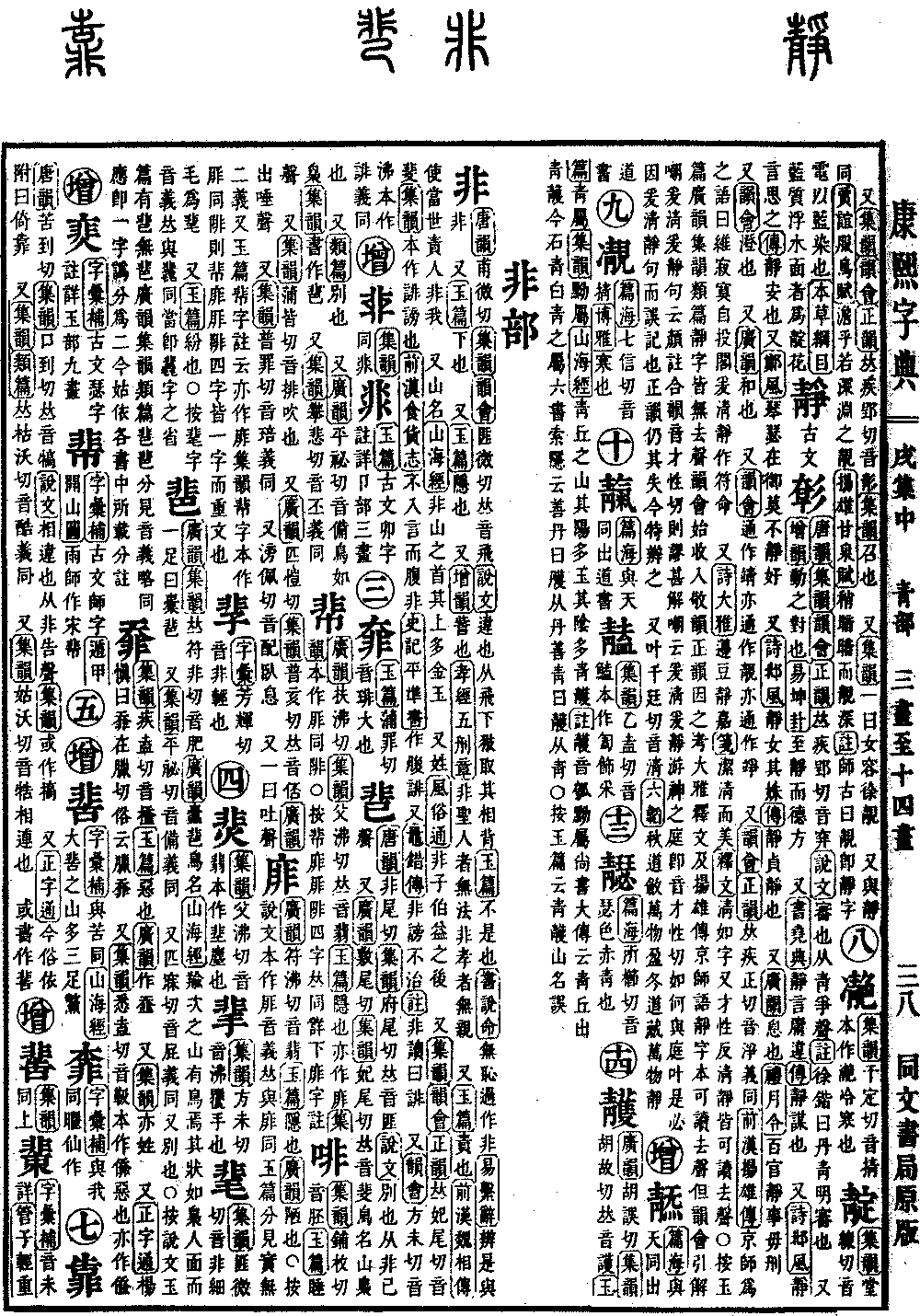
Xu Collection, Middle Volume
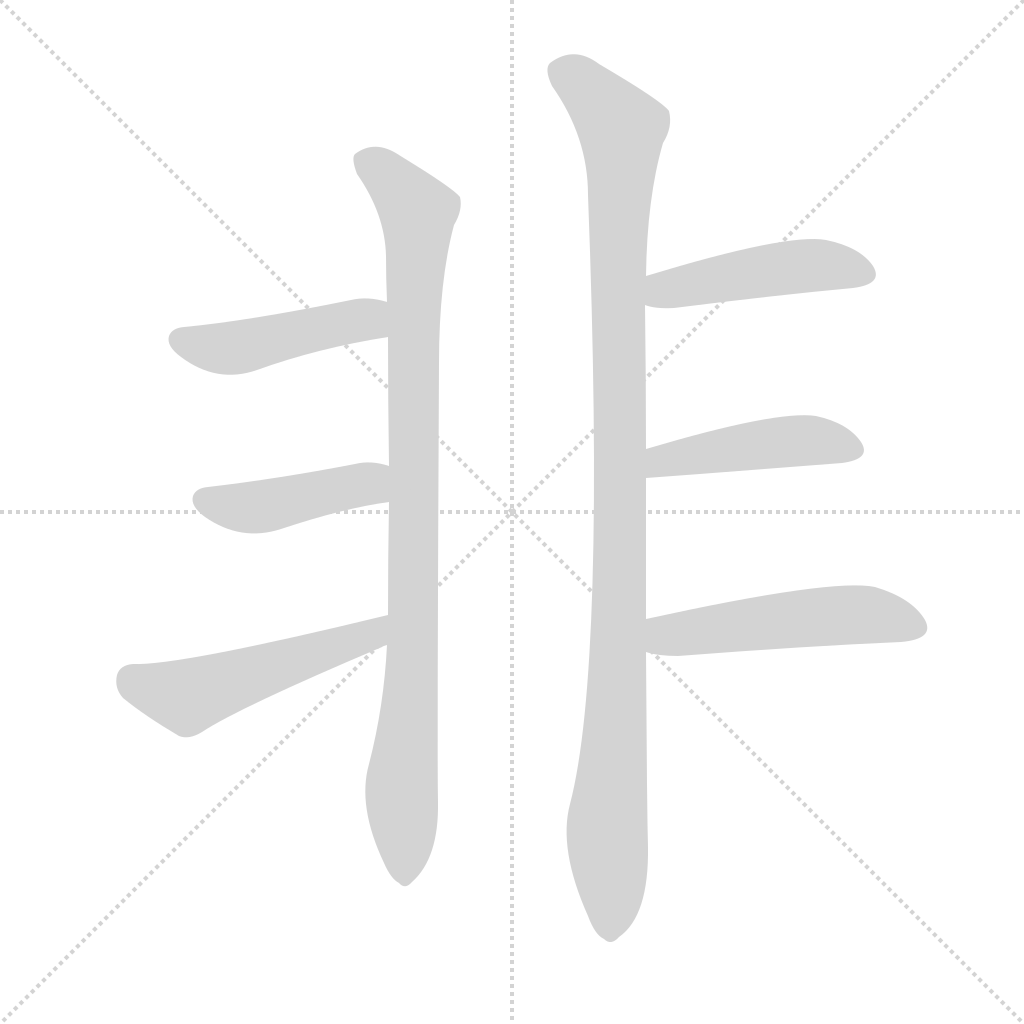
Radical: Non (fēi)
Page 1382, Entry 11
Pronounced fēi.
According to the Shuowen Jiezi (Shuowen), to violate or go against. The character structure derives from the lower portion of the character for fly, representing wings moving in opposite directions.
According to the Yupian (Yupian), it is not.
In the Book of Documents (Shangshu), do not be ashamed of mistakes and persist in error.
In the Book of Changes (Yijing), to distinguish between right and wrong.
Also, according to the Yupian, the meaning of under.
Also, according to the Yupian, the meaning of to hide.
Also, according to the Zengyun (Zengyun), to slander.
In the Classic of Filial Piety (Xiaojing), one who slanders the sages lacks proper conduct; one who slanders filial piety lacks familial affection.
Also, according to the Yupian, to reproach.
In the History of the Former Han Dynasty (Hanshu), let the people of the current generation reproach me.
Also, the name of a mountain. According to the Classic of Mountains and Seas (Shanhaijing), the origin of Fei Mountain, which produces much gold and jade.
Also, a surname. According to the Fengsu Tong (Fengsu Tong), Feizi was a descendant of Boyi.
Also, pronounced fěi.
According to the Jiyun (Jiyun), originally written as the character for slander. The meaning is to speak ill of someone.
In the History of the Former Han Dynasty (Hanshu), not speaking out publicly but slandering in one's heart.
In the Records of the Grand Historian (Shiji), written as belly-slander.
In the Biography of Chao Cuo (Chao Cuo zhuan), slandering is not punished. The commentary notes that non is read as the character for slander.
Also, pronounced fèi.
Originally written as the character for slander. The meaning is the same.