You Collection, Lower Volume
Radical: Carriage (chē)
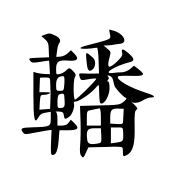
轓
Kangxi Stroke Count: 19
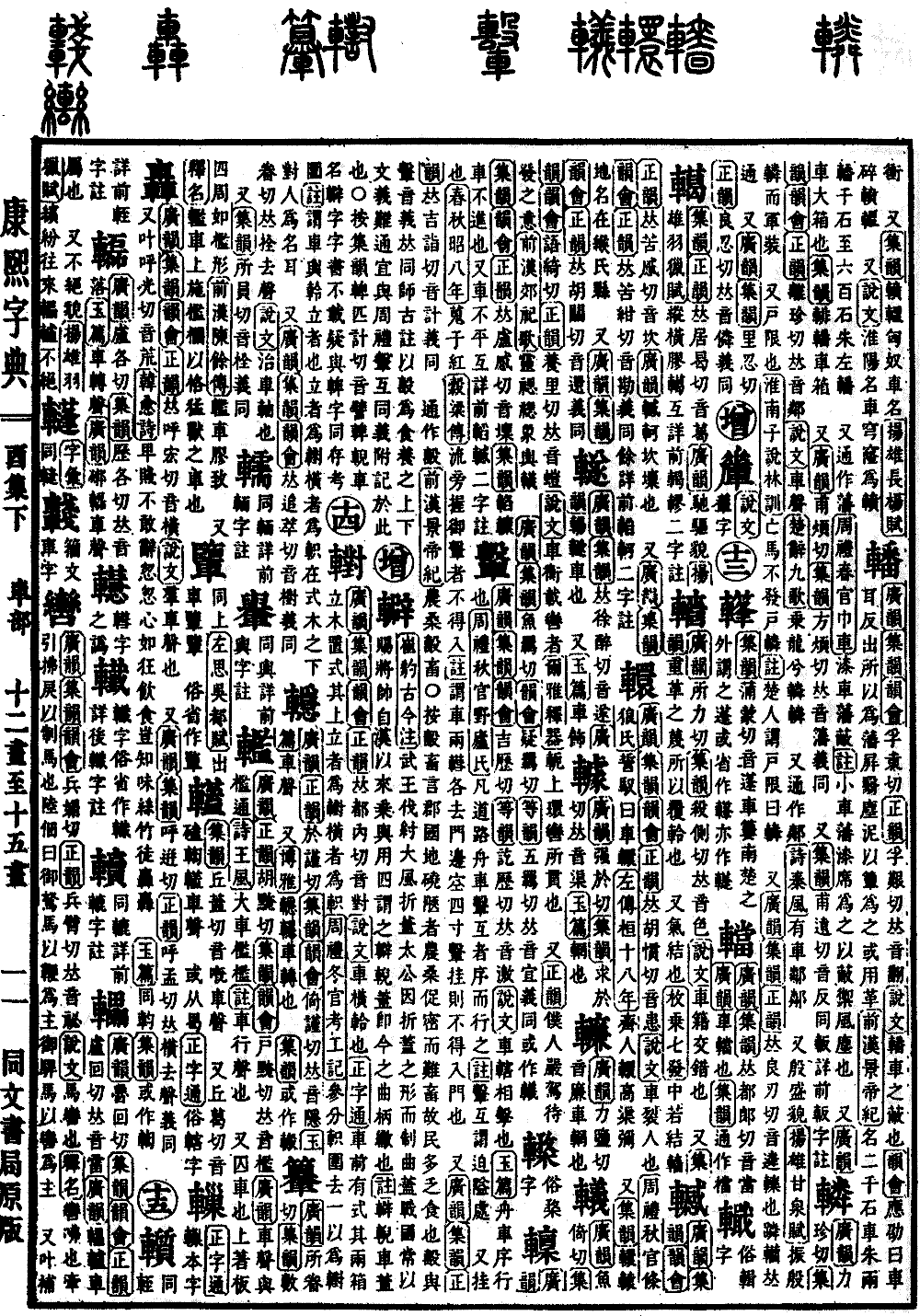
Page 1249, Entry 01
Broad Rhymes (Guangyun), Collected Rhymes (Jiyun), and Dictionary of Rhymes (Yunhui) state it is pronounced fan; Correct Rhymes (Zhengyun) states it is pronounced fan.
According to the Explaining Graphs and Analyzing Characters (Shuowen Jiezi), it is the screen of a carriage.
According to the Dictionary of Rhymes (Yunhui), Ying Shao states: The side pieces of a carriage turn outward to act as a screen to block dust and mud. They are made of bamboo mats, or sometimes leather.
In the Book of Han (Hanshu), Records of Emperor Jing: Orders stated that those with a two-thousand-dan rank use carriage side panels painted red on both sides, while those with a one-thousand to six-hundred-dan rank use side panels painted red only on the left side. It is also interchangeably written as fan (fence/screen).
In the Rites of Zhou (Zhouli), Spring Officials, Official of Carriages: Lacquered carriages with fan screens. The commentary states: The screens of small carriages are made of lacquered mats to block wind and dust for the driver.
Also, per Broad Rhymes (Guangyun), it refers to the large storage box of a carriage.
Per Collected Rhymes (Jiyun), the term hui-fan refers to a carriage box.
Also, per Broad Rhymes (Guangyun), it is pronounced fan; per Collected Rhymes (Jiyun), it is pronounced fan. The meaning is the same.
Also, per Collected Rhymes (Jiyun), it is pronounced fan. It is the same. See the note for the previous character.
Textual research: In the Book of Han (Hanshu), Records of Emperor Jing, the text originally read ming (to name); it has been corrected to ling (to order) to match the original text.