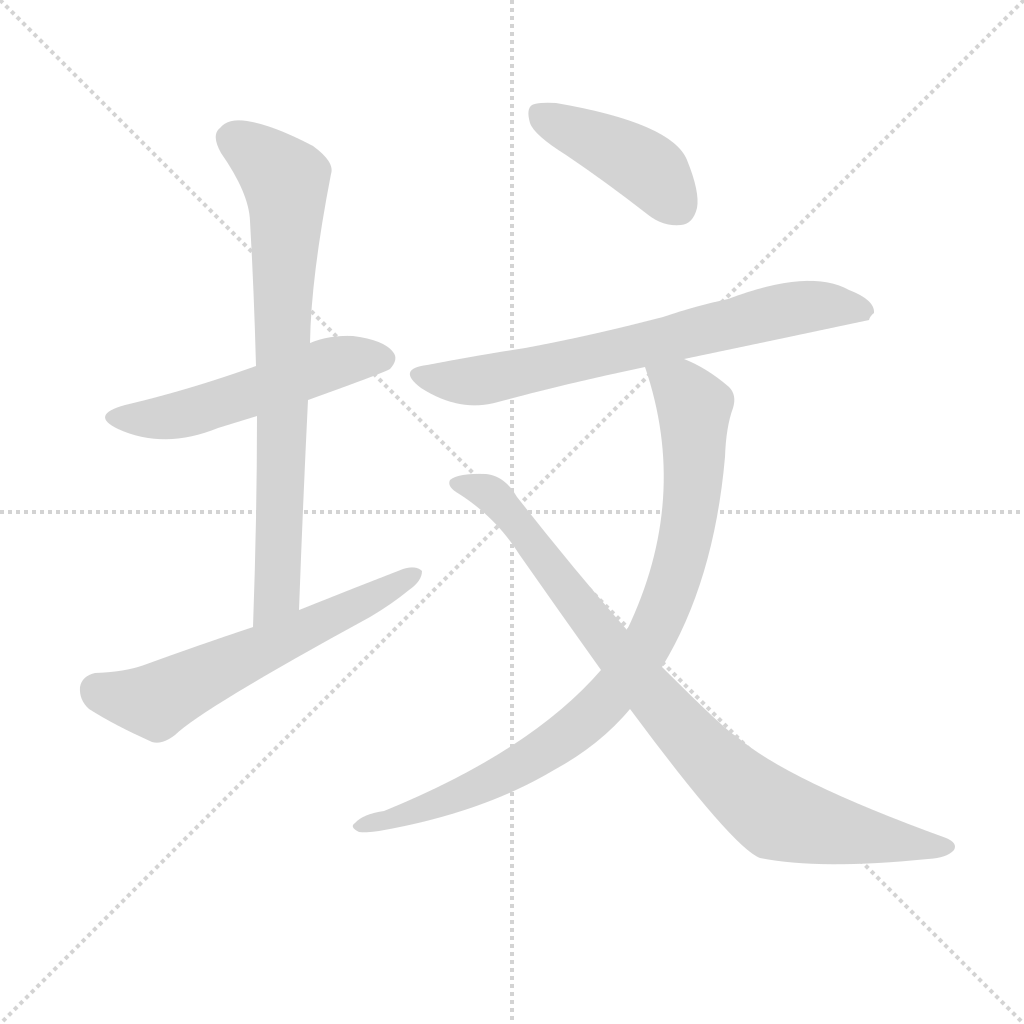
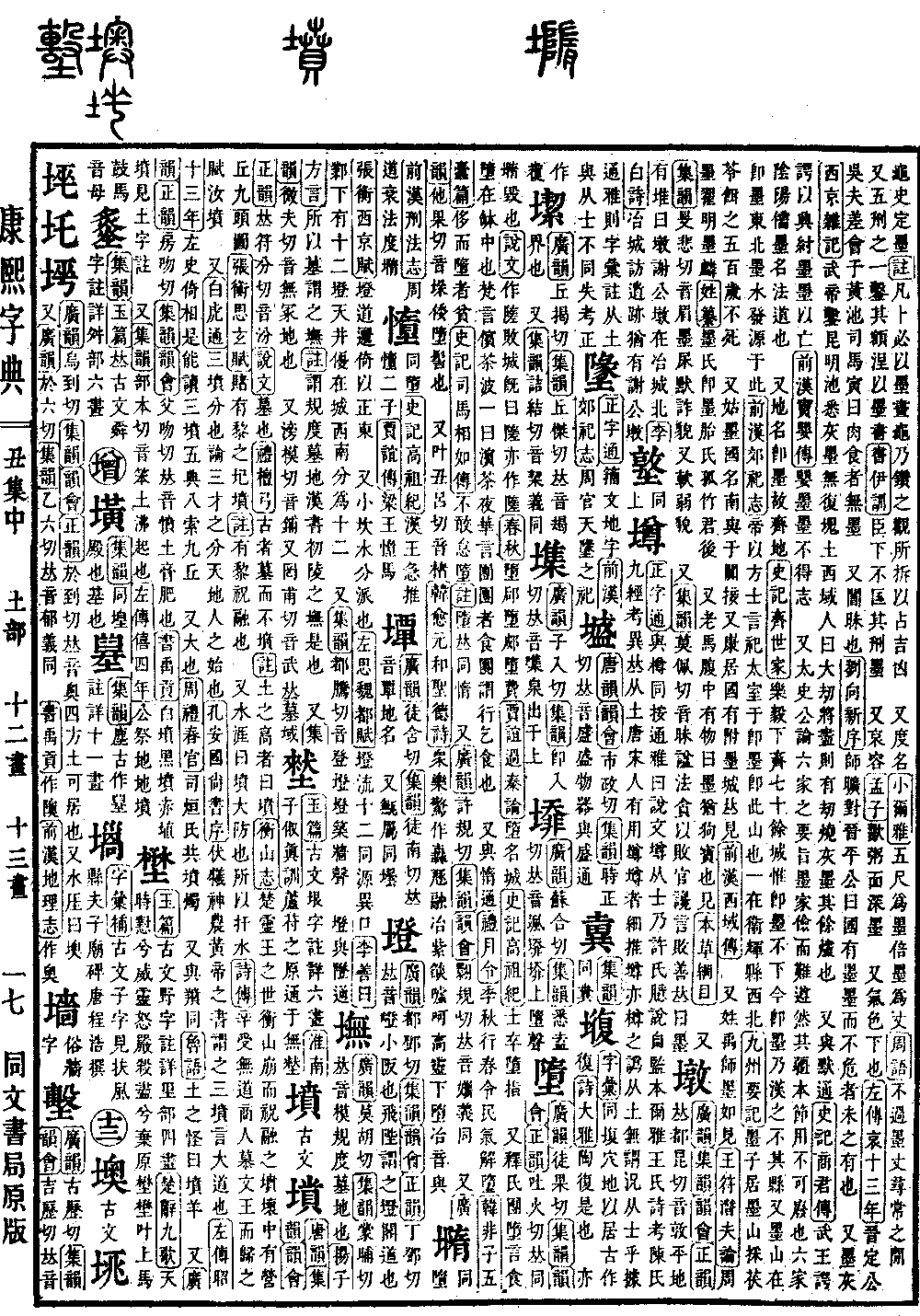
Chou Collection, Middle Volume. Radical: Earth (tǔ). Fen. Kangxi strokes: 15. Page 239, Entry 01.
Ancient text. According to the Tangyun, Jiyun, Yunhui, and Zhengyun, the pronunciation is fen (level tone).
According to the Shuowen, it refers to a grave.
In the Book of Rites (Liji), specifically the Tan Gong chapter, it states that in ancient times there were graves without mounds. The commentary notes that when a mound of earth is high, it is called a fen.
According to the Hengshan Gazetteer (Hengshan zhi), during the time of King Ling of Chu, Mount Heng collapsed and the grave of Zhurong was destroyed, containing within it the Map of the Nine Heads of Yingqiu.
In Zhang Heng’s Thinking Rhapsody (Si fu), it mentions seeing the collapsed grave of the Youli clan. The commentary notes that Youli is Zhurong.
It also refers to the area by the water as a fen, meaning a great levee used to block water.
In the Poetry Commentary (Shizhuan), it states that when King Zhou of Shang was without virtue, the merchants longed for King Wen of Zhou and went to him, and composed the poem titled Ru Fen.
According to the White Tiger Hall Discussions (Baihu tong), the Three Fen mean to divide. They discuss the division of the three realms of Heaven, Earth, and Man, marking the beginning of the principles of Heaven, Earth, and Man.
According to Kong Anguo’s Preface to the Book of History (Shangshu xu), the books of Fuxi, Shennong, and the Yellow Emperor are called the Three Fen, which expound upon great principles.
In the Zuo Commentary (Zuo zhuan), specifically the thirteenth year of Duke Zhao, it is mentioned that the Left Historian Yixiang was a man who could read the ancient texts of the Three Fen, Five Canons, Eight Cords, and Nine Hills.
It also means great.
In the Rites of Zhou (Zhou li), in the Autumn Official (Qiuguan) section, it states that the Official of Torches provides great candles.
It is also identical to the character fen.
In the Discourses of the States (Lu yu), it states that the monster in the soil is called a fen sheep.
According to the Guangyun and Zhengyun, the pronunciation is fen (rising tone); according to the Jiyun and Yunhui, the pronunciation is fen (rising tone). It refers to fertile soil.
In the Book of History (Shu), specifically the Tribute of Yu (Yu gong) chapter, it mentions white fen, black fen, and red clay fen. See the notes under the Earth (tǔ) radical.
According to the Jiyun, the pronunciation is ben (falling tone). It describes soil rising as if boiling.
In the Zuo Commentary (Zuo zhuan), in the fourth year of Duke Xi, it states that when Duke Xi of Lu sacrificed to the Earth God, the earth rose up.
Textual Research: In the Rites of Zhou (Zhou li), under the Spring Official section, it mentions the Official of Torches providing fen candles. This has been corrected to the Autumn Official (Qiuguan) in accordance with the original text.