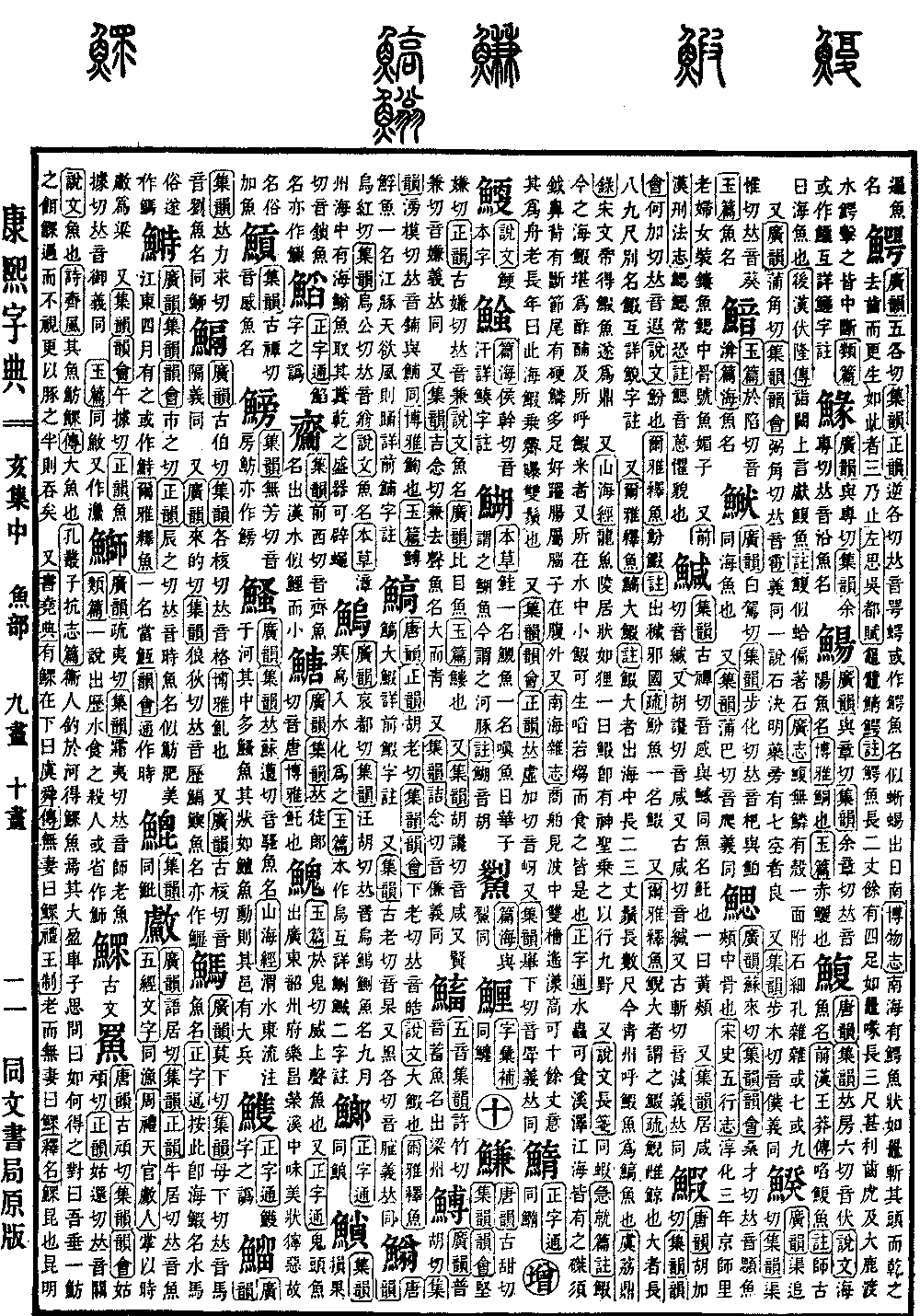
Hai Collection, Middle Volume
Radical: Fish (yú)
Crocodile (è)
Kangxi Strokes: 27
Page 1475, Entry 03
In the Collection of Rhymes (Jiyun) and the Correct Rhymes (Zhengyun), it is pronounced è. Originally written as a different form. Also written as è.
According to the History of the Tang (Tangshu), Biography of Han Yu: When Han Yu arrived in Chao, he inquired about the hardships of the people. They all said, "In the Evil Stream, there are crocodiles that have eaten nearly all of the people's livestock, leaving the people impoverished." Several days later, Han Yu went to inspect the stream himself. He ordered his subordinate, Qin Ji, to cast a sheep and a pig into the stream as an offering and recited a prayer. That evening, a violent storm with thunder and lightning erupted from the stream. After several days, the water completely dried up, and the stream shifted sixty li to the west. From that time on, Chao was free of the crocodile plague.
According to the Records of Leisurely Living in Xiushui (Xiushui Xianju Lu): The appearance of the crocodile includes the snout of a dragon, the claws of a tiger, the eyes of a crab, and the scales of an alligator. Its tail is several feet long, with a tip as large as a winnowing basket, covered in hooked thorns that are sticky. They often lie in wait by the water's edge, and when people or livestock approach, they strike and capture them with their tails, using them much like an elephant uses its trunk.