Wu Collection, Lower Volume
Radical: Grain (hé)
Du (falling tone)
Kangxi stroke count: 11
Page 853, Entry 02
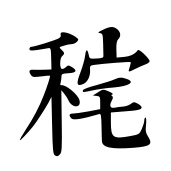
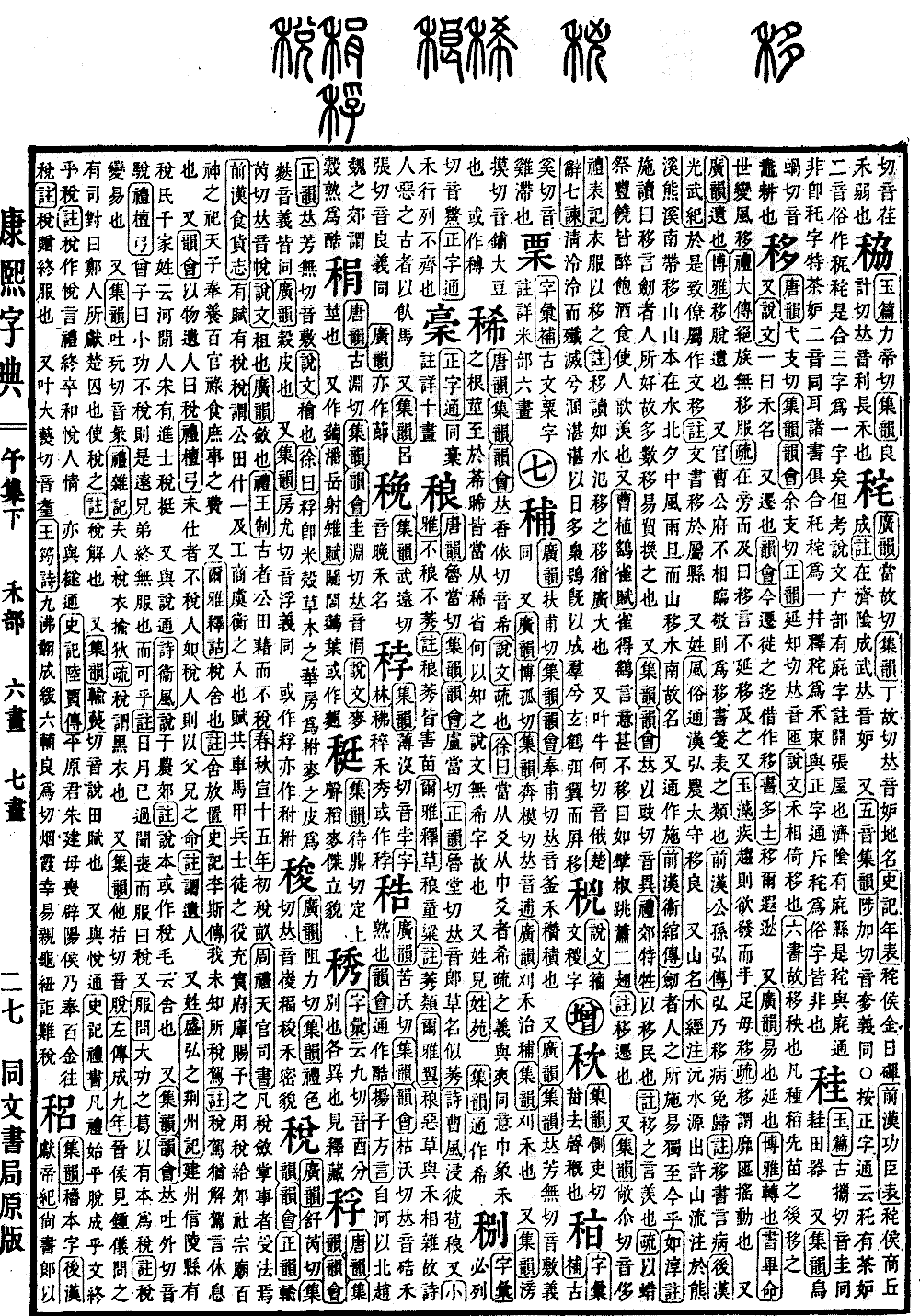
According to the Broad Rhymes (Guangyun), it is pronounced du (falling tone). According to the Collection of Rhymes (Jiyun), it is pronounced du (falling tone). It is the name of a place. In the Records of the Grand Historian (Shiji), Chronological Tables, it mentions the Marquis of Du, Jin Midi. In the History of the Former Han (Qianshu), Table of Meritorious Officials, it mentions the Marquis of Du, Shangqiu Cheng. The commentary notes it is located in Chengwu, Jiyin. It is pronounced du (falling tone).
Also, according to the Five Sounds Collection of Rhymes (Wuyin Jiyun), it is pronounced zha (level tone). The meaning is the same. Note: The Correct Character Guide (Zhengzitong) states that the character zha has two pronunciations: cha and du. It suggests that the form du is a common variant, combining three components into one character. However, examining the Explaining Graphs and Analyzing Characters (Shuowen Jiezi), under the radical for wide (guang), there is the character zha, which is defined as the opening of a house. Since Jiyin has a county by that name, du and zha are interchangeable, yet they are not identical to the character zha; it is merely that the two pronunciations cha and du coincide. Various books conflate the characters zha and du, defining du as a bundle of grain. Both this definition and the assertion in the Correct Character Guide that du is merely a vulgar form are incorrect.