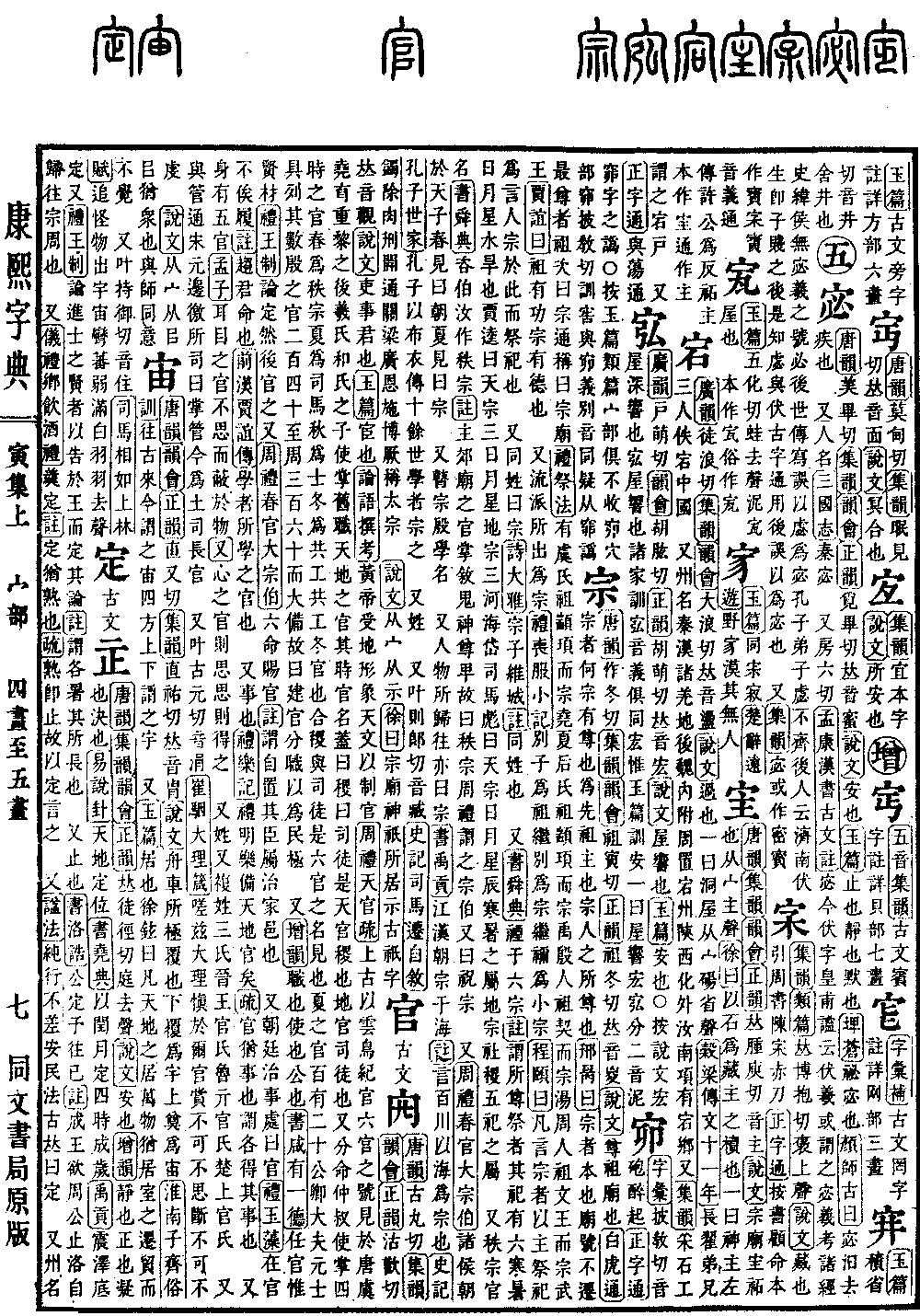
Yin Collection, Upper Volume
Radical: Roof (bù)
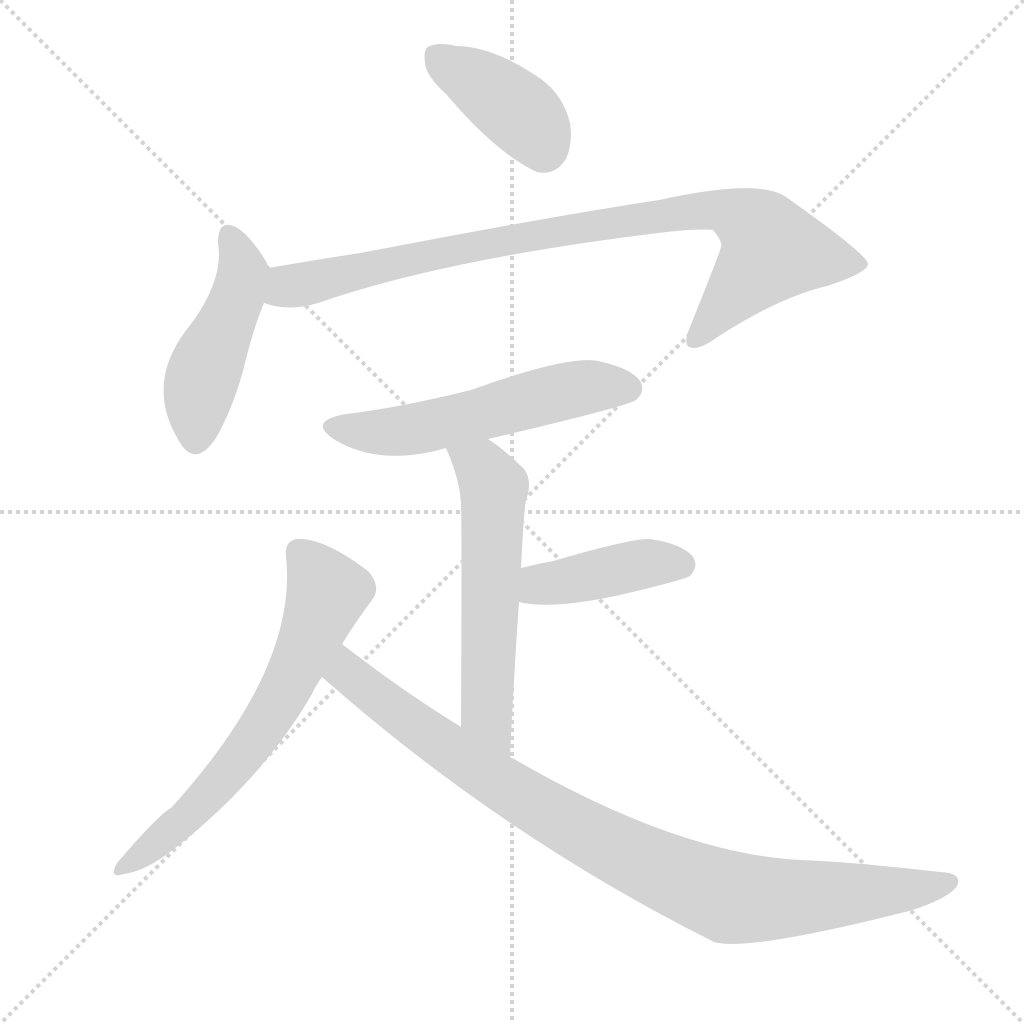
Ding
Kangxi Stroke Count: 8
Page 283, Entry 18
Archaic script
According to Tang Rhymes (Tangyun), Collection of Rhymes (Jiyun), Dictionary of Rhymes (Yunhui), and Correct Rhymes (Zhengyun), pronounced ting (falling tone).
According to Explaining Graphs and Analyzing Characters (Shuowen), it means peaceful.
According to Augmented Rhymes (Zengyun), it means quiet, upright, solidified, or decided.
According to Book of Changes (Yijing), Explanation of the Trigrams: The positions of heaven and earth are fixed.
According to Book of Documents (Shujing), Canon of Yao: Determine the four seasons by intercalary months to complete the year.
According to Tribute of Yu (Yugong): The region of Zhenze was pacified.
Also, according to Book of Rites (Liji), Royal Regulations: Discuss the merits of the candidates and report to the king to establish their assessments. The commentary states this refers to signing off on their respective strengths.
Also, it means to stop. According to Book of Documents (Shujing), Announcement concerning Luo: The Duke stays; I shall depart. The commentary states that King Cheng wanted the Duke of Zhou to remain in Luo while he himself returned to the ancestral capital of Zhou.
Also, according to Book of Etiquette and Ceremonial (Yili), District Drinking Ceremony: The soup is settled. The commentary states that settled means cooked. The sub-commentary explains that when food is cooked, the bubbling stops, hence it is referred to as settled.
Also, according to the Law of Posthumous Titles: Those whose conduct is pure and consistent, who pacify the people and follow the ancients, are called Ding.
Also, a prefecture name. In the Han dynasty it was Zhongshan Commandery; during the Tang dynasty it was renamed Ding Prefecture, named for the pacification of the realm.
Also, a hill name. According to Er Ya, Explanation of Hills: A hill with marshland on the left is called Ding.
Also, according to General Rhymes (Guangyun), Collection of Rhymes (Jiyun), Dictionary of Rhymes (Yunhui), and Correct Rhymes (Zhengyun), pronounced ding. It is the name of the Ying-shi constellation.
According to Book of Odes (Shijing), Odes of Yong: When the Ding star is directly overhead, work begins on the palace of Chu. The commentary states that when the Ding star reaches the zenith at dusk, it is the appropriate time to build palaces, hence it is called Ying-shi (Camp Chamber). Sun Yan says: Ding means to rectify. One source says Ding refers to a hoe.
Also, according to Book of Odes (Shijing), Odes of Zhou and the South: The forehead of a unicorn. The commentary states that Ding means forehead.
Also, according to Book of Rites (Liji), Canon of Rituals: The soup is settled and announced in the hall. The commentary states that soup refers to meat broth, and settled refers to cooked meat.
Also, according to Er Ya, Explanation of Implements: A hoe is called a ding. Guo's commentary states it is a type of agricultural tool.
Also, rhyming with ting, pronounced ting. According to Book of Odes (Shijing), Lesser Odes: Chaos knows no end. Rhymes with ning and cheng.
Also, according to Dictionary of Rhymes (Yunhui), anciently interchangeable with zheng (upright). It is also written as dian. It cites the Rites of Zhou (Zhouli), Blind Musicians: Generationally record the lineages. The term dian is read as ding, referring to works such as the Imperial Lineages and the Genealogies of the Feudal Lords.