Xu Collection, Upper Volume
Radical: Metal (jīn)
Kangxi Strokes: 16
Page 1311, Entry 01
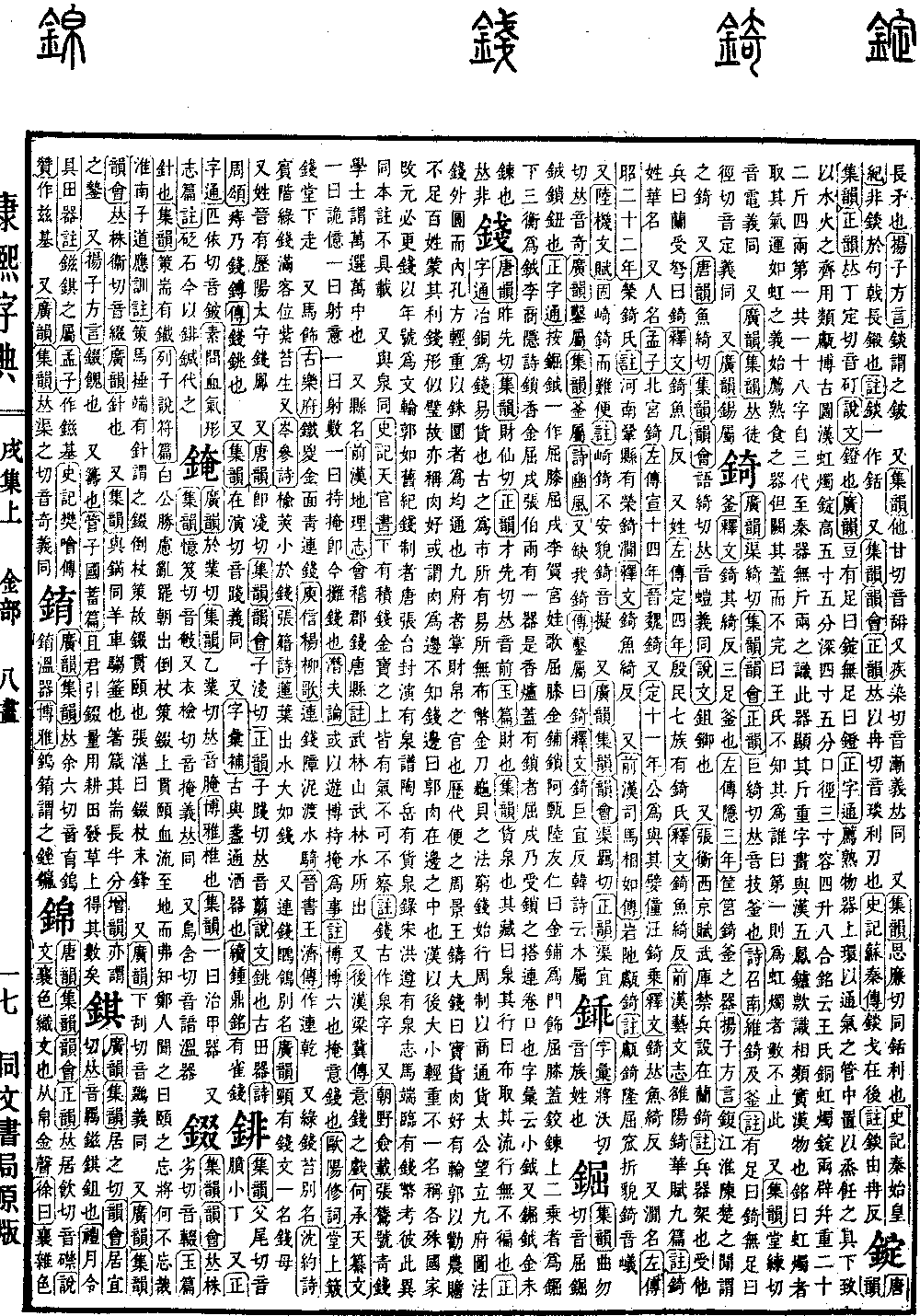
Pronounced ding. The pronunciation is the same as ding.
According to the Analytical Dictionary of Characters (Shuowen Jiezi), it refers to a lamp stand.
According to the Expanded Dictionary of Characters (Guangyun), a vessel for holding food that has feet is called ding, while one without feet is called deng.
According to the Correct Meaning Through (Zhengzitong), it is a type of steaming vessel. The upper part features a ring-shaped ventilation pipe, the middle section holds the steaming utensils, and the lower section is used to regulate the fire and water; its function is similar to a steamer (yan).
According to the Illustrations of Antiquities (Bogutu), the Han dynasty rainbow candle stand is five cun and five fen high, four cun and five fen deep, with a mouth diameter of three cun and a capacity of four sheng and eight he. The inscription on it reads: "Wang family copper rainbow candle stand, a pair, each weighing twenty-two jin and four liang, number one," for a total of eighteen characters. From the Xia, Shang, and Zhou dynasties through the Qin dynasty, vessels did not typically carry weight markings. This item is marked with its weight, and the calligraphy resembles the inscriptions on the Han dynasty Five Phoenix Censer, confirming it is indeed from the Han period. The inscription calls it a "rainbow candle," referring to the idea of breath flowing like a rainbow. This was a vessel for presenting cooked food, though it is incomplete as it lacks a lid. The inscription says "Wang family," though it is unknown specifically who this refers to. The mention of "number one" implies there was more than one such rainbow candle stand.
Additionally, in the Collected Rhymes (Jiyun), it is pronounced dian. The meaning is the same.
Additionally, in the Expanded Dictionary of Characters (Guangyun) and the Collected Rhymes (Jiyun), it is pronounced ding. The meaning is the same.
Additionally, in the Expanded Dictionary of Characters (Guangyun), it refers to metals of the tin variety.