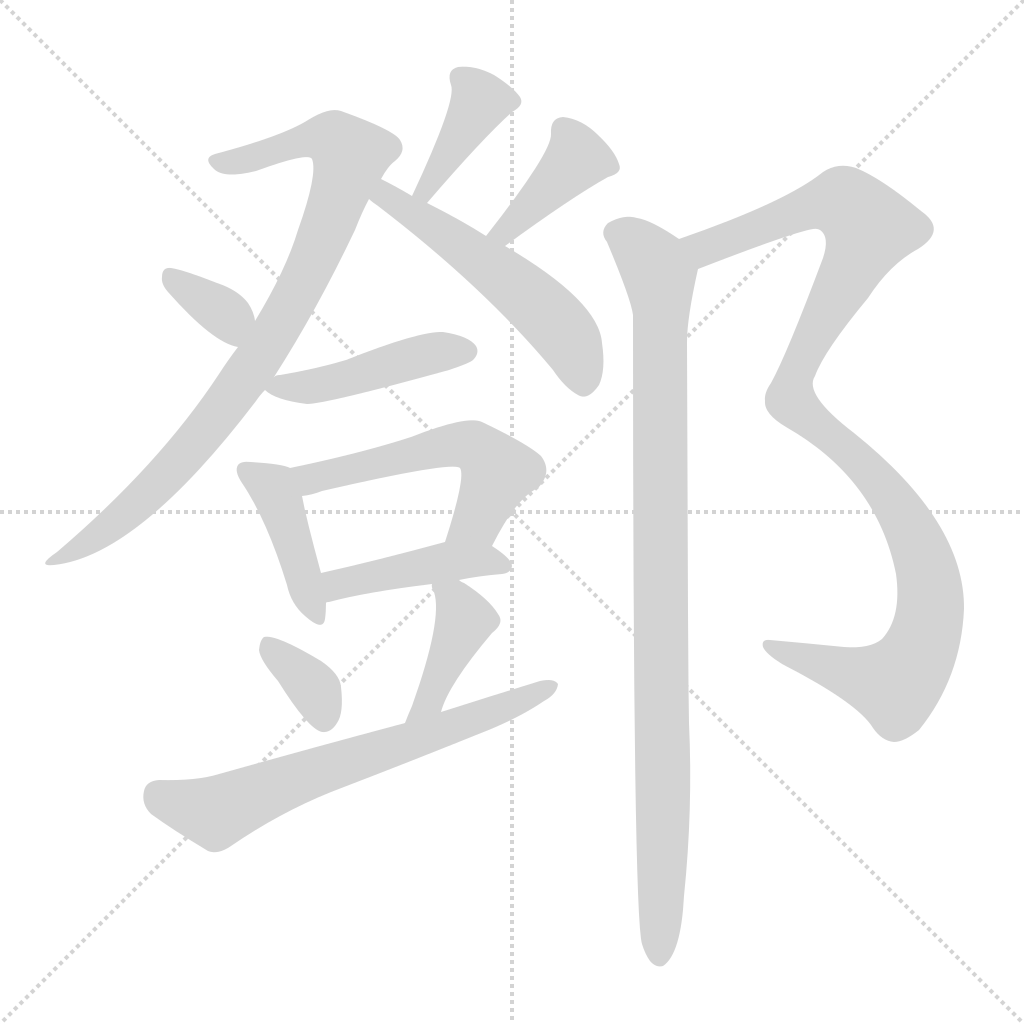
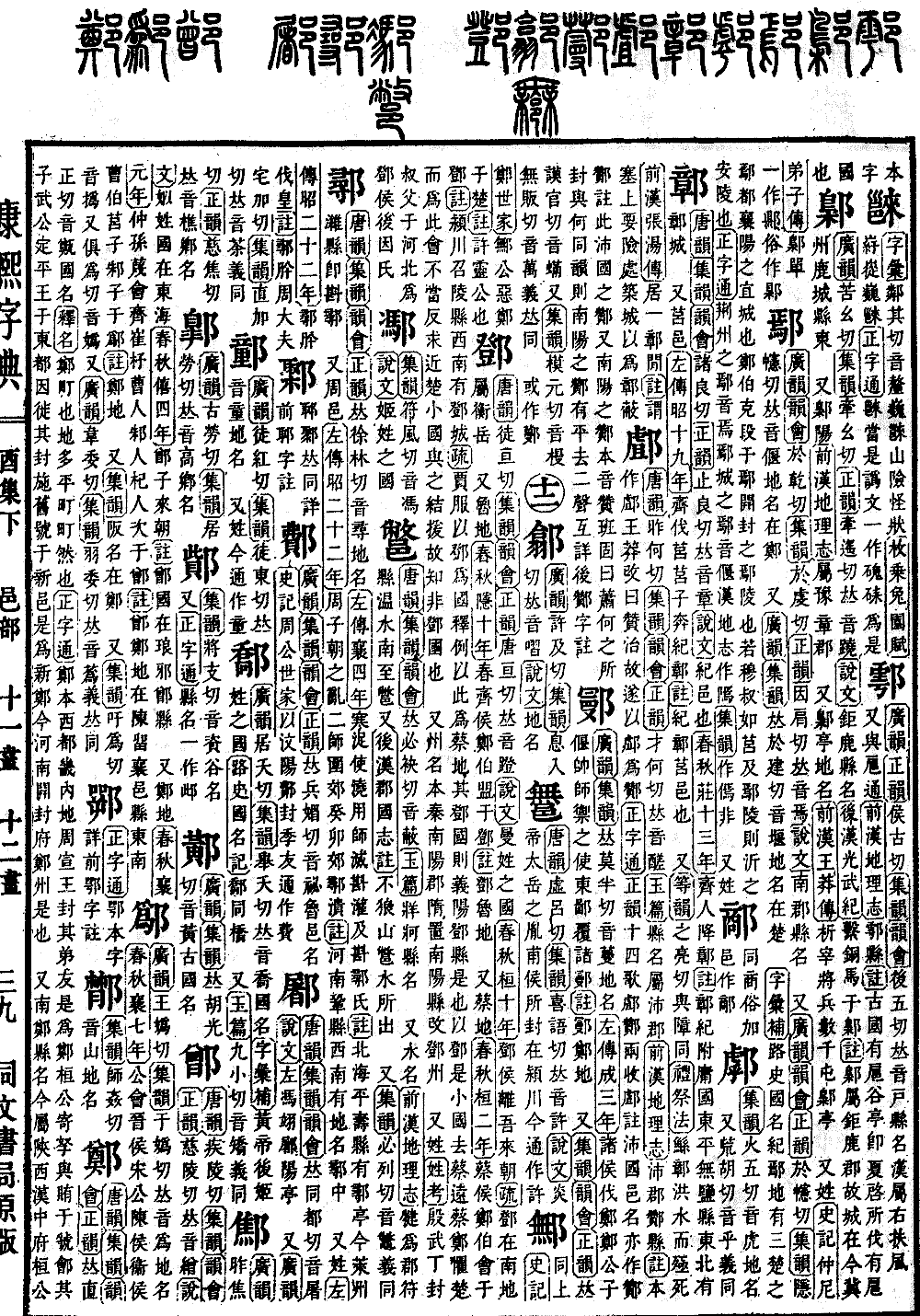
You Collection, Lower Volume. Radical: City (yì). Dèng. Kangxi Strokes: 19. Page: 1277, Entry 13.
According to Tangyun, Jiyun, Yunhui, and Zhengyun, the pronunciation is dèng. According to Shuowen Jiezi (Shuōwén Jiězì), it was a state of the Man surname. In the Spring and Autumn Annals (Chunqiu), Duke Huan, 7th year: “Lord Deng Wu Li came to pay court.” The commentary notes: Deng was located in the southern region, belonging to Mount Heng (Héngyuè). Also, a place in Lu. In the Spring and Autumn Annals, Duke Yin, 10th year: “In spring, Marquis Qi and Count Zheng formed an alliance at Deng.” The annotation states: Deng was a place in Lu. Also, a place in Cai. In the Spring and Autumn Annals, Duke Huan, 2nd year: “Marquis Cai and Count Zheng met at Deng.” The annotation states: Southwest of Zhaoling County in Yingchuan there is Deng City. The commentary by Jia Fu considered Deng to be a state; this example refers to it as a place in Cai. The state of Deng was Yiyang County, Deng County. Since Deng was a small state, far from Cai, and Cai and Zheng feared Chu and held this meeting, it would not have been appropriate to seek out a small state close to Chu to form an alliance. Therefore, it is known that this was not the state of Deng. Also, a prefecture name. Originally Nanyang Commandery (Nányáng Jùn) in Qin. During the Sui Dynasty, Nanyang County was established, and its name changed to Dengzhou. Also, a surname. According to Xingkao (Xìngkǎo), Emperor Wu Ding of Yin enfeoffed his uncle in Hebei as Lord Deng, and later the surname was adopted from this.
Correction: The entry "Spring and Autumn Annals, Duke Huan, 10th year: Lord Deng Li Wu came to pay court" should be corrected according to the original text: "10th year" should be "7th year", and "Li Wu" should be "Wu Li".